

In the last investigation I traced the event chain that killed them;
Bank credit inflates property,
Property inflates rent,
Rent stays fixed while revenue collapses,
The tenant absorbs the adjustment,
The landlord’s mortgage does not.
But I left one question unanswered, and it sits underneath everything.
Where did that credit come from?
Not from the government. Not from a saver’s deposit. Not from a vault somewhere with stacks of notes waiting to be lent out.
It was typed into existence - in early days on a typewriter - today on a keyboard.
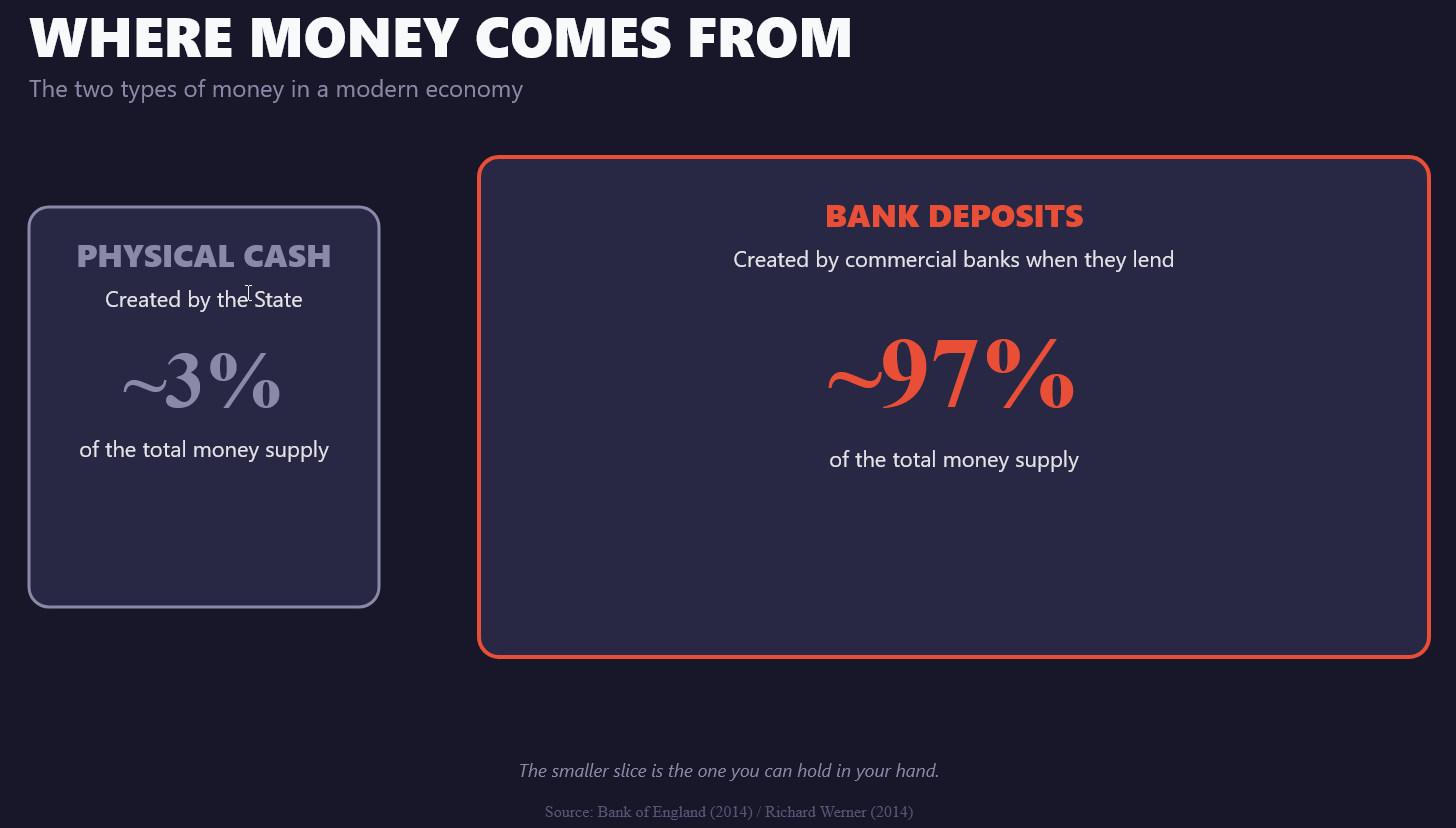
Three Stories About Banking. Two Are Wrong.
Ask how a bank works and you’ll get one of three answers.
Story One — The Middleman. Banks gather deposits from savers and lend that existing money to borrowers. They’re intermediaries, moving other people’s money around. This is what most economics textbooks still teach.
Story Two — Fractional Reserve. Banks keep a fraction of deposits in reserve and lend out the rest. A $100 deposit becomes $90 of loans, which becomes another deposit, which becomes another loan. The money multiplies, but it starts with someone’s savings.
Story Three — Credit Creation. Banks need neither prior savings nor reserves.
When a bank approves a loan, it creates a new deposit in the borrower’s account.
The money did not exist before. It exists now.
For a century, the banking profession preferred the first two stories. Both make banks sound like harmless plumbing.
In 2014, Professor Richard Werner ran the first direct empirical test of all three.
The Experiment!
Professor Werner didn’t build a model. He didn’t run a simulation.
He went to a bank and borrowed money.
He arranged a €200,000 loan from a cooperative bank in Bavaria — Raiffeisenbank Gaimersheim-Buxheim — with the bank’s cooperation, and watched what actually happened inside their systems while the transaction was processed.
The three theories make different, testable predictions:
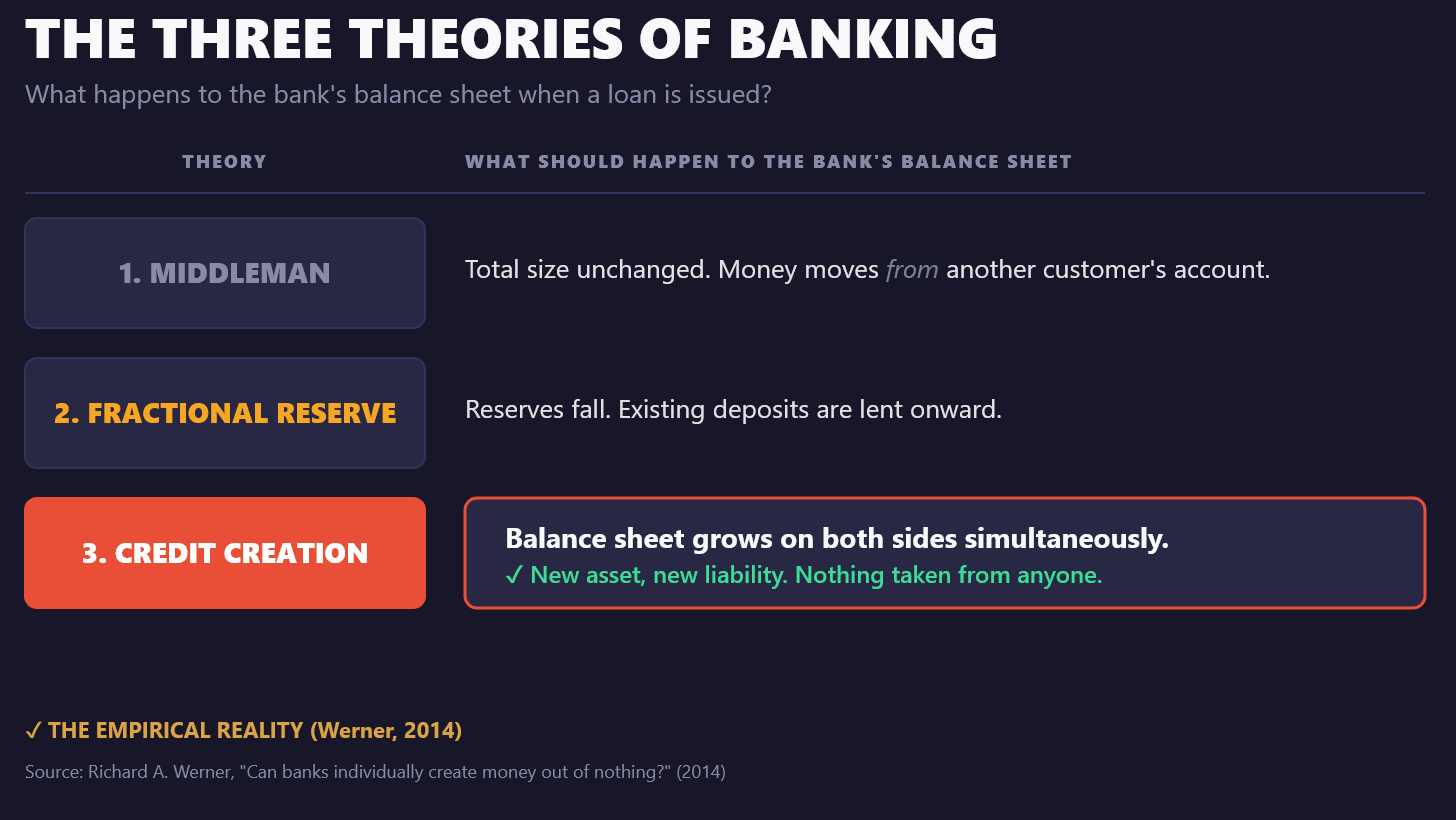
Only one matched.
The bank’s balance sheet lengthened by €200,000. No depositor’s account was debited. No reserves were drawn down. No money was transferred from anywhere.
Werner’s conclusion was blunt: banks create money ex nihilo — out of nothing — when they extend credit. The other two theories were empirically rejected.

How a Loan Actually Works
Strip away the jargon and the accounting is almost absurdly simple.
You sign a loan application —> bank accepts = legal Contract.
That signed Contract is an IOU —> a legally binding promise to pay —> it is now a legal financial asset with real value.
The bank ‘buys your IOU contract’ from you and records it on the asset side of its ledger.
For the Banks part —> they credit your account with a deposit.
That deposit is money the bank pays you, so it goes on the liability side.
Two entries. Same moment. Same amount. The books balance.
Nobody gave up anything.
No savings was tapped. No vault was opened.
The bank purchased your promise and issued a claim on itself in exchange — and we all treat that claim as money.
That is the whole trick. It has been the whole trick for centuries.
The Part That Should Make You Angry
Here is where this stops being an accounting curiosity.
When a bank creates money, it makes three decisions at once:
How much New Money - purchasing power - enters the economy.
Who is selected to receives this New Money.
What this New Money will be used for.
Those are not clerical choices.
They are the most consequential economic decisions made in any country, every working day, by private institutions answerable to shareholders.
And the third one is where Australia went wrong.
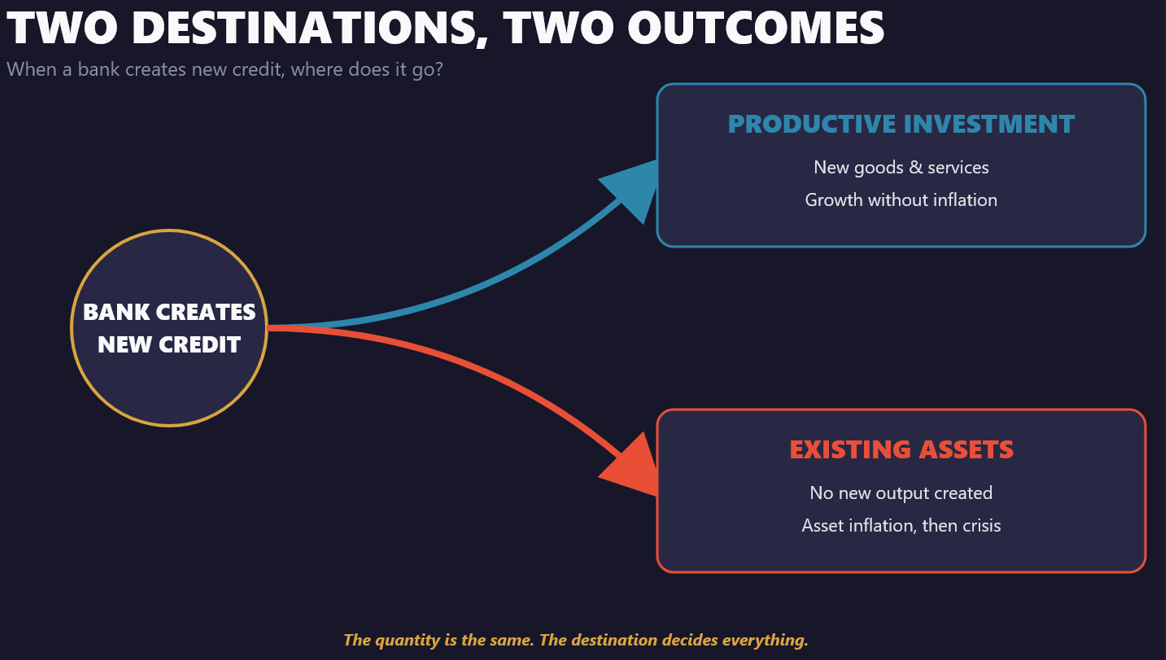
New credit/money pointed at building refineries, factories, farms and productive capacity generates goods and services to match the new money.
New credit/money pointed at bidding up existing houses generates no new goods at all — just higher prices for the same stock, and bigger mortgages attached to them.
Same mechanism. Opposite outcomes.
That is why a nation sitting on world-scale oil and gas reserves imports most of its refined fuel while posting world-record household debt.
The money was created. It was simply pointed somewhere else.
Even the Bank of England Admitted It
This is not a fringe claim. Three months after Werner’s paper appeared, the Bank of England published its own explanation in its Quarterly Bulletin.
Its opening line:
“Money creation in practice differs from some popular misconceptions — banks do not act simply as intermediaries, lending out deposits that savers place with them.”
And then, unambiguously:
“Whenever a bank makes a loan, it simultaneously creates a matching deposit in the borrower’s bank account, thereby creating new money.”
The central bank confirmed what the empirical test had shown.
The textbooks were wrong. Most of them still are.
Why Interest Rates Are the Wrong Lever
Now the double standard from Part 1 makes mechanical sense.
If banks create the money supply, then the RBA cash rate is not a tap controlling the volume. It is a price signal influencing the appetite to borrow — and it lands almost entirely on the household with a mortgage.
Meanwhile the two engines still running are untouched by it.
Government spending continues at 26.9% of GDP.
And commercial banks keep creating credit against existing property, because under the Basel risk-weighting framework that consumes less capital than funding a refinery.
One brake. Applied to you.
Warren Hogan is right that government spending has, in his words, “absolutely exploded.”
But that is half the picture.
The other half is private credit creation, and nobody votes on where it goes.
The Lie vs. The Truth
The Lie: Banks are regulated utilities that safely move other people’s savings from those who have surplus to those who need it.
Interest rates control the money supply.The Truth: Commercial banks create the overwhelming majority of the money supply, from nothing, at the moment they lend.
Their allocation decisions determine whether a country builds productive capacity or inflates a property bubble.
No electorate is consulted, and the interest rate lever reaches only part of the system.
The Architects of the Rules
Covered so far — Banks create the money. But who decides where it goes?
The answer lies in a set of rules that almost nobody has heard of, written by an institution that answers to no one.
When a bank creates a new loan, it must hold a certain amount of capital in reserve to protect against the risk of that loan going bad.
This is dictated by the Basel Accords, specifically the rule that banks must hold capital equal to at least 8% of their risk-weighted assets.
Here is the catch: under the Basel framework, lending to a business to build a new factory or a domestic oil refinery is considered “high risk.”
It consumes a lot of the bank’s capital.
But lending to a homebuyer to purchase an existing house is considered “low risk.”
It consumes very little capital.
The rulebook doesn’t just regulate banks. It actively incentivizes them to point newly created credit at existing property, inflating the housing bubble, while starving productive industry.
Who wrote this rulebook?
The Basel Committee on Banking Supervision. And where does it meet?
In the Tower of Basel, Switzerland.
To understand how our money is weaponized against the real economy, we have to look at the architects of the system.
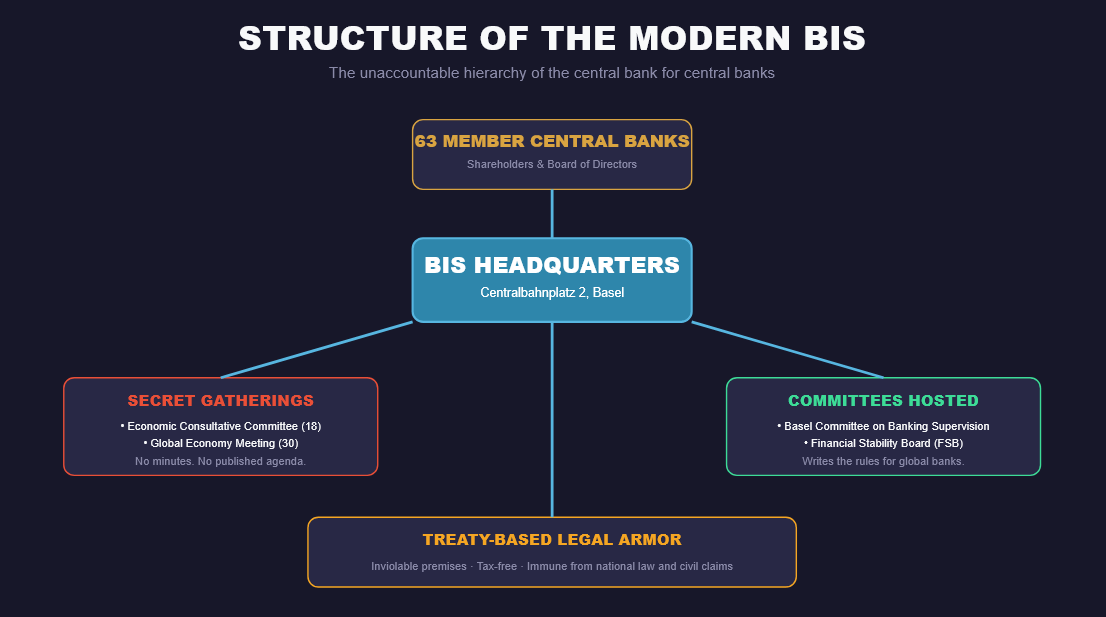
The unaccountable hierarchy. The Basel Committee, hosted at the BIS, dictates the capital rules that force 63 Global banks to favor mortgages over manufacturing.
The Historical Blueprint
This system was not built by accident. It was engineered over nearly a century by a Transnational Elite that has successfully insulated itself from democracy, war, and economic collapse.
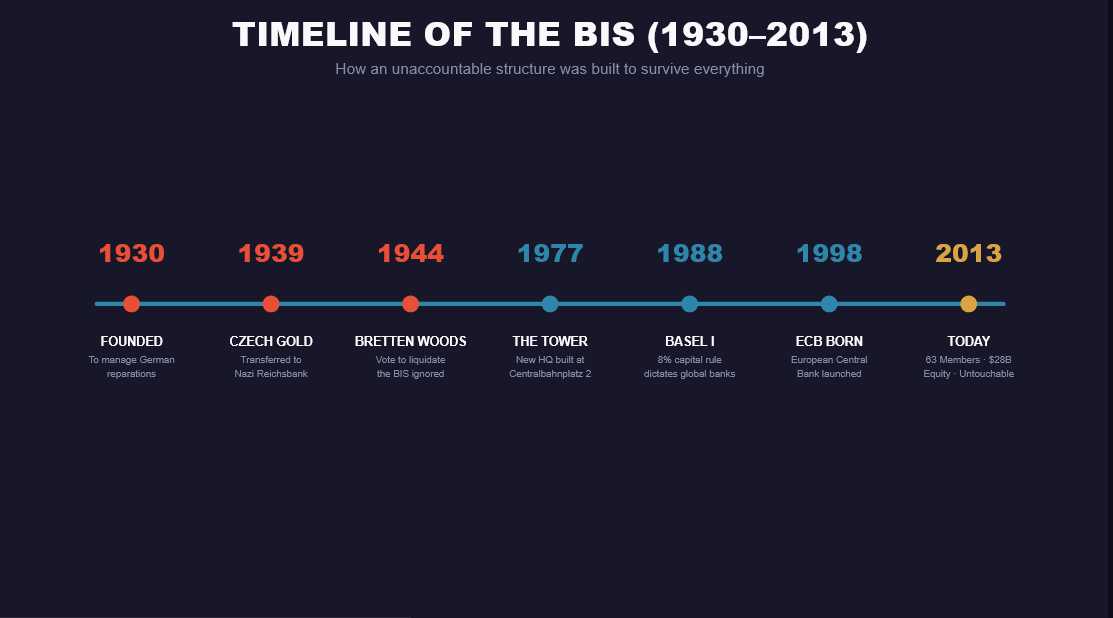
From managing German reparations to hosting the Basel Committee, the BIS has continuously reinvented itself to remain the apex of global finance.
The Unbroken Network
The true power of the BIS lies in its continuity. The personal and financial networks forged in the 1930s and 1940s — connecting Wall Street, the City of London, and the Reichsbank — were never broken.
They were merely repurposed for the postwar world.
The men who managed the flow of capital during the darkest days of the 20th century are the intellectual forefathers of the technocrats who manage our money today.
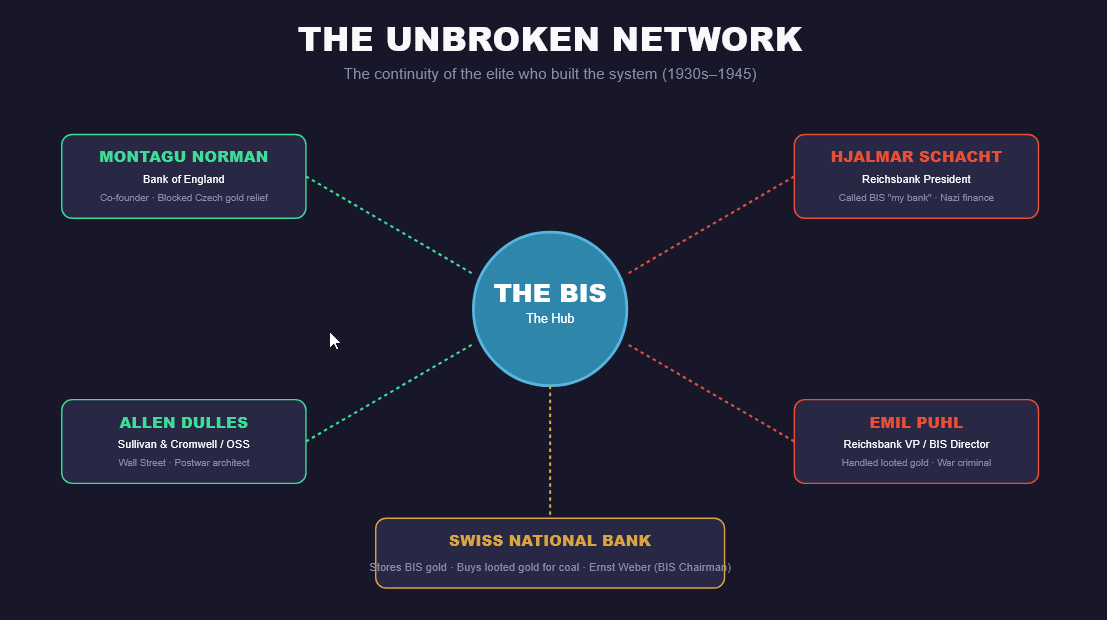
The transnational financial network. The BIS acted as the hub connecting Allied and Axis financiers, ensuring that the flow of capital survived World War II.
Coming Next: The Theory That Explains the Split
We now know money is created by banks, and that its destination matters more than its quantity.
But how do you measure that?
How do you separate credit that builds — from credit that inflates — and prove which one drives growth and which one drives crashes?
In the 1980s Japan’s money supply exploded while growth stayed flat.
Economists called it the “Mystery of the Missing Money” and concluded the old relationships had broken down.
They hadn’t. They were measuring the wrong thing.
Professor Richard Werner’s analysis & disaggregation of bank credit into Productive Versus Speculative flows, shows that the Japanese data settles the argument.
References & Further Reading
Werner, Richard A. (2014). “Can banks individually create money out of nothing? — The theories and the empirical evidence.” International Review of Financial Analysis, 36, 1–19. ScienceDirect
Werner, Richard A. (2016). “A lost century in economics: Three theories of banking and the conclusive evidence.” International Review of Financial Analysis, 46, 361–379. ScienceDirect
McLeay, M., Radia, A. & Thomas, R. (2014). “Money creation in the modern economy.” Bank of England Quarterly Bulletin, Q1. bankofengland.co.uk
Reserve Bank of Australia, Cash Rate Target — 4.85%, effective 4 November 2026. rba.gov.au
APRA, Prudential standards — Australian implementation of the Basel capital framework. apra.gov.au
LeBor, Adam. Tower of Basel (PublicAffairs, 2013) — on the Basel Committee’s authority without enforcement power. adamlebor.com
Companion investigation: Retail Collapse — The Debt Behind the Empty Shops
Part 2: The Tower of Basel — The Bank That Rules Central Banks
