

Every second month, a fleet of limousines collects the world’s most powerful unelected officials from Zürich airport and drives them to a quiet Swiss border city.
At 7 p.m. on Sunday, fewer than twenty men enter Conference Room E in a tinted-glass cylinder overlooking Basel’s central railway station.
The meeting lasts an hour.
Then the aides leave, and the real work begins over dinner on the eighteenth floor — superb food, grand cru wines, and a simple understanding: nothing said at this table is ever repeated.
No official minutes are taken. No agenda is published.
No attendance list is released to any parliament on Earth.
Yet the countries represented in that room produce roughly four-fifths of the world’s GDP.
The institution hosting them is the Bank for International Settlements [BIS] — the central bank for central banks, owned by 63 national monetary authorities, including the US Federal Reserve, the Bank of England, the European Central Bank, and our own Reserve Bank of Australia.
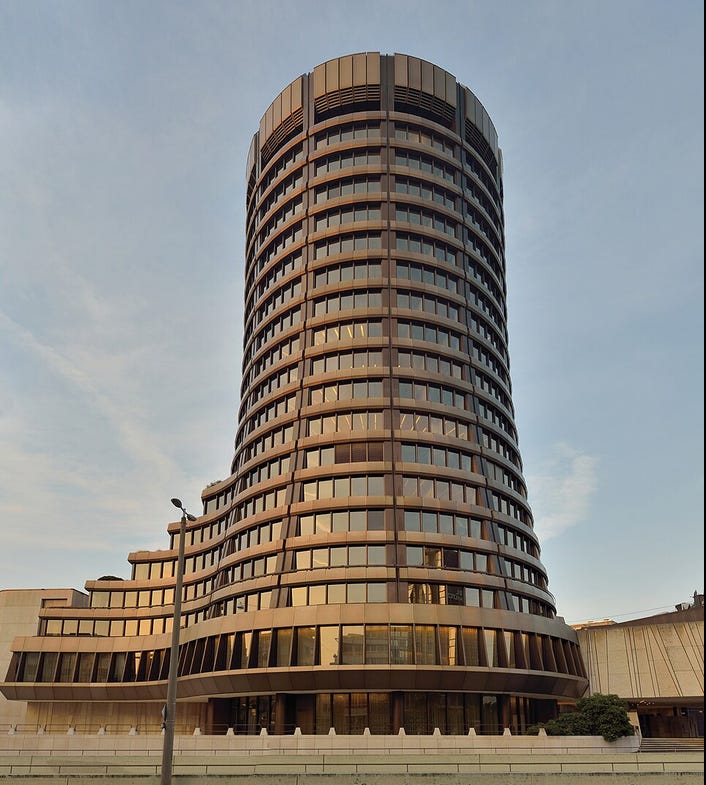
Source: The Bank for International Settlements - wikipedia

In Part 1 we exposed the double standard:
** households crushed by rate hikes while governments splurge.
Now we go one level up — to the place where the people who set those rates compare notes, coordinate, and write the rules that bind every bank on the planet.
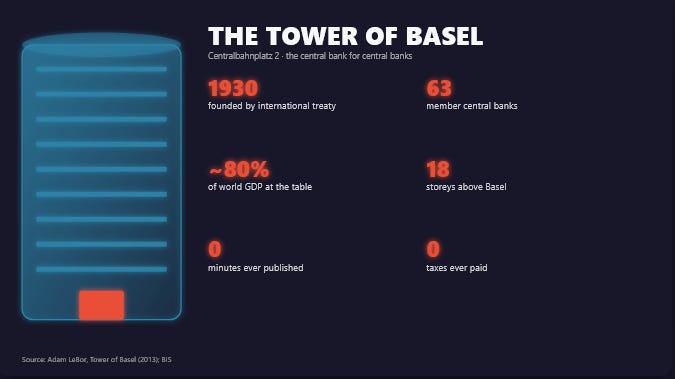
This BIS documentary, entitled “One Institution, No Elections, $9 Trillion,” by The Blueprint, exposes the world's least accountable financial institution — the Bank for International Settlements in Basel, Switzerland, known as "the central bank of central banks."
“It holds no elections. It answers to no parliament. It enjoys absolute diplomatic immunity on Swiss soil. And it manages at least $9 trillion in central bank reserves. The BIS was founded in 1930 to process German war reparations.
During World War II, it accepted Nazi gold.
Today, it hosts the Basel Committee on Banking Supervision, setting the regulatory framework that governs every bank on Earth — without a single vote being cast by the people those regulations affect.”
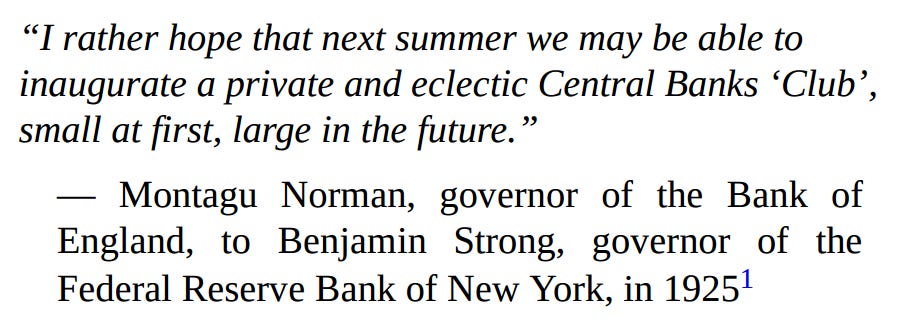
Source: Gates McGarrah, “A Balance Wheel of World Credit,” Nation’s Business, March 1931, 24. BIS archive, File 7.18 (2), MCG8/55
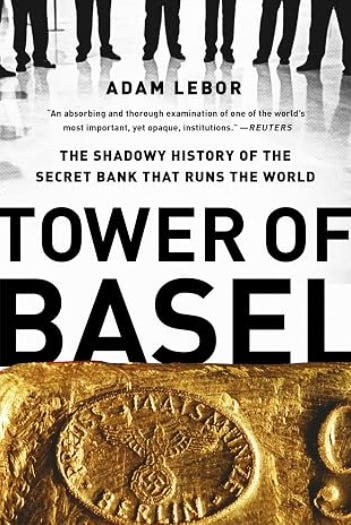
Primary source: Tower of Basel - Adam LeBor
Born to Escape Democracy
Officially, the BIS was founded in 1930 to administer Germany’s World War I reparations. But its chief architects — Bank of England Governor Montagu Norman and Reichsbank President Hjalmar Schacht — had a grander ambition: a permanent, self-financing club for central bankers, shielded from politicians and journalists.
When Norman asked The Economist’s editor, Walter Layton, to draft a constitution placing the bank “beyond the reach of governments,” Layton refused.
It violated, he warned, “the right of every democratic government to reserve its freedom of action.” Norman pressed ahead anyway.
The result, enshrined in the 1930 Hague Convention and reinforced by a 1987 headquarters agreement with Switzerland, is a legal fortress:
Inviolable premises. Swiss police cannot enter without the BIS’s permission.
Untouchable assets. Under Article 10 of its charter, BIS funds and gold can never be seized, frozen, or requisitioned — in peace or in war.
Diplomatic-grade protection. Communications travel in sealed bags that cannot be opened; senior staff enjoy lifetime immunity for official acts.
Tax-free. The bank pays no Swiss taxes; its staff pay no income tax on generous salaries.
The BIS’s first president, Gates McGarrah, boasted of it in 1931:
“The Bank is completely removed from
any governmental or political control.”
That was not a mistake. It was the design.
Source: “Have you heard of the Bank for International Settlements?” - Finance Optimum
The Darkest Chapter — and the Escape
The fortress was tested almost immediately.
In March 1939, after the Nazis invaded Czechoslovakia, the Reichsbank ordered the transfer of 23.1 tonnes of Czech gold held in a BIS sub-account at the Bank of England. The order was issued at gunpoint. Montagu Norman — a British governor, with war looming — let it go through. The paperwork, he insisted, was in order.
During the war, the BIS accepted looted Nazi gold, including gold melted from the possessions of concentration-camp victims. Emil Puhl, vice-president of the Reichsbank, described the BIS as the “only real foreign branch” of the Nazi central bank.
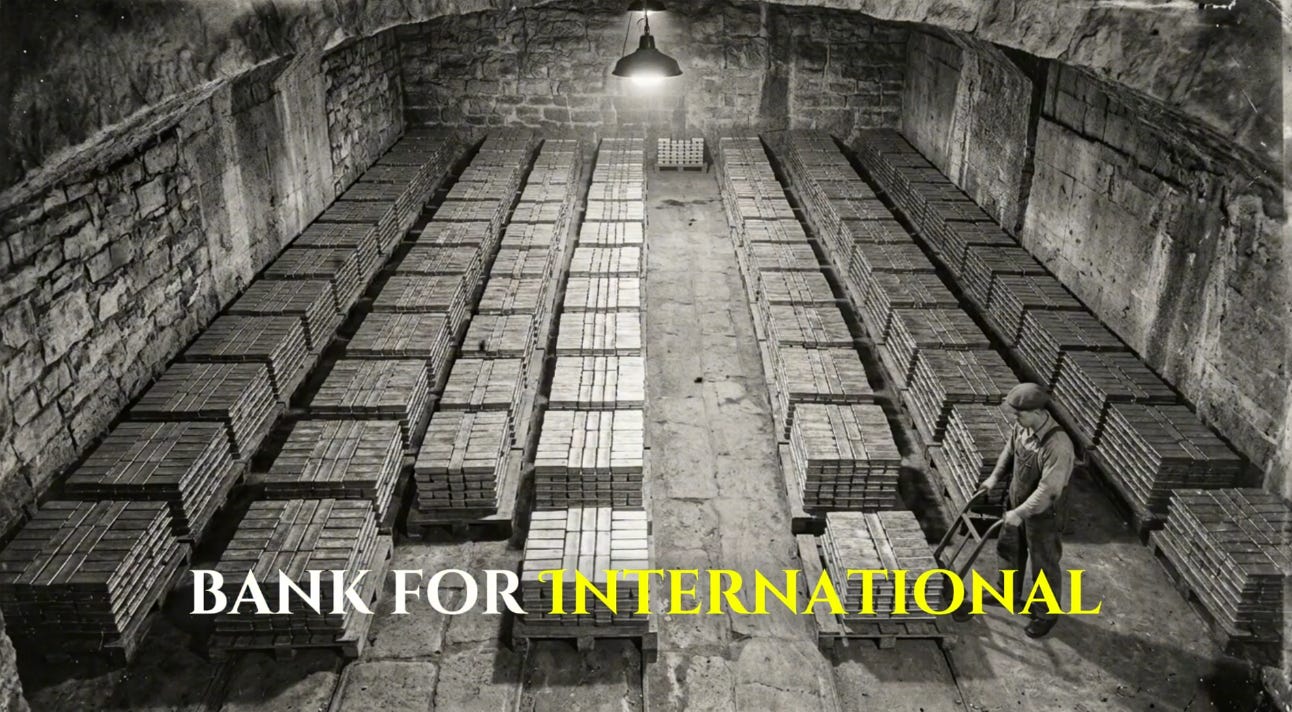
Source: YouTube video - “The Bank That Owns No Country — The Bank for International Settlements and the Men Behind It !” - Terrifying Records
In 1944, at Bretton Woods, US Treasury Secretary Henry Morgenthau and his delegate Harry Dexter White pushed a resolution to liquidate the BIS.
It passed. It was never implemented.
By 1948 it had been quietly abandoned.
The BIS’s American president, Thomas McKittrick, moved straight into a vice-presidency at Chase National Bank in New York.
The lesson the institution learned was permanent:
its legal armour was stronger than any democratic verdict.
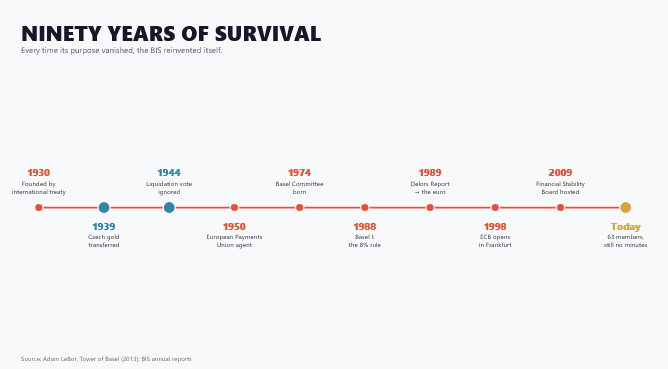
Every time its original purpose vanished, the BIS reinvented itself — and grew more powerful.
The Phoenix: From Reparations to the Euro
With reparations finished, the BIS made itself indispensable to the next great project: European integration. It managed the European Payments Union (1950), hosted the EEC governors’ committee [1964], ran the exchange-rate “Snake,” and — crucially — hosted the Delors Committee that drafted the blueprint for the euro.
The European Central Bank was, in effect, born in Basel.
The pattern was always the same: present the surrender of national sovereignty as a technical adjustment, never a political choice. As former BIS president Fritz Leutwiler put it with remarkable candour:

Source: Harpers article, “Ruling the World of Money,” by Edward Jay Epstein.
The Rulebook That Binds 63 Nations
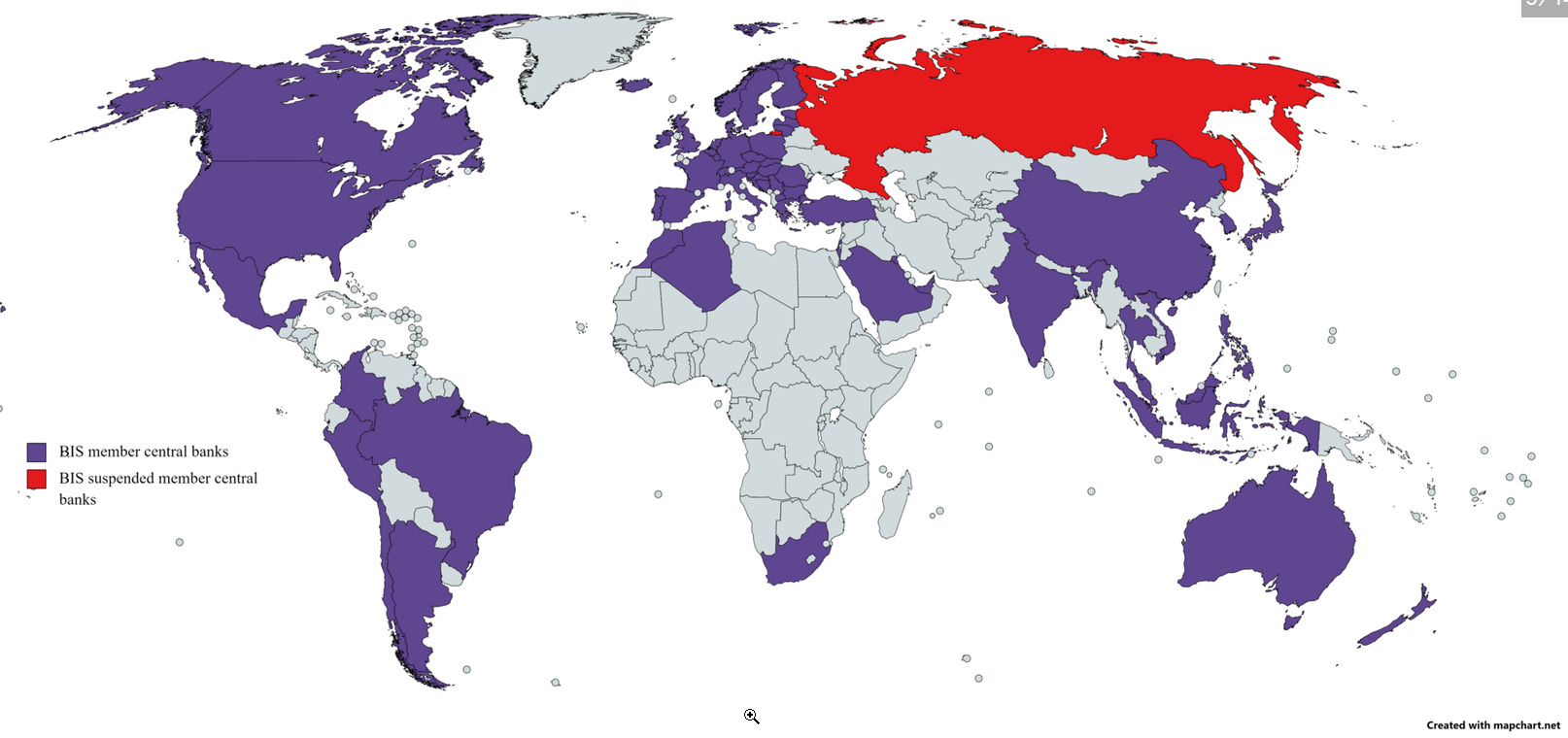
Source: wikipedia - bis membership nations

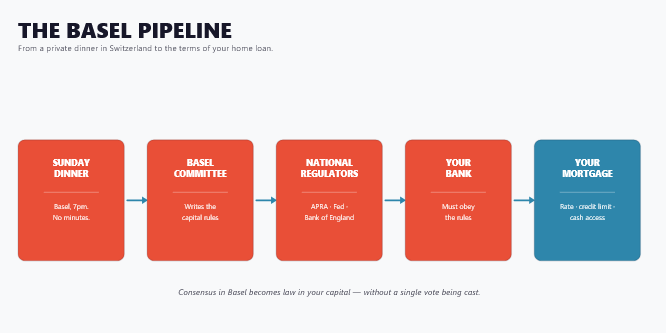
Here is where the tower touches your life. In 1974, after two banks collapsed, the BIS created the Basel Committee on Banking Supervision.
Its accords — Basel I (1988), Basel II (2004), Basel III — set the capital rules for every internationally active bank on Earth.
The core rule: banks must hold capital equal to at least 8% of risk-weighted assets.
The Committee has no legal power to enforce anything. It doesn’t need it. As former Hungarian central bank governor Peter Akos Bod explained:
“It’s like voltage. Voltage has been set at 220. You may decide on ninety-five volts, but it would not work.”
Step outside the Basel framework and you step outside the global financial system. That is not regulation. That is leverage.
The BIS also hosts the Financial Stability Board, now described as the “fourth pillar” of global finance after the IMF, the World Bank, and the commercial banks.
What This Means for You
Three consequences flow from this architecture:
1. Credit gets pointed where the club wants it. As we’ll explore with Professor Richard Werner’s work later in this series, who gets newly created credit, matters more than the interest rate.
The Basel Framework risk-weightings have long favoured mortgages and government debt over productive business lending — helping inflate property bubbles while starving real enterprise.
2. The bias is always toward austerity for you, never for them. From its first annual reports in the 1930s, the BIS preached price stability and curtailed public spending.
In 2012, former ECB president Jean-Claude Trichet called for a “quantum leap” of European governance — including fining countries whose parliaments misbehave. The club’s answer to crisis is always more power for the club.
3. It sees the crashes coming — and says nothing actionable. The BIS warned about excessive credit from 2003, and again in its June 2007 annual report, months before Lehman fell. Its own research department had the data.
The governors read it. The crash happened anyway.
Either the tower couldn’t stop it, or stopping it wasn’t the priority.
No institution on Earth has the authority to ask questions.
And now the BIS Innovation Hub is coordinating the research and pilots for central bank digital currencies — the next layer of the architecture, where money itself becomes programmable.
The Accountability Chasm
Consider what the immunity actually does in practice.
When Argentina defaulted, it parked a large share of its reserves at the BIS — beyond the reach of creditors, because no court can touch BIS deposits. When private shareholders challenged the BIS’s compulsory buy-back of their shares in 2001, the Hague Arbitral Tribunal ruled the bank had undervalued them and ordered it to pay over 50% more. Meanwhile the bank posts tax-free profits of roughly $1.17 billion a year (2011–12), from managing the public reserves of its members.
Adam LeBor’s verdict is blunt: the BIS should publish minutes of its governors’ meetings, be stripped of its legal inviolability, and return some of its profits to society. None of these reforms requires new treaties — just the political will of the member governments that appoint the governors.
The Lie vs. The Truth
The Lie: The BIS is a harmless technical forum where central bankers share research and coordinate stability.
The Truth: It is a treaty-protected, tax-free, unauditable club that writes the binding rules of global banking, survived a democratic vote for its own abolition, and answers to no electorate on Earth.
Its “neutrality” is the alibi that lets unelected officials set the financial conditions of eight billion people.
Coming Up - Part 3: The Basel–Canberra Pipeline
If the tower sets the rules, how do they reach your mortgage?
In Part 3 we follow the pipeline from Centralbahnplatz 2 to Martin Place, Sydney — how the RBA sits at the Basel table, how APRA translates Basel capital rules into Australian law, and why the next time your rate moves, the decision may have been rehearsed over dinner in Switzerland weeks earlier.
References & Further Reading
LeBor, Adam. Tower of Basel: The Shadowy History of the Secret Bank That Runs the World (PublicAffairs, 2013). Author site
BIS, About the BIS — official mission and structure. bis.org
BIS, 1987 Headquarters Agreement with Switzerland (legal status and immunities). PDF
BIS, Note on Gold Operations Involving the BIS and the German Reichsbank, 1939–1945. PDF
Basel Committee, International Convergence of Capital Measurement and Capital Standards (Basel I, 1988). bis.org
Financial Stability Board. fsb.org
THE BLUEPRINT, “One Institution, No Elections, $9 Trillion.” YouTube
Finance Optimum, “Have you heard of the Bank for International Settlements?” (feat. Adam LeBor). YouTube