

▓ Bonus Investigation — Why Australians Are Facing a Debt Crisis ▓
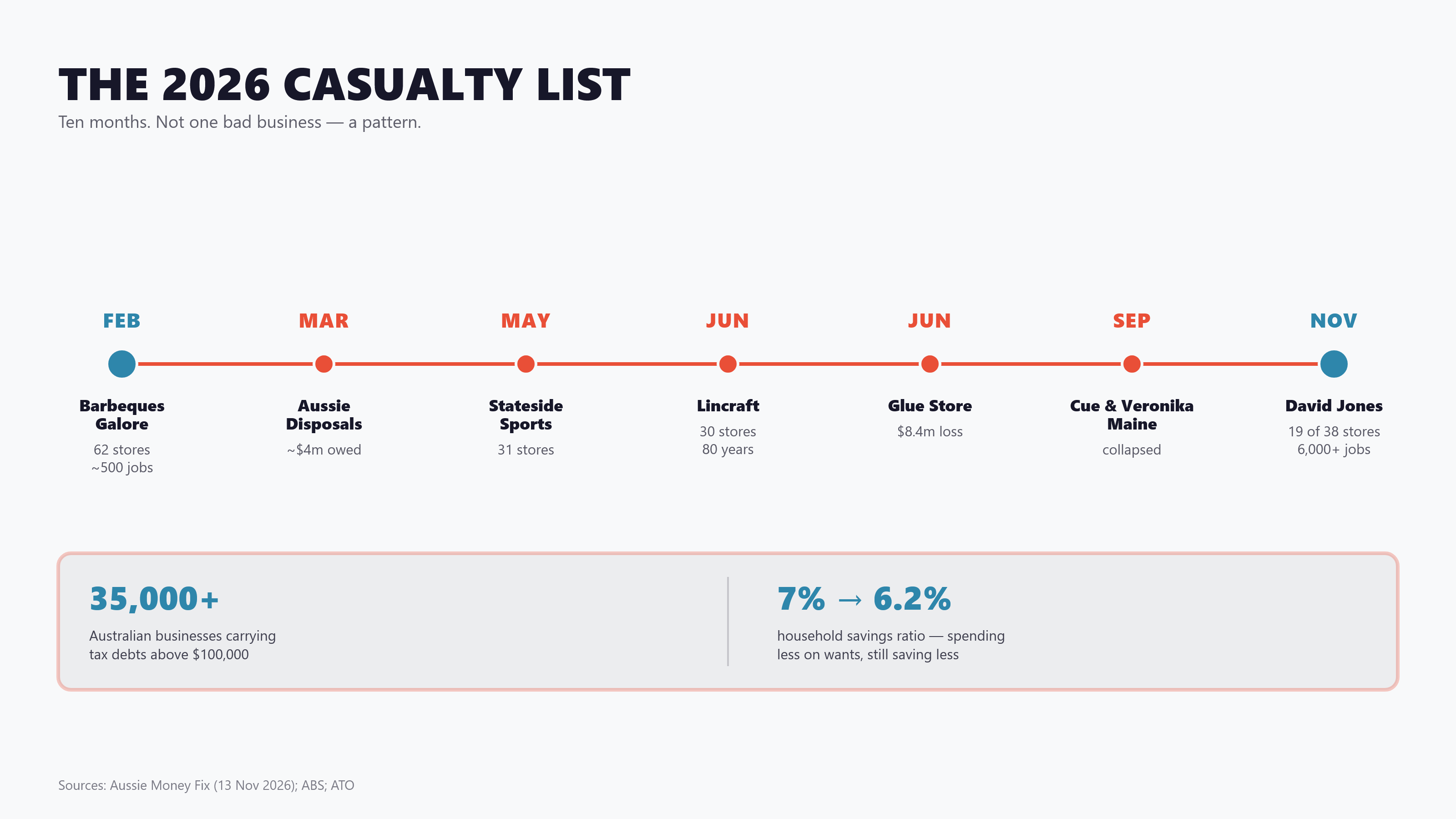
David Jones is not alone. More businesses crushed & closed include;
Barbeques Galore: 62 company stores marked for closure, around 500 jobs.
Lincraft: 80 years of trading, all 30 remaining stores shut.
Betts: 130 years, once 220 stores, shrinking to 15.
Glue Store: gone, after an $8.4 million loss.
Cue and Veronika Maine: collapsed and up for sale.
Mosaic Brands last year took Katies, Rivers, Noni B and Millers with it — nearly 3,000 jobs - gone.
This is not a run of bad management.
It is a pattern.
And a pattern has a cause.
Source: Why Australia’s Biggest Stores Are Suddenly Shutting Down? - Aussie Money Fix
Don’t let the graphics in this video fool you into thinking that this is just a “blip on the Australian business radar.”
These are the larger businesses — there are thousands of small businesses closing too!
I want to be precise about the word I use here: these businesses and their workers are now suffering Critical Financial Injuries.
They are not lazy, not overextended by choice, not punished for failing to budget.
▓ Critical Financial Injuries — caused by a mechanism that can be named, traced and documented. ▓
The Four Overloads, As Reported
The channel Aussie Money Fix published a clear-eyed breakdown of this collapse in November. No ads, no bank sponsors, funded by readers. It identifies four pressures hitting simultaneously, and Aussie Money Fix it is right about all four:
Interest rates. The RBA lifted the cash rate to 4.85% on 3 November. Every household with a mortgage has less left over. The first thing to go is the outfit, the shoes, the barbecue.
Fuel and freight. Prices spiked on the Middle East conflict. Everything in a shop arrives on a truck.
Rent. A big store in a big centre carries a very big lease, and that bill arrives whether customers walk in or not.
Online competition. Cheap overseas retailers have been eating the middle of the market for a decade.
The national numbers back it up. The Bureau of Statistics described discretionary spending as subdued. The household savings ratio fell from 7% to 6.2% — Australians are spending less on wants and still saving less.
More than 35,000 Australian businesses now carry tax debts above $100,000, and late payments between businesses hit a six-year high.
Now let me do something that will separate this analysis from the shouting.
Overload #Four Is Real, and It Is Not Monetary
Online retail is a genuine structural shift.
It is global, it is technological, and it would be hollowing out mid-market department stores under any monetary regime. The stores in most trouble are the ones stuck in the middle — not the cheapest, not the most special, just there.
No central bank did that, and no credit reform will undo it.
I concede that fully. Which is why the other three deserve your attention.
Overload #Three Is the One Nobody Connects
Here is the question the media & politicians never asks: why is the rent so high, and why can’t it come down?
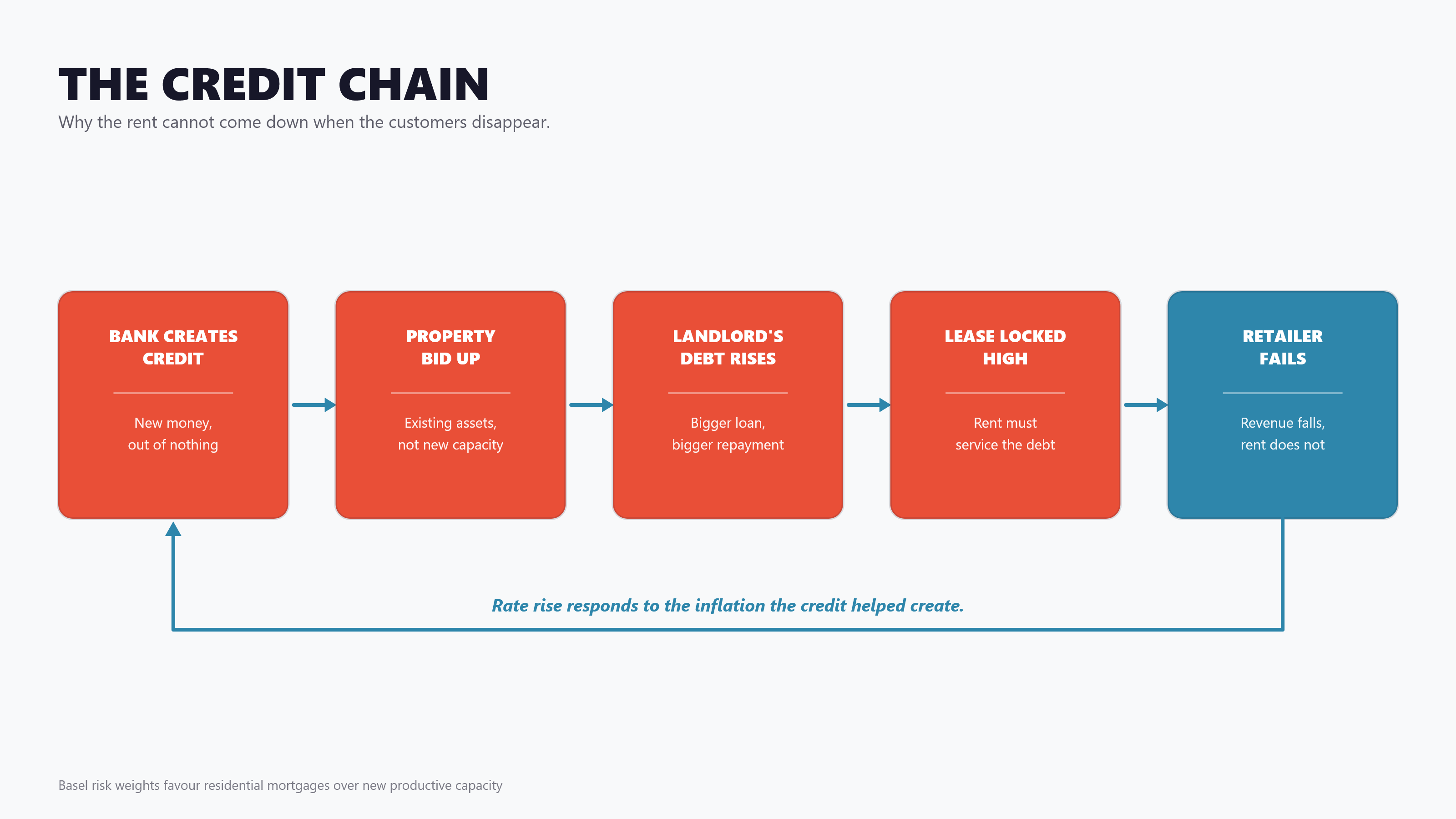
A shopping centre is valued on the rent it collects. An investor borrows to buy it. The rent must service that debt.
When bank credit is abundant and cheap, buyers bid the asset up. The next owner therefore pays more — and needs even higher rent to service an even larger loan.
Each cycle of credit-fuelled appreciation locks in a higher claim on the tenant’s revenue.
The lease is rigid because the landlord’s balance sheet is rigid.
So when the RBA raises rates and discretionary spending collapses, the retailer’s income falls — but its largest fixed cost is contractually welded to a property valuation set during a credit boom.
The tenant’s revenue is variable.
The landlord’s debt service is not.
David Jones had not paid rent on its Westfield stores since the end of September. Talks with the landlord broke down. Administrators were called in days later.
That is not a story about a department store losing touch with fashion.
That is a story about who absorbs the adjustment when a credit cycle turns.
Overload #Two: We Chose Not to Build Our Own Oil Refineries
Australia sits on world-scale oil and gas reserves and imports the overwhelming majority of its refined fuel. When a conflict closes a shipping lane, we have no buffer.
That was not geology. That was capital allocation.
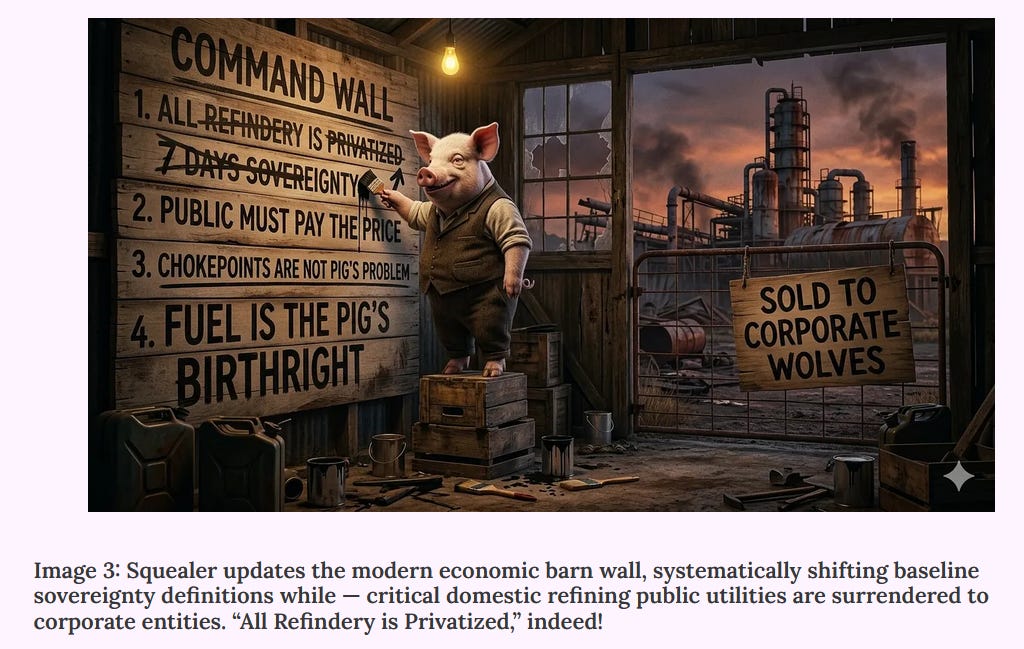
Under the Basel capital framework — written in Switzerland, translated into Australian law by APRA — residential mortgages carry far lower risk weights than lending to a business building new productive capacity.
A bank creating fresh credit against an existing house consumes less capital than one funding a refinery.
The rulebook does not merely regulate banks. It points newly created credit at existing assets and away from industrial capacity. We have world-class mortgage markets and shrinking fuel sovereignty because that is what the incentives reward.
Every extra dollar of freight cost squeezing a retailer in Tamworth is downstream of that choice.
Overload #One: The Adjustment Is Not Shared
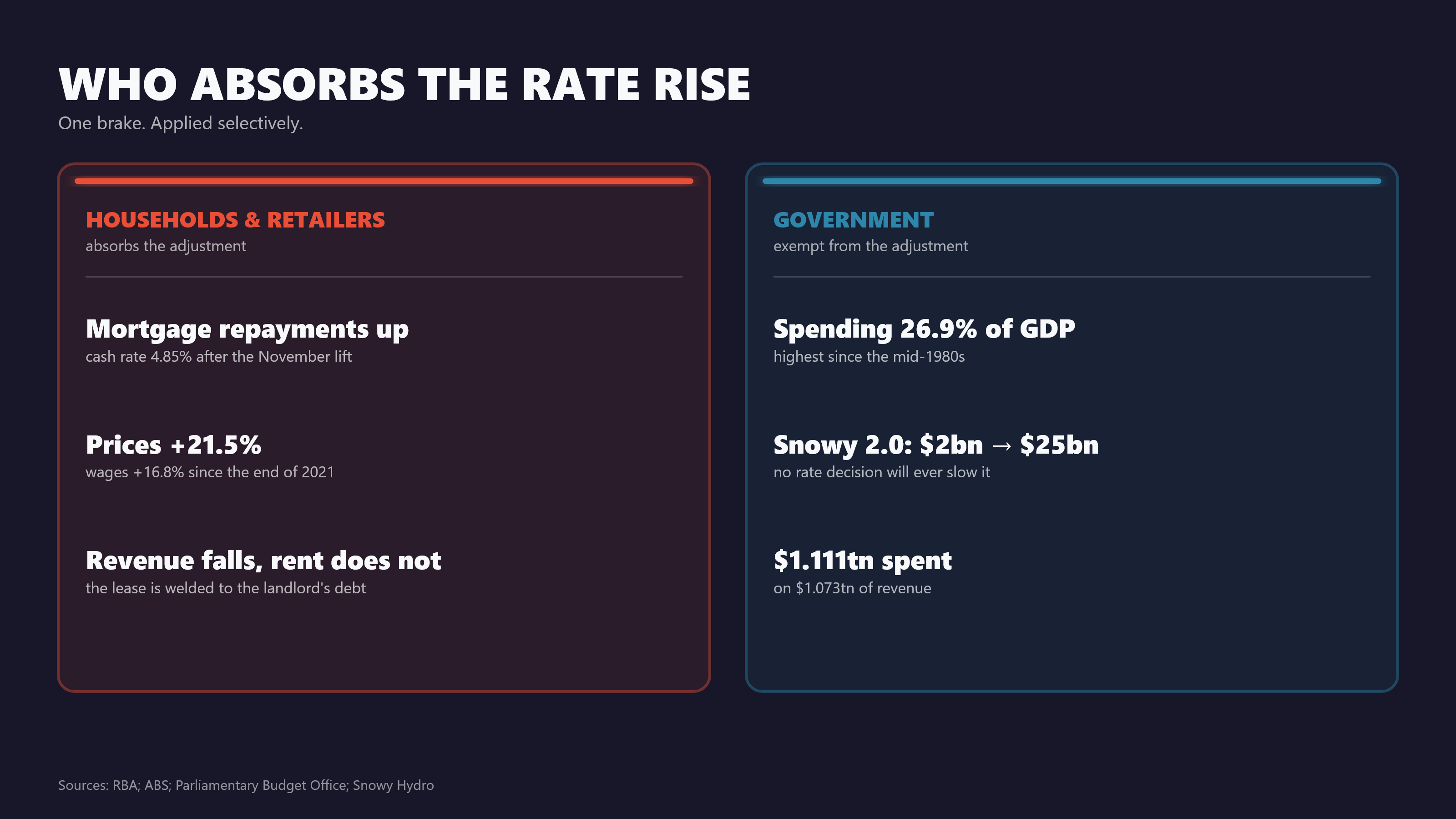
The cash rate is 4.85%. The November decision was a 6–3 split — three board members voted to hold.
Meanwhile: federal spending at 26.9% of GDP, the highest since the mid-1980s. All levels of government took in $1.073 trillion and spent $1.111 trillion.
Spending grew 8.2%; revenue grew 6.6%.
Snowy 2.0 went from roughly $2 billion to as much as $25 billion.
No interest rate decision will ever slow that down.
When the RBA’s Chief Economist Sarah Hunter was asked on 60 Minutes why households are squeezed while governments splurge, she said:
“It’s really not our place.”
Economist Warren Hogan — who has been warning about this for years — puts the government spending problem bluntly, saying it has “absolutely exploded” over the past decade.
He is right.
But there is a second engine nobody names: private bank credit creation, overwhelmingly directed at bidding up existing assets rather than funding new capacity.
Two engines still running. One brake, applied to the household and the shop.
What This Means for You This Christmas
The practical advice matters, and it is worth taking seriously:
Gift cards. In administration they are not a sure thing. When Barbeques Galore went under, cards were honoured only if you spent the same amount again — a $100 card meant $200 in store.
When Dick Smith collapsed in 2016, cards were not honoured at all. Spend them now. Think twice before buying one from a retailer in trouble.Online orders. Buy in store where you can. If you order online, pay by credit or debit card so you have chargeback rights.
Lay-by. Pay it off and collect, or ask for your deposit back.
Returns. Check the policy on the day you buy. At David Jones, anything bought from 7 November now has just 14 days for change-of-mind exchange.
If your employer goes under. The Fair Entitlements Guarantee can cover unpaid wages, leave and redundancy up to certain limits. It does not cover unpaid super. Check your super fund now and confirm the payments are landing.
And the deeper lesson: know your fixed costs, keep them as low as you sensibly can, hold a cash buffer. An 188-year-old department store could not outrun that maths.
But hold two truths at once. That advice is sound — and it is not a solution.
You cannot budget your way out of a monetary architecture that points credit at existing assets, starves productive capacity, and then hands you the entire bill for the resulting inflation.
Personal prudence is the lifeboat. It is not the reason the ship is sinking.
The Lie vs. The Truth
The Lie: A century-old retailer failed because it lost touch with shoppers, and 6,000 workers are casualties of a changing market.
The Truth: Those retailers were carrying leases priced during a credit boom, freight costs inflated by a refining capacity we chose not to finance, and demand crushed by rate rises that governments were exempted from.
The market changed. The mechanism decided who paid for it.
Coming Next: Where the Money Actually Comes From
We have traced the chain from credit creation to the empty shopfront. But there is a question underneath all of it.
Where does that credit come from? Not from the government. Not from savers. Next in this series: the empirically tested reality that 97% of the money supply is created by private commercial banks, out of nothing, at the moment they issue a loan — and why that makes the allocation of credit, not its price, the true lever of power.
References & Further Reading
Aussie Money Fix, “Why Australia’s Biggest Stores Are Suddenly Shutting Down?” (13 November 2026) — casualty list, four pressures, consumer protections. Watch
Reserve Bank of Australia, Cash Rate Target — 4.85%, effective 4 November 2026. rba.gov.au
RBA, Cash Rate Target Overview — next decision 2.30pm, 8 December 2026. rba.gov.au
Parliamentary Budget Office, Fiscal Outlook — revenue, spending and debt servicing. aph.gov.au/pbo
APRA, Prudential standards — Australian implementation of the Basel capital framework. apra.gov.au
Basel Committee, International Convergence of Capital Measurement and Capital Standards (Basel I, 1988). bis.org
Australian Government, Fair Entitlements Guarantee. dewr.gov.au/fair-entitlements-guarantee
Part 1 of this series: How Central Banks Really Operate — The Great Deception — Why Your Pain Is Their Policy.
Part 2 of this series: The Tower of Basel - The Central Bank that Rules Central Banks