

Down at the local fuel pumps, ordinary Australians are staring at pricing meters that resemble the revised Seven Commandments on the barn wall — constantly changing to benefit the ruling elite while leaving the working class in the dirt.
While the "pigs" of the Canberra technocracy and political leadership sip their cocktails & whiskey, a devastating physical bottleneck is systematically crushing the global supply of middle distillates.
The message scrawled on the modern economic barn wall is clear:
All consumers are equal, but some corporate wolves
are far more equal than others.

Image 1: Chairman Bourgeois monitors skyrocketing Singapore Gasoil margins from a position of insulated comfort, while Australia’s private logistics networks operate on heavily depreciated asset structures, in an artificial economic calm.
The Windmill Collapses: The 2026 Geopolitical Choke-hold
In Orwell’s allegory, the collapse of the windmill represented the sheer incompetence of the regime’s grand promises.
In 2026, the global economy has seen its primary energy lifelines targeted in tandem:
The Bab al-Mandeb Siege: The narrow maritime gateway has been heavily mined, bringing commercial transits to a halt.
The Petroline Sabotage: Highly coordinated strikes have disabled multiple pump stations along Saudi Arabia’s critical East-West pipeline.
This synchronized offensive has instantly stranded 2.5 million barrels a day of crude. The financial blowback is immediate:
US diesel has skyrocketed to a record $6.26 per gallon, while the Singapore Gasoil front-month time spread has blown out to over $10.00 per barrel in steep, panic-driven backwardation.
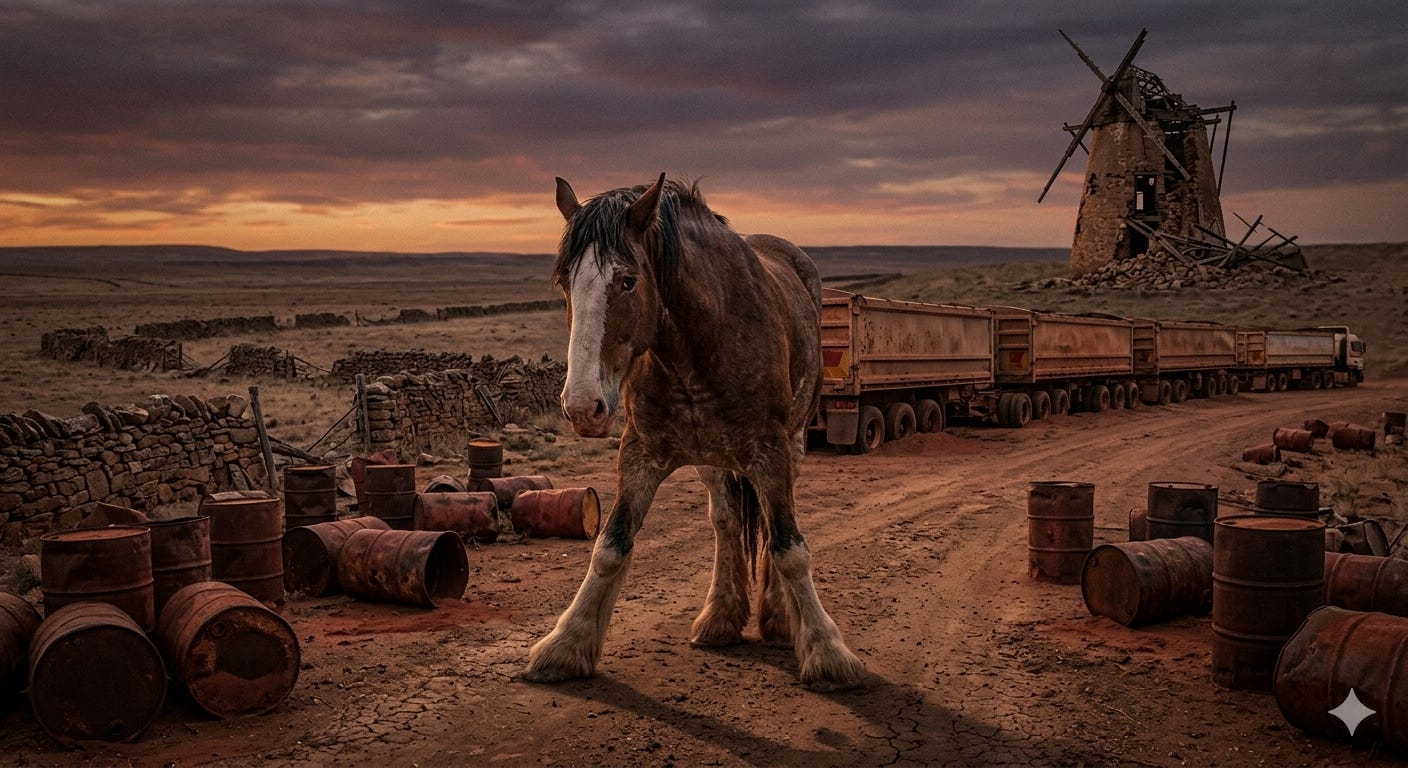
Image 2: Boxer the usually indefatigable draught horse, views the structural erosion of the Farm — domestic resources landscape — with a broken heart — stranded beside stalled supply lines and a crumbling infrastructure grid.
The Home Affairs Blindspot: A Catastrophic Failure of Vision
How did Australia prepare for this? It didn't.!
The Department of Home Affairs’ Critical Infrastructure Annual Review (November 2025) completely misjudged the landscape.
Despite the joint US-Israeli strikes on Iran in June 2025 serving as a massive, screaming combat indicator, bureaucratic complacency ranked “Disrupted Fuel Supply” as a mere #3 on its national risk priority list.
Our leaders completely ignored the obvious moves on the geopolitical chess board. Now that the Middle East conflict has escalated past the point of no return, the true vulnerability of our “floating pipeline” is exposed.
Australia’s Achilles Heel: The 25-Day Illusion
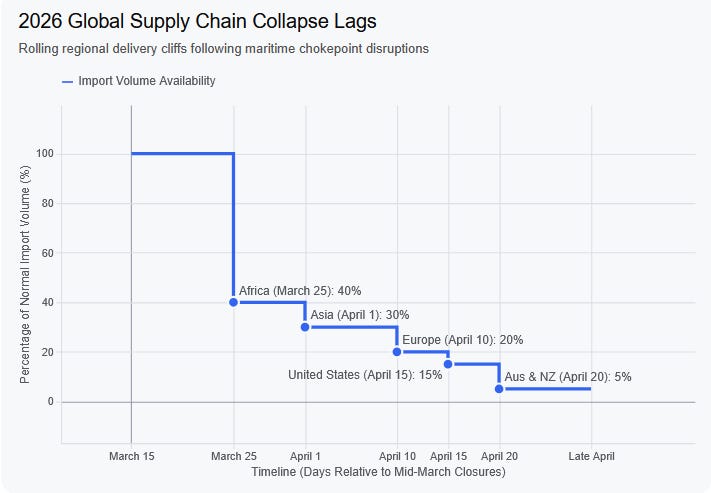
Australia operates in a state of artificial calm. The fuel currently being consumed at local bowsers is not post-war supply — it is pre-war cargo that took weeks to cross the ocean.
The supply chain lag moves in stages, and Australia’s delivery stop-date hit that cliff after April 20, 2026.
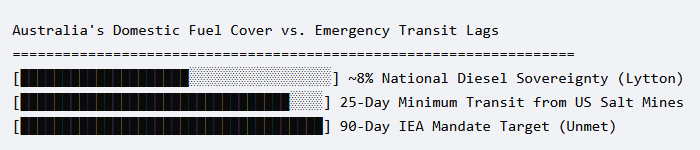
The structural absurdity of Australia’s energy architecture is staggering:
The US Salt Mine Hoax: Part of Australia’s mandated strategic oil reserves is physically stored in old salt mines inside the United States.
If a total maritime blockade locks down the Pacific, it will take at least 25 days for those reserves to be extracted, loaded, and sailed to Australian shores.
Did anyone in our Dept of Defence ever consider the implications of a Fuel Blockade around Australian Trade Routes?The Refined Deficit: Successive governments have spent 25 years celebrating the systematic destruction and closure of our domestic refining capabilities.
Today, Queensland’s Lytton refinery — one of our last remaining major assets —produces a fraction of what we consume, representing a meager 8% of our nation’s diesel sovereignty.
Small regional operations like the Eromanga Inland Refinery west of Roma provide a localized cushion for rural operations, but are nowhere near scaled to insulate the broader, National economy.
Slaying the Golden Goose — From Menzies to the Perdaman Giveaway
This chronic vulnerability is no accident — it is the result of a decades-long bipartisan commitment to the false gods of privatization.
In 1920, the Billy Hughes government established the Commonwealth Oil Refineries [COR], giving the public a 50% stake in its own fuel security and refining standards. But in 1952, the Menzies government systematically slew the goose that laid the golden eggs, selling our public share to the Anglo-Iranian Oil Company — now BP — for a gross undervalue of just £2.7 million.
The resulting privately owned Kwinana refinery near Perth was eventually abandoned and closed by corporate interests in 2021.

Now, Western Australia is repeating this historical disaster at an even larger scale with the $6.5 billion Perdaman urea and refinery project near Karratha.
The Public Risk: The WA and Federal Labor governments are funneling over $800 million in taxpayer-backed funding (via NAIF, Export Finance Australia, and Port/Water utility loans) to underwrite the project.
The Private Profit: The asset is 100% privately owned by the billionaire Vikas Rambal family enterprise. While taxpayers shoulder the financial exposure of the loans, the projected $77 billion in lifetime revenue flows exclusively to private shareholders.
The Corporate Black Hole: A deep-dive search of the ATO’s corporate tax transparency dataset reveals that Perdaman does not even appear in the records, meaning they have full public subsidies with zero visible corporate tax contributions.

Image 3: Squealer updates the modern economic barn wall, systematically shifting baseline sovereignty definitions while — critical domestic refining public utilities are surrendered to corporate entities. “All Refindery is Privatized,” indeed!
The Next Line in the Sand: The Bedout Sub-Basin
Instead of protecting national security by building state-owned refineries or enforcing strict public-equity mandates — like Norway’s brilliant “10 Oil Commandments” which secured 67% state ownership via Equinor and built a $2 trillion sovereign wealth fund — Australian politicians function on the CGARA principle:
Couldn’t Give A Rat’s Arse.
But while the Perdaman financing is already locked in, Western Australians have an immediate opportunity to draw a line in the sand before the next asset is surrendered.
Offshore from Port Hedland, the Bedout Sub-Basin represents a massive unexploited frontier for oil and gas, featuring significant finds like the Dorado discovery holding an estimated 250 million barrels of recoverable oil. As major operators advance drilling plans toward a final investment decision, the policy framework established here will dictate future resource sovereignty. Experts and advocates argue that avoiding past mistakes requires stringent tax transparency, halting unbacked public subsidies, and securing a mandatory 51% public ownership stake.
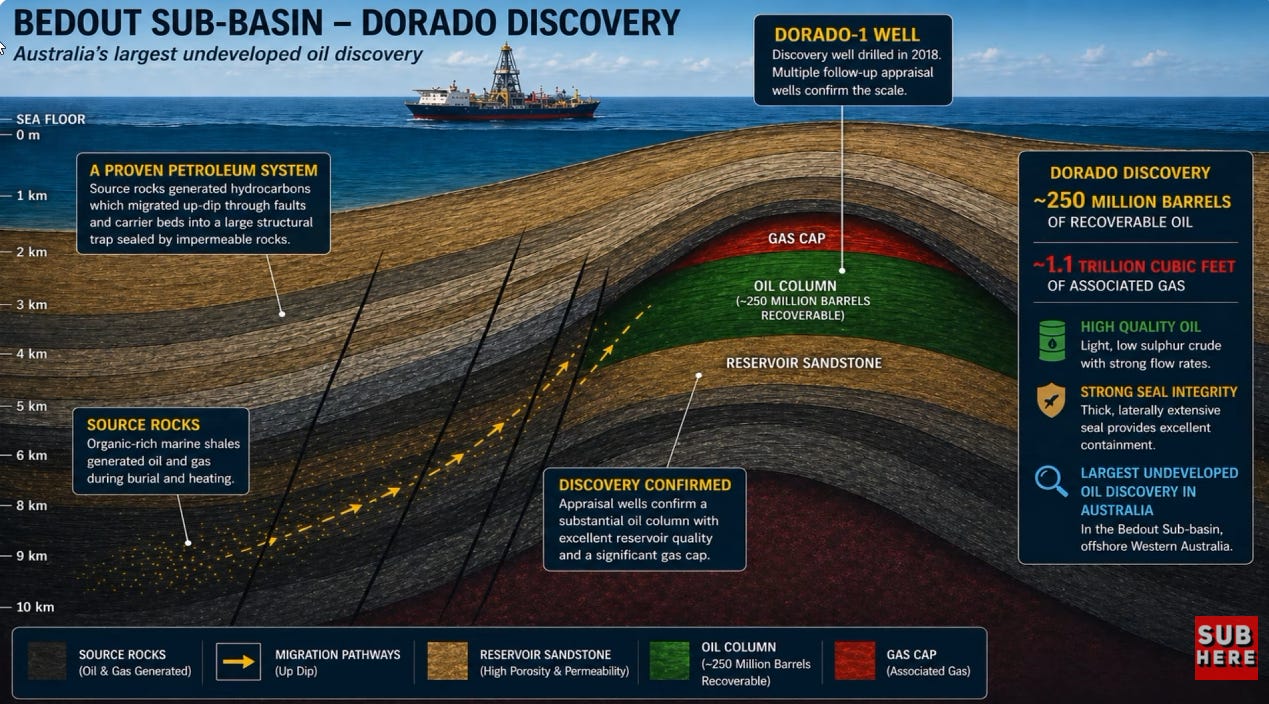
Full details and complete statistical breakdowns regarding the Bedout Sub-Basin and storage metrics can be reviewed directly in the referenced source material.
References & Further Reading
Michael West Media TaxData Platform. An open-access corporate tax tracking database analyzing 1,274+ systemic multinational enterprises operating in Australia. michaelwest.com.au
Northern Territory Government (2008). Ichthys Project Development Agreement (PDA): Confidential Clause 14 (Fiscal Stability Framework Provisions). Northern Territory Treasury.
Northern Territory Parliamentary Budget Office (PBO) Data Series. Analysis of sub-national per-capita debt trajectories and structural revenue constraints. nt.gov.au
Northern Territory Budget Review (2025/26). Treasurer’s Report on Debt Expansion, Capital Expenditure, and Public Balance Sheet Pressures. ABC News Analysis. abc.net.au
Northern Territory High Court Legal Precedents. Codelfa Construction Pty Ltd v State Rail Authority of New South Wales (1982) 149 CLR 337 (The Judicial Baseline for the Doctrine of Frustration).
The Australia Institute (2024). Exposing the False Gods of Privatisation: The Empirical Failure of Deregulation, Commercial Asset Disposals, and Strategic Outsourcing in Modern Public Finance Systems
United Kingdom Department for Energy Security and Net Zero. The £800 Billion Gap: Historical Analysis of North Sea Hydrocarbon Concessions and the Failure to Establish an Sovereign Wealth Architecture. Michael West Media Comparative Series. michaelwest.com.au
Equinor ASA Governance Principles. The 10 Oil Commandments (Rolf Hellem Blueprint for the Norwegian Continental Shelf - 1971). State-Owned Enterprise Structural Review. equinor.com
Department of Home Affairs (November 2025). Critical Infrastructure Annual Review of Risk: Energy Grid Systems, Liquid Fuel Logistics, and National Vulnerabilities. Commonwealth of Australia. homeaffairs.gov.au
Australian Taxation Office (ATO). Corporate Tax Transparency Reporting Series (2014-2024 Tracking Datasets). Commonwealth of Australia. ato.gov.au
Northern Territory Corporate Litigation Archive. The Australian Taxation Office v. Vikas Rambal: Multi-Million Dollar Personal Settlement Tracking Data. The West Australian Legal Series. thewest.com.au
Northern Australia Infrastructure Facility (NAIF). Project Investment Summary: The Perdaman Urea Production Plant and Karratha Common User Infrastructure Loans. naif.gov.au
United Nations Security Council Briefing Series. Geopolitical Escalation in the Red Sea: Strategic Implications of the Bab al-Mandeb Maritime Standoff and Persian Gulf Energy Vulnerabilities. Jordan News International Database. jordannews.jo
Rapier, R. (September 2026). Why Global Diesel and Distillate Markets Are on Track for Record Nominal Price Breakouts. Forbes Energy Architecture Matrix. forbes.com
Simplicius Energy Intel. Experts Declare Global Fuel Crisis Imminent as Middle Eastern Refining Bottlenecks and Infrastructure Disruption Materialize. Geopolitical Deep Dives. substack.com
Sparta Commodities Analytics Hub. Europe Stays Bid as Saudi Supply Risk Spreads Eastward into Asian Gasoil and Singapore Swaps Markets. Refining Margin Outlook. spartacommodities.com
OzGeology Field Database (April 2026). The Bedout Sub-Basin Evolution and the Dorado Discovery: Tracking Australia’s 250 Million Barrels of Undeveloped Hydrocarbon Capabilities. Geological Survey Analysis.
Visual Capitalist Energy Flow Maps. Charted Oil and Product Trade Flows Through Global Maritime Chokepoints Following Structural Geopolitical Disruptions. Energy Now Archive. energynow.com
ThoughtCo Literary Series. Animal Farm Themes and Symbols: Deconstructing the Political and Economic Allegory of the Ruling Elite. thoughtco.com
Artistic & Media Attributions
Custom allegorical illustrations depicting Chairman Bourgeois, Squealer’s Command Wall, and Boxer at the Ruined Windmill were digitally rendered using the Nano Banana Image Generation Platform.