
Nations That Said No ~ Inside the Global Revolt Against AI Data Centres
PART 11 ~ Resource Sovereignty Series ~~ Eight nations, one pattern: AI data centres promise jobs, take the water, and rewrite the rules when caught. Here's who fought back ~ and won.

The Animal Farm allegory still applies with the AI Data Centre Reports.
** «All animals are equal, but some animals get first claim on the water.»**
On the wall of the farmhouse, the pigs keep rewriting the rules.
Investigation #7 ~ *The Servers are Coming ~~ showed how Big Tech’s data centres arrived in resource-rich nations promising jobs and «digital sovereignty.»
Investigation #8 ~ *Thirst Machines* ~~ showed what they actually drink.
Investigation #9 ~ *Data Centres Destroy the Serenity ~~ shows how Noise ~ audible & infrasound vibrations ~ will destroy the neighbourhood serenity.
Investigation #10 ~ *Water is already Drained ~ now comes the Power Drain ~~ shows how communities will require more massive Power Stations to drive the AI Data Centres.
This eleventh investigation asks a different question: what happens when the animals stop believing the promises and vote, litigate, or march the pigs off their land?
The answer, it turns out, is a lot.
Since 2019, city councils, national regulators, courts, and ~ in one landmark case ~ voters themselves have said no to AI and cloud data centres in numbers too large to dismiss as NIMBYism = Not In My Back Yard-ism.
This is a tour of that resistance: where it happened, who led it, and what each community actually said when the digital economy’s most water- and power-hungry infrastructure showed up at their door.
The Global Timeline
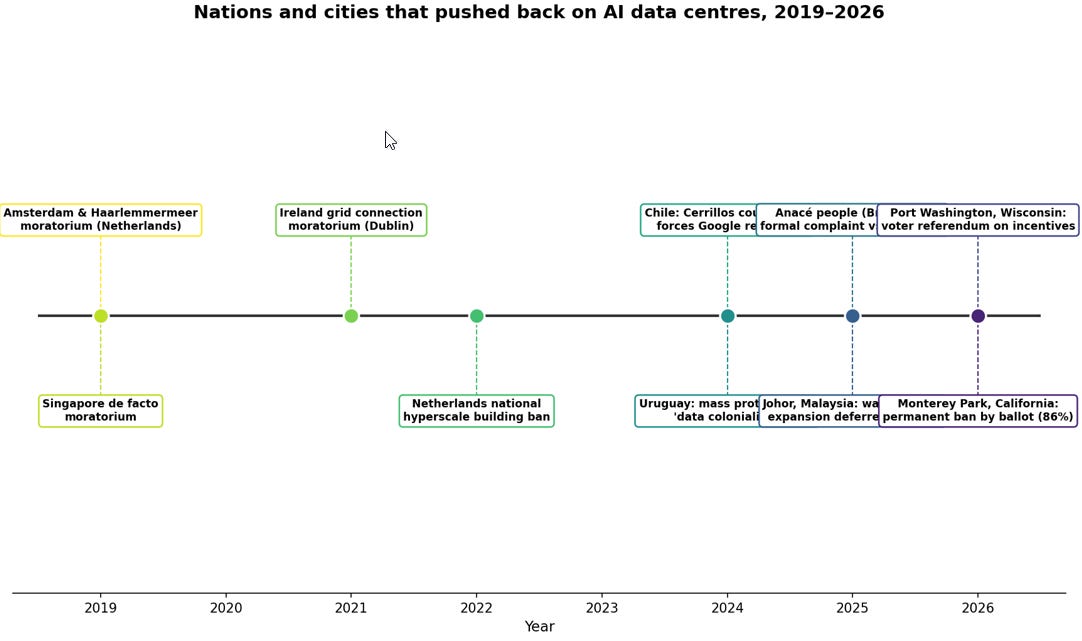
*Ten flashpoints across four continents, seven years, and every possible mechanism of refusal ~ court injunctions, regulatory moratoria, and now the ballot box.*
1. Amsterdam, Netherlands ~ The Original Shock
Long before «AI boom» was a headline, Amsterdam broke the industry’s sense of inevitability. On 12 July 2019, the municipality ~ together with the neighbouring precinct of Haarlemmermeer ~ announced an **immediate, unannounced ban** on all new data centre developments¹.
It landed on an industry that considered the Dutch capital one of Europe’s safest bets.
The reasoning was blunt: data centres were eating an outsized share of scarce land and grid capacity relative to the jobs and tax revenue they produced, and Amsterdam’s own climate targets were on a collision course with the sector’s power appetite². Alderman Reinier van Dantzig, who oversaw the policy, put the underlying scarcity in five words: **«Space is limited in Amsterdam.»**³
The moratorium lasted a year before giving way to a stricter licensing regime.
But it never really ended ~ in 2022 the Dutch national government imposed a separate ban on new *hyperscale* facilities across most of the country, restricting them to two designated zones⁴.
In April 2025, Amsterdam went further again, barring new data centres or expansions within the municipality until at least 2030⁵.
Microsoft has since found a workaround ~ splitting one large project into three towers, each individually below the size threshold that triggers the ban.⁶
A Vital Reminder ~ all victories are provisional and the pigs are always redrafting the sign on the barn.
2. Singapore ~ The City-State That Ran Out of Room
If Amsterdam said no because of politics, Singapore said no because of arithmetic.
By 2019, data centres already consumed roughly 7% of the city-state’s total electricity on a landmass with nowhere left to expand⁷.
The government imposed a de facto moratorium on new large-scale approvals that August, and for three years ~ an eternity in cloud-infrastructure time ~ effectively nothing new was built⁸.
Trade and Industry Minister Gan Kim Yong explained the freeze by naming what data centres are, structurally: **«intensive users of resources.»**⁹
When the pause lifted in 2022, it came with conditions unprecedented for the industry: a hard efficiency ceiling [PUE below 1.3], mandatory renewable energy certificates, majority liquid cooling, and a strict annual capacity cap ~ turning what had been an open market into a curated one¹⁰.
The unintended consequence is the story told in Section 7 [Malaysia’s Story]:
Singapore’s discipline didn’t make the demand disappear.
It exported it across the border.
3. Ireland ~ When the Grid Said Enough
Dublin became Europe’s second-largest data centre cluster almost by accident, riding low taxes and EU access¹¹.
By 2021, data centres were consuming so much electricity that Ireland’s grid operator warned of a real risk of rolling blackouts¹².
The regulator, the Commission for Regulation of Utilities [CRU], responded with an effective moratorium on new grid connections around Dublin.
The scale of the imbalance is the real story.
Data centre electricity use in Ireland rose from about 5% of national consumption in 2015 to 22% in 2024 ~ and Ireland’s own grid operator, EirGrid, forecast that 89% of *all* new electricity demand over the following decade would come from data centres alone¹³.
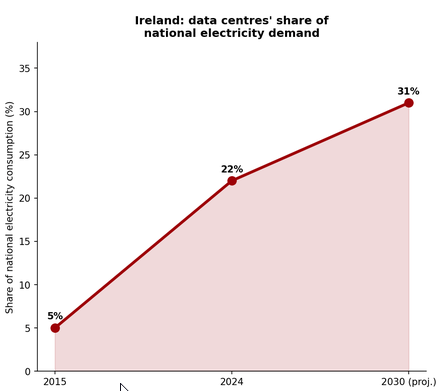
Irish households picked up part of the bill too: emergency gas generators commissioned to stabilise the grid added roughly €100 to the average family’s power bill in 2024¹⁴.
*Update, for the record: Ireland lifted this moratorium in December 2025.*
New data centres can now connect, but only if they supply 80% of their own demand from on-site renewables or batteries and feed power back into the grid when needed.¹⁵
This arguably less a retreat than a renegotiation of the terms of surrender.
Analysts interviewed by Tech Policy Press described the underlying pattern as a government that, rather than confronting the political trade-off between digital growth and sustainability directly, deferred the decision to a regulator tasked with managing the fallout as quietly as possible¹⁶.
« Ireland is now home to one of the highest concentrations of data centers in the world. What began as a quiet build-out of server farms around Dublin has expanded into an industrial presence with an ecological footprint that dominates the country’s electricity system. In the meanwhile, Big Tech has falsely portrayed itself as a partner in green transition.»
« The surge in energy consumption has reshaped the energy system around the needs of a handful of multinational tech companies. Grid capacity is being diverted to new hyperscale sites, transmission upgrades are being driven by their load, and the state is pouring billions into emergency fossil-fuel generators to keep supply stable. Households face higher bills, electrification plans have stalled, and national climate targets are slipping out of reach. What looks like a renewable success story on paper masks a system increasingly strained by a single, rapidly expanding sector of energy users.»
4. Chile ~ The Aquifer That Fought Back
Chile is fifteen years into a mega-drought, with government-enforced water rationing since 2022¹⁷.
Into that landscape, Google proposed a $200 million data centre in Cerrillos, on Santiago’s outskirts, drawing an estimated **7.6 million litres of potable water a day** ~ equivalent to the daily consumption of roughly 55,000 people — directly from the strained Santiago aquifer¹⁷.
Local residents and the Cerrillos municipality took Google to Chile’s Second Environmental Court.
In February 2024, the court partially reversed the project’s permit, ruling the original environmental assessment hadn’t properly accounted for climate change¹⁸. Community organiser Pamela Ramirez, who helped lead the resistance, produced a protest poster reading: **« Danger! Danger! No to the data center! Data theft!» **¹⁹ Indigenous groups and unions rallying against the project adopted a chant that translates to «this is not a drought, this is a robbery.»²⁰
Google’s response was total: rather than fight the ruling, it scrapped the original design entirely. **« A new process will start from scratch, »** the company said, committing to switch from water-based cooling towers to air-cooled condensers²¹. Chile’s Economy Minister, Nicolás Grau, framed the outcome as a net positive for the country’s environmental review process rather than a loss for the project itself²².
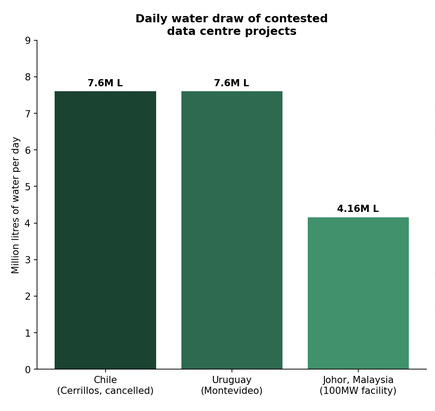
The victory has limits. Reporting on the broader Quilicura data centre corridor near Santiago has found that even after the redesign, cumulative water rights held by hyperscalers in the area ~ including a separate, still-active Google facility drawing 50 litres per second ~ continue to strain wetlands already stressed by drought and industrial encroachment²³.
5. Uruguay ~ «Data Colonialism» Enters the Lexicon
Montevideo’s fight became the one that gave this global movement its sharpest phrase.
Google announced a data centre for the Uruguayan capital in 2019; by 2023, transparency campaigner Daniel Pena had forced the release of the true water figure through legal action ~ the facility was designed to draw;
**two million gallons of water a day directly from the drinking supply**,
equivalent to what 55,000 people use daily²⁴.
The revelation landed weeks after parts of Montevideo began receiving salinated water through household taps, and thousands of Uruguayans took to the streets²⁵.
A Uruguayan researcher summed up the local economic case against the project in a single line: **« It won’t pay tax, as it’s being built in a duty-free zone.»**²⁶
The facility was projected to create only around 30 permanent jobs once operational²⁷.
Google eventually redesigned the Uruguay project too ~ switching to waterless cooling and shrinking the facility to roughly a third of its original footprint²⁸.
Pena’s campaign continues to push for full supply-chain transparency, including where the minerals inside the servers are mined and under what labour conditions²⁹.
Commentators tracking the story coined the phrase that now anchors the whole debate across the Global South: **« data colonialism »** ~ the extraction of a community’s water and power to serve computing demand generated almost entirely elsewhere³⁰.
6. Brazil — The Anacé and a $10 Billion Complaint
The Uruguay and Chile fights inspired a formal Indigenous rights challenge in Brazil. In 2025, the Anacé Indigenous people of the country’s northeast filed an official complaint with federal authorities seeking to cancel a proposed $10 billion TikTok data centre planned for their land³¹.
Their leaders argue their right to prior consultation was violated and that concerns about the project’s water impact were dismissed outright³².
As of the most recent reporting, the complaint remains unresolved³³ ~ a reminder that not every act of resistance in this movement has yet produced a win, only a filing and a wait.
7. Johor, Malaysia ~ Singapore’s Overflow = Someone Else’s Problem
This is the clearest case study in how a « No » in one jurisdiction simply relocates the demand next door.
When Singapore restricted data centre growth to protect its own resources, global operators ~ Microsoft, Equinix, ByteDance, China’s Zdata ~ pivoted en masse to Johor, just across the causeway.
Johor’s data centre capacity nearly doubled in a single year, reaching roughly 5.8 gigawatts by mid-2025³⁴.
In February 2026, Malaysia recorded its first-ever public protest against a data centre. More than 50 residents ~ representing roughly 1,000 people across four housing estates in the Gelang Patah district ~ gathered outside a Zdata construction site, citing dust pollution and fears for their water supply³⁵. Residents told reporters they could no longer dry laundry outdoors and that air purifiers were registering dangerously poor air quality³⁶. The developers did not meet the protesters.
The state government responded with policy, not just police. Johor stopped approving the most water-intensive tiers of data centre in 2025, and in November 2025 ordered operators using water-cooled systems to defer expansion for at least 18 months while authorities managed drought conditions³⁷ ~ a single facility’s cooling demand had reached an estimated 4.16 million litres a day³⁸.
Not every local voice frames the backlash as justified: one Malaysian opinion piece argues the water fears are largely « the more emotive worry, and the more answerable,» pointing to mandated recycled-water cooling and a rising state water reserve margin as evidence the government has already adapted³⁹.
That dispute ~ between lived anxiety and official reassurance ~ is, in miniature, the entire argument playing out in every country in this investigation.
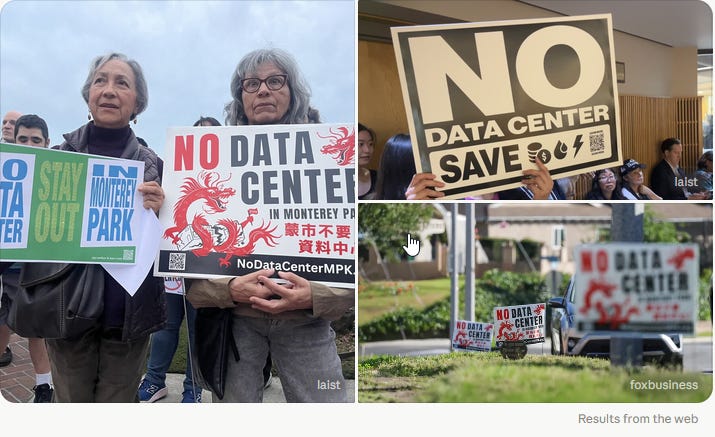
The US & Other Western Nations will Feature in another Report ~ soon.
Sources — Nations That Said No to AI Data Centres
DataCenterDynamics — “The ongoing impact of Amsterdam’s data center moratorium,” 2026.
Dutch Data Center Association — “Two years after the Amsterdam moratorium,” 2021.
HostingJournalist — “City of Amsterdam Puts Halt to New Data Center Construction,” 2026.
IDC-A — “The Netherlands temporarily bans the construction of new hyperscale data centers,” 2022.
Yahoo Finance / Reuters — “Factbox: Where authorities are restricting data centres amid AI boom,” 2026.
Dutch Brief — “Microsoft to Build Massive Data Centre in Amsterdam Despite Bans,” 2026.
Addleshaw Goddard — “The Future of Data Centres in Singapore.”
Reed Smith — “Singapore’s data centre expansion: Jurong Island and the next phase,” 2026.
Introl — “Singapore’s Green Data Center Gamble,” 2026.
Mingtiandi — “Singapore Lifts Data Centre Moratorium, Caps Capacity,” 2022.
KPMG Ireland — “Ireland’s data centre policy reset.”
Houses of the Oireachtas — “Research Matters: The future of data centres in Ireland,” 2025.
Pinsent Masons — “New Irish data centres must generate power back into national grid,” 2025.
Tech Policy Press — “What Ireland’s Data Center Crisis Means for the EU’s AI Sovereignty Plans,” 2025.
Bloomberg / Energy Connects — “Ireland Ends Moratorium on New Power Links to Data Centers,” 2025.
Tech Policy Press (see note 14, specialist interviews).
Business & Human Rights Resource Centre — “Chile: Google to halt data centre project in Santiago.”
Climate Change Litigation Database — “Municipality of Cerrillos (Google Data Center) v. Evaluation Commission,” 2025.
Mongabay — “Indigenous advocates push for rights protections around AI data centers,” 2026.
Mongabay (see note 19).
DataCenterDynamics — “Google pauses Chilean data center project to rethink water use,” 2026.
bne IntelliNews — “Google scraps $200mn Chile data centre plan over environmental concerns,” 2024.
Yahoo News — “Chile’s AI Data Centers Are Draining Ancient Wetlands Dry,” 2026.
Goodreads reader notes, Karen Hao, Empire of AI: Dreams and Nightmares in Sam Altman’s OpenAI (2025), citing Daniel Pena’s legal campaign in Uruguay — source link.
Goodreads reader notes, Empire of AI (see note 24).
Medium — “AI, Colonialism, and Water,” 2024, quoting Mongabay’s Uruguayan researcher interview.
Mongabay — “The Cloud vs. drought: Water hog data centers threaten Latin America, critics say,” 2023.
Goodreads reader notes, Empire of AI, on Uruguay redesign — source link.
Goodreads reader notes, Empire of AI (see note 28).
Semafor — “Chile puts brakes on Google data center over environmental concerns,” 2024.
Mongabay (see note 19), on the Anacé complaint against TikTok.
Grist — “Data centers are booming. Indigenous leaders want help protecting their lands,” 2026.
Grist (see note 32).
The Diplomat — “Whose Water Powers the Cloud? Data Centers and the Right to Water in Johor,” 2026.
South China Morning Post — “Malaysia’s data centre boom faces backlash as residents protest over dust, water woes,” 2026.
Bangkok Post — “Malaysia draws first data centre protest over pollution, water,” 2026.
South China Morning Post — “Data centres in Malaysia’s Johor told to wait for water ‘until mid-2027’,” 2025.
Free Malaysia Today — “Malaysia’s data centre backlash is loud, popular and wrong,” 2026.
Free Malaysia Today (see note 38).
Take Home Messages
We are witnessing a New Tech Gold Rush ~ this time AI Data Centres.
They require massive amounts of Land, Water, Power and put out Pollution, Noise, Community Disruption & Destroy landscape Serenity.
If you live in a major city ~ there are already Plans for these in Your Back Yard.
Innocence and Naïvety is No Protection ~ Neighbourhood Due Diligence is a Must!