

They also came with press conferences and prime ministerial handshakes and numbers so large they made the evening news.
A$100 billion.
The largest technology investment in the nation's history.
The future of the Australian economy, arriving in server racks.
As the Driest Inhabited Continent on Earth, you would think that Australian political leaders would have some clue about the Value of Water to Civilizational Survival.

Source: Suzy Kassem ~ Rise Up and Salute the Sun: The Writings of Suzy Kassem
What they ~ the AI salespeople ~ did not come with & what nobody at those press conferences mentioned ~ is the water.
A hyperscale data centre is, at its operational core, a machine for moving heat. Thousands of AI processors generate extraordinary amounts of it.
That heat must go somewhere.
And the most common, cheapest, and most water-intensive way to remove it is evaporative cooling: spray water into the air and let it evaporate, carrying the heat with it.
Simple physics. Enormous consequences.
Australian utilities have been receiving applications from data centre proponents seeking between 5 and 40 million litres of water per day ~ up to 20 times the consumption of the largest existing single drinking water customer.
Sydney Water estimates that data centres water-demand could be 15-20 % of Sydney’s total water supply by 2035.
Not 15 to 20 % of Sydney’s industrial water. Of Sydney’s total water supply.
Australia is a continent where 80 per cent of Sydney’s water is rainfall-dependent, where cities from Perth to Brisbane regularly face restrictions.
Agricultural regions feeding the nation are already competing for diminishing water resources.
Into this landscape, the world’s largest technology companies are proposing to install thirst machines on an industrial scale ~ and the question of who pays for the water, who manages the scarcity, and who bears the consequences, has not been answered.
This is the investigation the press conference didn’t give you.
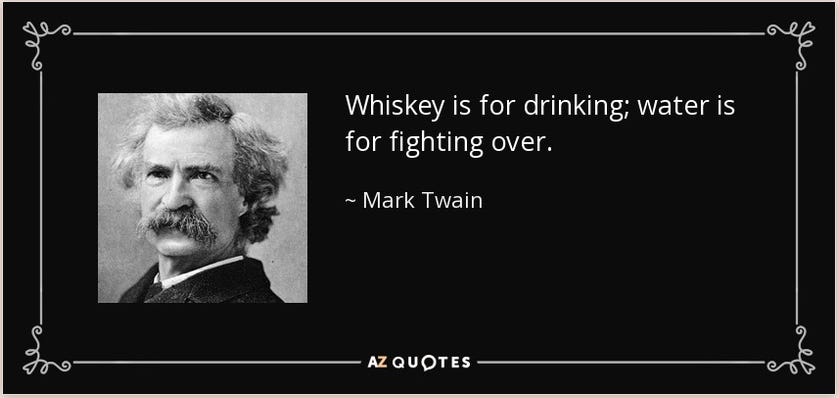
Sydney residents will end up fighting for their survival against hyperscale data centres.
Section 1 — The Thirst
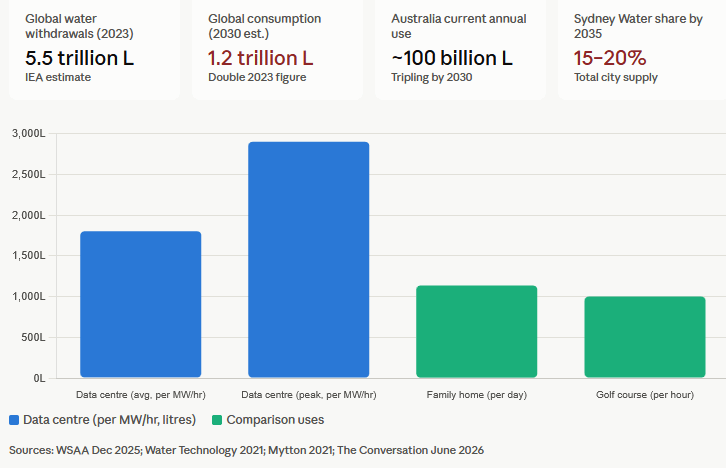
The physics is straightforward. Evaporative cooling works the same way the human body uses sweat: water absorbs heat as it transitions from liquid to vapour.
A cooling tower takes hot water heated by the server racks, sprays it over fill media through which air is drawn, and the resulting evaporation carries the heat away.
The catch: that water does not come back. It is GONE!
Data centres across Australia now consume approximately 100 billion litres of water annually for cooling systems, a figure projected to triple by 2030 as digital demands accelerate.² A medium-sized facility — not a hyperscale monster, a medium facility — uses anywhere from 11 to 19 million litres annually.²
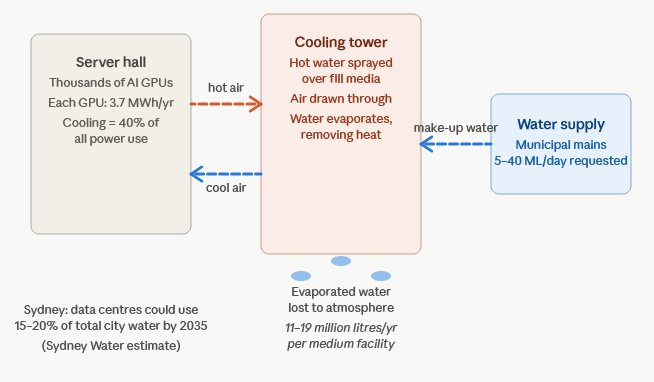
On average, evaporative cooling systems use approximately 1,800 to 2,900 litres of water per megawatt per hour.³ To put that in perspective: a large data centre uses roughly the same amount of water as 720 average US families — every single hour, around the clock, 365 days a year.³
The global picture is even more confronting. The IEA estimates global water withdrawals at around 5,500 billion litres and consumption of around 560 billion litres in 2023. This consumption could more than double by 2030, reaching 1,200 billion litres if current trends persist.⁴
Globally, electricity demand from data centres is expected to triple by 2030 ~ from around 200 TWh today to 600–700 TWh.
Given that cooling and power generation are the largest drivers of water consumption, this could translate into a threefold surge in water use, placing added pressure on already scarce water supplies.⁵
For Australia specifically, the situation is acute in ways that European or American comparisons don’t fully capture.
«Australia is a really dry continent,» notes Associate Professor David Gill of the University of Technology Sydney.
« And in the Sydney context, about 80 per cent of our water is rainfall-dependent.
A lot of other countries and cities around the world have a double diversified water supply.»⁶
The Water Services Association of Australia’s December 2025 report ~ Data Centres and Water in Australia ~ puts the regulatory problem plainly. Applications are arriving seeking between 5 and 40 million litres per day, and Sydney Water itself estimates data centres could represent 15-20 % of the city’s total water supply by 2035.¹
The NSW Data Centre Consultation Paper, released in March 2026, acknowledged what planners already knew: Sydney Water’s demand forecasts «differ drastically» from those in an industry-commissioned report, and precise water demand data from data centres is currently not available during the planning phase at all.¹

Source: waterNSW ~ greater sydney dam levels ~ 09 JUL 2026
This is the retrofit problem in its starkest form.
Data centres are being approved.
Water consumption figures are unknown.
By the time those figures become clear, the concrete has been poured.
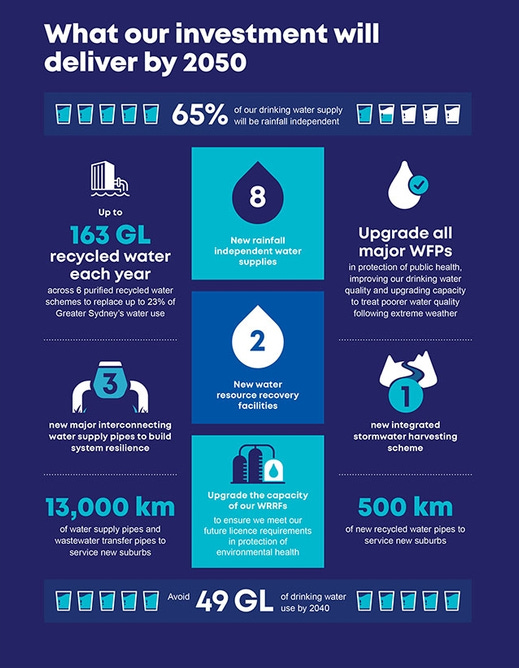
Source: sydney water ~ long term plan for the future ~ 2050

Note: 65% of potable water ~ for drinking ~ is rainfall dependent!
Consider ~ El Nino ~ AND | OR ~ The Indian Ocean Dipole!
As Joshua from Cyclones Oz has warned us ~ Australia is heading into a Super El Niño Event.
Video Transcript ~ Begins at 09:33 mins;
The Summer of 2026/2027 El Niño…..
« This El Nino is as I said unlike anything we have seen before and it does make for a very tricky and challenging forecast for Australia.»
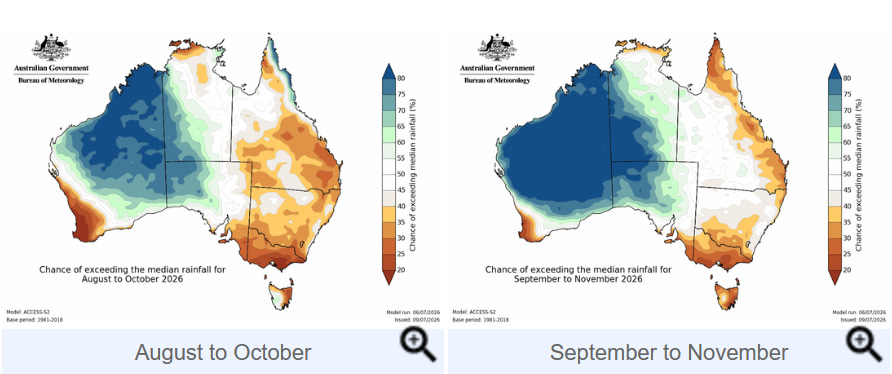
Source: BoM rainfall forecasts ~ August to November 2026
The Hidden Water Thirst ~ Power Generation
The figures above count only direct water used for AI Data Centre cooling.
The full picture is considerably worse.
Training a single large AI model consumes water indirectly through the electricity generation that powers it.
Li et al. estimated that training GPT-3 in Microsoft’s US data centres could consume a total of 5.4 million litres of water, including 700,000 litres of on-site consumption for cooling.
The same study projected that global AI-related water withdrawals could reach 4.2–6.6 billion cubic metres annually by 2027 ~ equivalent to 4–6 times the yearly consumption of Denmark, or half that of the United Kingdom.⁷
Every time you ask an AI chatbot a question, water is consumed.
One AI company’s lifecycle assessment revealed their large language model consumed 281,000 cubic metres of water by January 2025 ~ equal to the annual water consumption of over 5,100 French citizens ~ and delivered 45 millilitres per user prompt.⁵
Forty-five millilitres. Less than a shot glass. Per question.
The commandment ~ that Australian water resources belong to the Australian people ~ is being quietly amended.
No announcement.
No referendum.
Just planning approvals, processed one by one, each individually defensible, cumulatively transforming the continent’s most critical water resources into cooling liquids for foreign-owned AI infrastructure.
Take Home Messages
Australian land, water & infrastructure costs are once again, being given away for free.
AI is a new technology ~ we are on the Cusp of a New Revolution within Information Technology ~ a new Frontier.
We have not adequately planned or properly quantified the costs.