

Nobody could ever forget the Iconic Aussie Film ~ The Castle ~ where a family living next to Melbourne’s Tullamarine International Airport, are threatened with the compulsory acquisition of their home ~ their Castle.
Source: edited review of The Castle ~ Margaret Pomeranz
Featured are Aussie colloquialisms, such as « that’s going straight to the poolroom,» and « tell em their dreamin’,» the audience is also introduced to « how’s the serenity?»
When Audible « Noise » ~ Defeats Serenity
Water is the resource impact most people understand.
Noise is the impact people who live near data centres understand.
The human audible hearing range graphic from research gate show us;
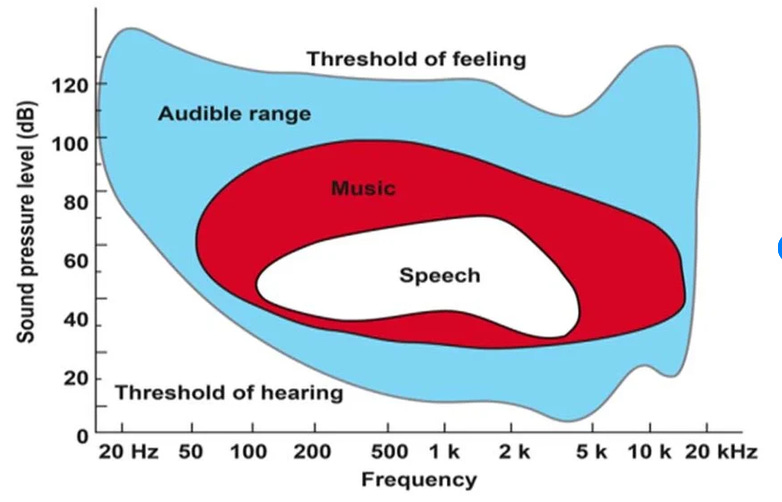
A data centre is an industrial facility housing tens of thousands of servers, each generating heat, each requiring cooling, each contributing to a combined acoustic output that operates without pause, without weekend breaks, without night-time quietude or serenity ~ 24 hours a day, 7 days a week, 365 days a year.
It will not only be the Loss of Serenity that is of concern.
Loss of Hearing is already a critical issue in the modern world.
Advances in scientific & acoustic instrumentation together with understanding about Noise & its anatomical & physiological effects enables enforcement of Internationally acceptable Standards.
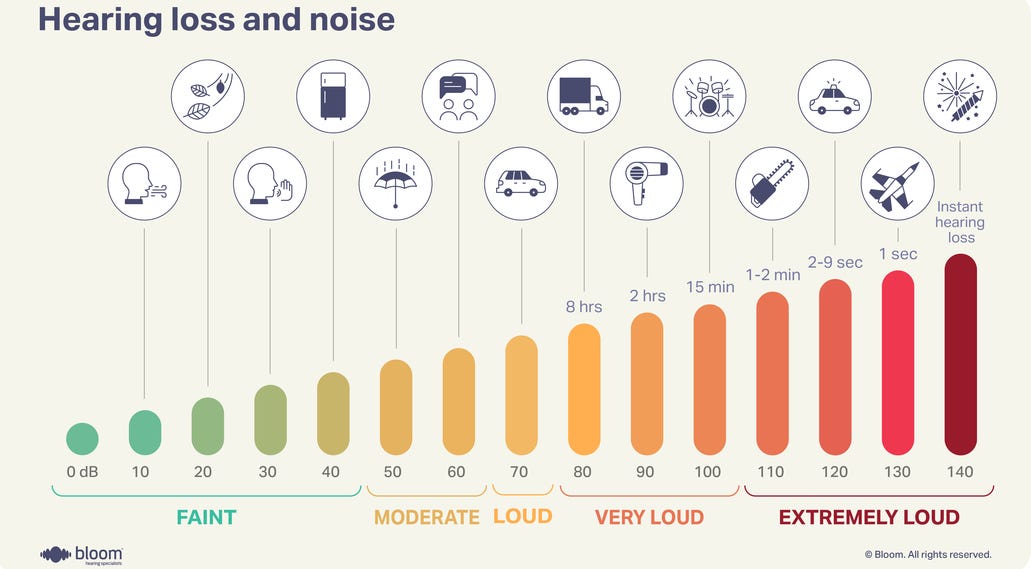
Safe Work Australia has provided this excellent infographic about Noise Issues.
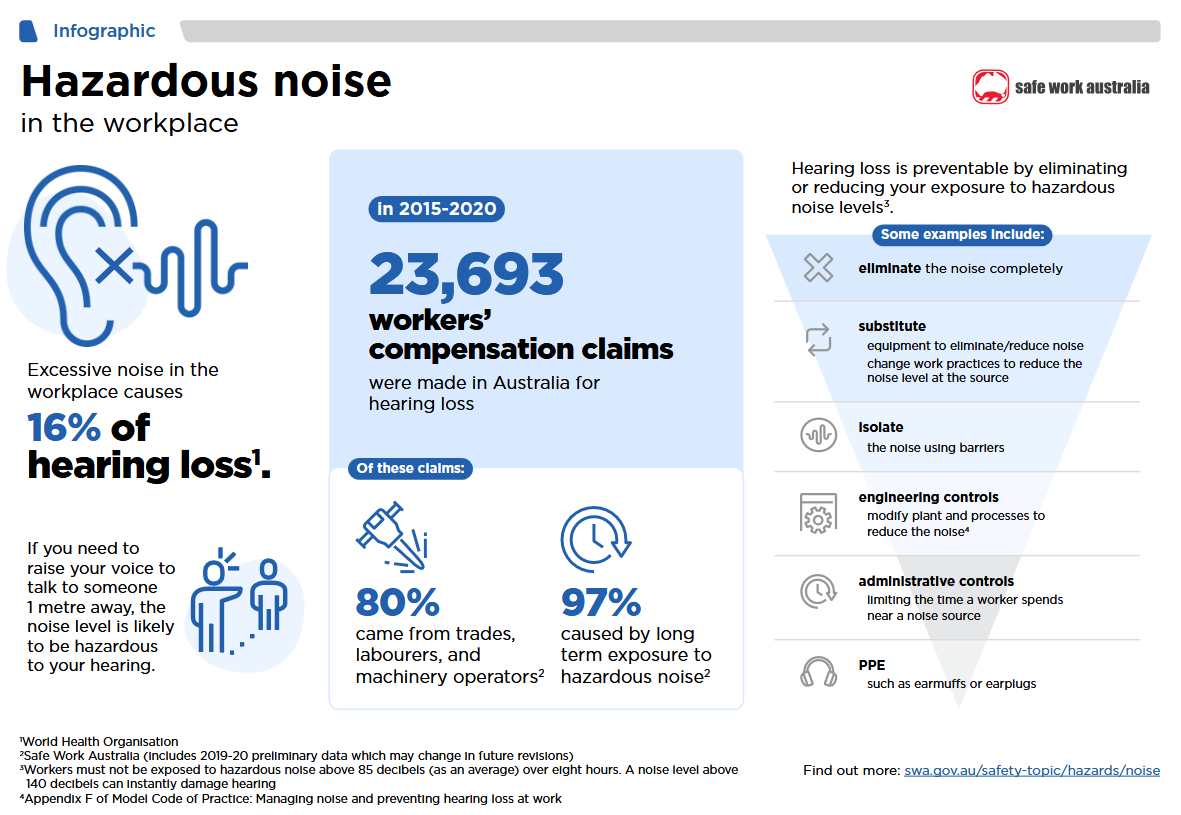
Data Centre Corporations & Australian Parliaments are advised to urgently review their Future Plans in respect of these compensation risks BEFORE they end up in Court, particularly in reference of this statistic.

The Environmental and Energy Study Institute noted that high and low-frequency sounds emitted by these industrial sites can be heard and felt for hundreds of metres in surrounding areas, with noise levels reaching as high as 96 dB for 24 hours a day and seven days a week.⁸
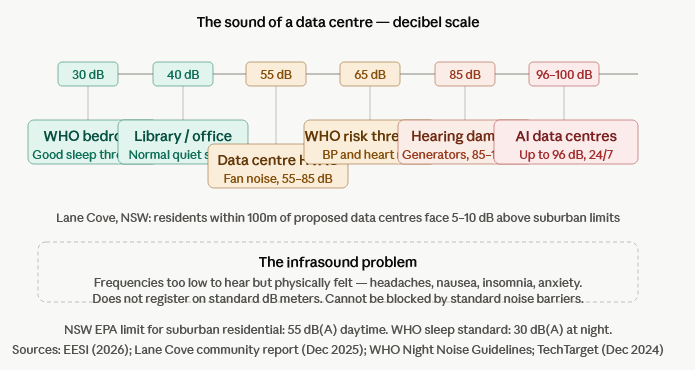
For context: safe sound levels are considered to be 70 dB(A) or lower. Sounds above 65 decibels are enough to cause an increase in stress and blood pressure.
High noise levels, particularly at night, can cause sleep deprivation and decreased cognitive performance.⁹
The World Health Organisation recommends community noise levels below 30 dB(A) in bedrooms at night for good-quality sleep.¹⁰
HVAC fans in data centres generate noise levels ranging from 55 to 85 dB(A). Small generators run at about 85 dB(A), while larger generators run closer to 100 dB(A).¹¹ Data centres require backup generators that are tested regularly — and run continuously during outages that can last days.
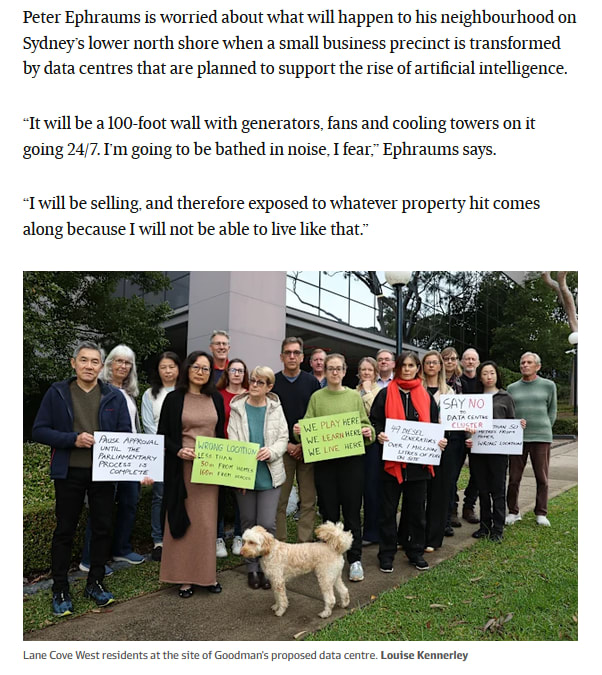
In this 29 JUNE 2026, report by Lucy Slade in the Financial Review, Lane Cove residents are already facing the Unbridled Rush to Build Data Centres.

When Inaudible «Infrasound» ~ Defeats Serenity
It is not just audible sounds that cause people problems.
Inaudible sound waves within the Infrasound range cause vibrational pressure waves that have already been proven to have serious harm to sleep & well-being.
This video below, from CurioMed, entitled « The Most Dangerous Sound for Humans ⚠️ | Infrasound Explained,» provides clarity.
Infrasound is inaudible to humans but the vibrations can easily be felt.
Communities living near data centres report headaches, insomnia, nausea, and anxiety ~ symptoms that do not register on standard decibel meters and cannot be addressed through standard noise barriers.⁸
This matters enormously for the regulatory framework. If a noise is inaudible, it cannot be measured by standard monitoring equipment.
If it cannot be measured, it cannot be regulated.
If it cannot be regulated, it cannot be remedied. Residents who experience it are told there is no problem ~ because the instruments say so.
In Lane Cove, a Sydney suburb with three data centres within 600 metres of each other ~ including facilities adjacent to residential areas and a childcare centre ~ the community has been grappling with exactly this problem.
The decibel count in some affected areas will be 5 to 10 decibels above the NSW EPA’s suburban residential limit.¹⁰
The sound these hyperscale facilities make has been likened to a humming refrigerator, piercing low vibrations through air, streets, and walls.
In a World first, Australia’s Administrative Appeals Tribunal (AAT) has declared that the «noise annoyance» caused by wind turbine generated low-frequency noise and infrasound «is a plausible pathway to disease» based on the «established association between noise annoyance and some diseases, including hypertension and cardiovascular disease, possibly mediated in part by disturbed sleep and/or psychological stress/distress.»
The AAT also held that « The dB(A) weighting system is not designed to measure [wind turbine noise], and is not an appropriate way of measuring it.»
The dB(A) weighting system is the basis of every wind turbine noise guideline in operation around the world.
The AAT’s finding means that every one of those noise guidelines is premised on an acoustic nonsense and, therefore, entirely irrelevant.
NB: Despite these findings of credible reports by Acousticians ~ scientifically qualified people within the Acoustics Industry ~ bogus claims by the Australian Broadcasting Corporation and other entities continue to dismiss any evidence that Wind Farm Infrasound is a Pathway to Disease.
Take Home Messages
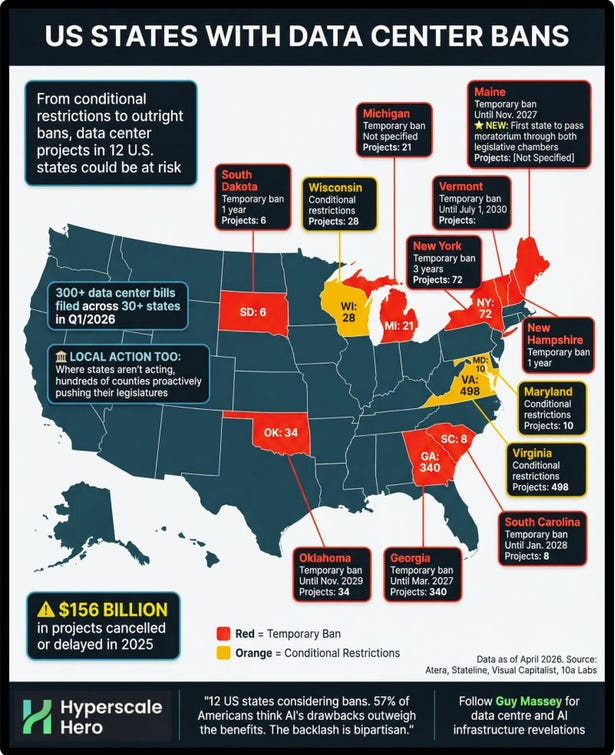
If Data Centres are so good ~ why then are US States Banning them?
Infrasound/Vibrational disturbances have already been chronicled as Pathways to Disease ~ as per Wind Farm experiences.
Consider: There will be many more Infrasound Studies resulting from detrimental health experiences by residents living near Data Centres.
In this Series so far: Land, Water, Weather & Noise have been covered, next up = Power!
Graham, you're onto a real issue, and you're right on one key point: standard A-weighted (dB(A)) limits are a poor way to judge this kind of noise, because they deliberately down-weight low-frequency energy, so a data centre can sit inside its dB(A) limit while the hum is still intrusive indoors. Where the piece goes wrong is the framing around infrasound. True infrasound sits below about 20 Hz; but the drone people actually describe near these sites, the "refrigerator" hum off the cooling plant, fans and transformers, lives mostly in the low-frequency band above that, roughly 50–200 Hz, as it is based on the grid frequency harmonics. That is audible, and it is entirely measurable. The problem isn't that the instruments can't detect it; it's that dB(A) under-represents it. Measured properly, with C-weighting (an LC–LA gap above about 15–20 dB is a reliable red flag), one-third-octave band analysis, an indoor low-frequency assessment and a tonal penalty, low-frequency noise can be characterised, conditioned and enforced at the planning stage. The fix is a better metric and better technology, not the conclusion that it can't be measured or regulated.