

In PART 9 of this Thirst Machines Series, we covered the barrage of Noise from Data Centres that is Destroying the Serenity of communities.
Water and noise are the impacts communities feel.
Electricity is the impact every Australian pays for — whether they live near a data centre or not.
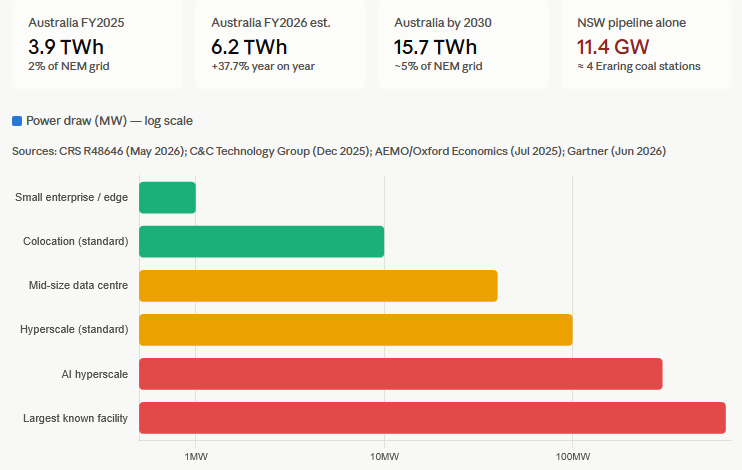
The scale of demand ~ from server room to AI factory
Not all data centres are created equal. Understanding the electricity demands of the sector requires distinguishing between the types of facilities now being approved across Australia at pace.
A small enterprise data centre ~ a facility serving a single organisation’s internal IT needs ~ typically draws less than 1 megawatt of power.²³
A standard colocation facility, housing equipment for multiple business tenants, runs between 1 and 10 megawatts.²³
A mid-size data centre serving regional cloud and storage needs might draw between 5 and 40 megawatts.²³
Then come the hyperscalers.
To qualify as a hyperscale data centre, a facility must contain at least 5,000 computer servers, occupy at least 10,000 square feet, and draw more than 100 megawatts of electric power.²⁴
One hundred megawatts is enough to supply the electricity needs of approximately 80,000 Australian households.²⁴
The largest hyperscale facilities now exceed 650 megawatts — equivalent to the entire output of a medium-sized power station.²⁵
A single facility of that scale consumes 2.4 gigawatt-hours of electricity every single day, running continuously at full utilisation.²⁶
AI has broken every previous model of electricity demand.
Traditional server racks consume 5 to 10 kilowatts.
AI-optimised racks with high-performance GPUs require 60 kilowatts or more ~ with some cutting-edge AI training facilities pushing individual racks to 100 kilowatts and beyond.²⁵
A single AI query uses approximately 0.3 watt-hours ~ roughly 1,000 times more electricity than a Google search.²⁵
Training a single large AI model can require 50 gigawatt-hours of energy ~ enough to power Sydney’s CBD for three days.²⁴
The increase in computing power required for next-generation AI chips is staggering ~ we are talking jumps from four kilowatts per rack to potentially a megawatt per rack.²⁷
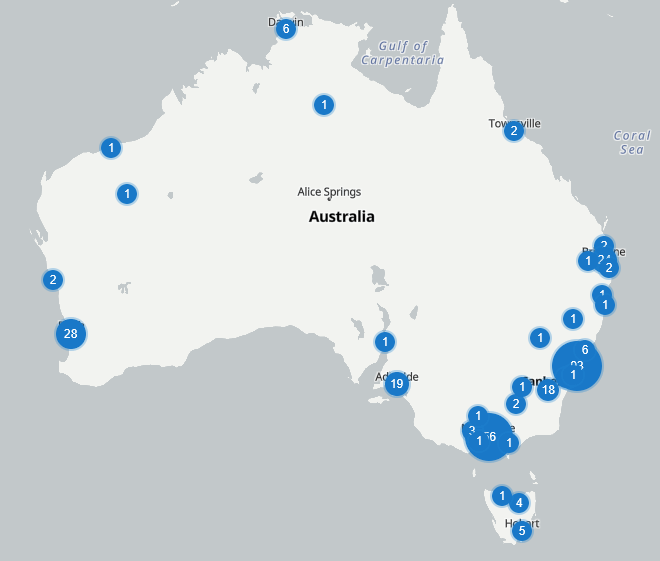
Data Centre Maps ~ Australia
According to Data Centre Maps, there are currently 289 Data Centres listed, as per this map below.
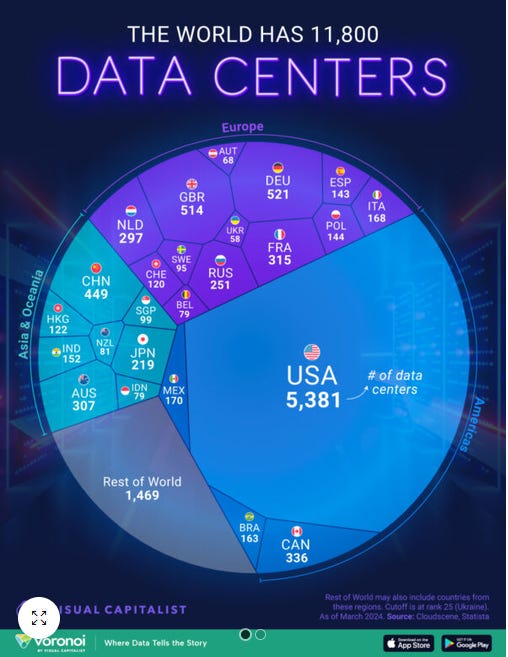
Global Data Centre numbers are staggering ~ according to Visual Capitalist, there were 11,800 in 2024.
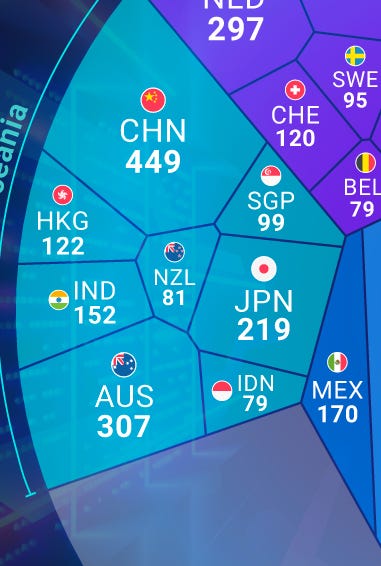
Australian numbers ~ of 307 ~ are closing in on Chinese numbers of 449.
What this means for Australia’s grid
The national figures are already alarming ~ and accelerating.
In financial year 2025, Australian data centres consumed 3.9 terawatt-hours of electricity, representing approximately 2 per cent of the National Electricity Market grid.²⁸
By 2026, consumption is expected to rise 37.7 per cent to 6.2 terawatt-hours.²⁹
By 2030, Gartner forecasts Australian data centre power demand will reach almost 3.8 gigawatts, with electricity consumption reaching 15.7 terawatt-hours.²⁹
Under AEMO’s Step Change scenario, that trajectory continues to 34.5 terawatt-hours by 2050 ~ 12 per cent of the entire NEM grid.²⁸
In NSW alone, 44 data centres in the development pipeline as at 31 March 2026 represent a combined capacity of 11.4 gigawatts ~ equivalent to the power output of nearly four Eraring coal stations, the largest coal power station in Australia.³⁰
Victoria has at least 30 data centres totalling 9 gigawatts in its pipeline.³⁰
AEMO has received 44 gigawatts of data centre connection requests from network service providers ~ a figure so large that Oxford Economics, commissioned by AEMO to investigate, found that 6 in every 7 megawatts of connection requests represent what it termed «phantom demands»: requests unlikely to materialise on the grid under realistic scenarios.³¹
Even so, the genuine demand that does materialise will fundamentally reshape Australia’s electricity system.
The efficiency illusion
The data centre industry’s standard response to electricity demand concerns is the Power Usage Effectiveness metric ~ PUE ~ which measures how efficiently a facility uses the power it draws.
A PUE of 1.0 would be perfect efficiency; all power goes to computing, none wasted on cooling or distribution. A PUE of 2.0 means half of all electricity drawn goes to non-computing overhead.
Modern hyperscalers have achieved remarkable PUE improvements.
Google reports a fleet-wide PUE of 1.09 ~ meaning only 9 per cent overhead.³² Microsoft achieves 1.12.³² These are genuine advances.
The average enterprise data centre, by contrast, operates at a PUE of 1.5 to 1.8, with older facilities often exceeding 2.0.³³
But here is the efficiency illusion: a lower PUE does not mean lower total electricity consumption. A hyperscale data centre consuming 300 megawatts at a PUE of 1.12 uses vastly more electricity than a small enterprise facility consuming 2 megawatts at a PUE of 1.8.
Efficiency improvements at the chip level have been largely offset by the sheer scale of new AI workloads. AWS reports its infrastructure is 3.6 times more energy-efficient than the median US enterprise data centre ~ and it still consumed enough electricity to power tens of millions of homes.³²
Between 2022 and 2026, global data centre energy use more than doubled ~ from approximately 460 terawatt-hours to over 1.1 petawatt-hours per year ~ despite industry-wide PUE improvements.²³
Efficiency and scale are running in opposite directions. Scale is winning.
Who pays for the electricity infrastructure?
The electricity costs of the data centre boom fall into two categories ~ and only one of them is paid by the data centres.
The first category: This is the power itself. Data centres pay for the electricity they consume, negotiated through commercial tariffs or power purchase agreements with renewable energy generators. This is genuine market-based cost recovery.
The second category: This is the grid infrastructure required to connect and service those loads ~ the transmission lines, substations, transformers, and network upgrades needed to deliver electricity to the facilities and maintain grid stability as demand grows.
This is where the sovereign question arises.
Australia’s National Electricity Rules require new facilities connecting to the grid to pay for the infrastructure costs directly caused by that connection.³⁴
Between 2020 and 2025, the data centre sector invested A$3.1 billion in grid infrastructure, including A$500 million in direct connection costs.³⁴
On its face, this appears substantial.
But the Climate Council’s analysis is stark: without appropriate policy settings, data centre growth could place upward pressure on electricity prices for all consumers ~ not just data centres ~ through increased reliance on gas peaking generation during periods of peak AI workload demand.³⁰
A 26 per cent increase in wholesale electricity prices in NSW by 2035 has been modelled if data centres do not bring commensurate new renewable generation with them.³⁰
Wholesale prices make up approximately 40 per cent of a typical household electricity bill. Network costs make up almost half.³⁴
Both are exposed to data centre demand growth.
The connection costs recovered from data centres under existing rules do not capture the system-wide costs of managing a grid under sustained exponential demand growth from a small number of very large commercial users.
The commandment is being rewritten again.
Original: the electricity grid serves the Australian people.
Amended: the electricity grid serves the Australian people, and also 11.4 gigawatts of approved data centre capacity in NSW alone, with household consumers bearing the price consequences of gas peaking generation required to fill the gap between renewable supply and AI demand at peak times.
Report ~ AI data centre boom threatens Australia’s energy transition
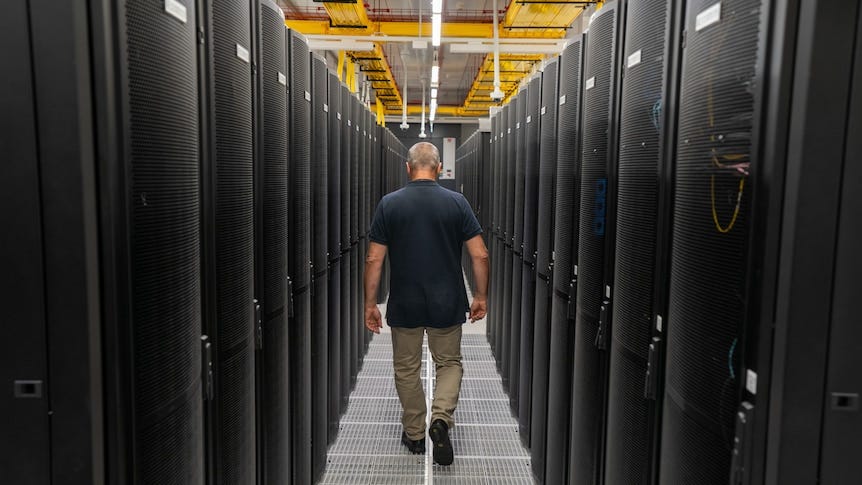
A new report concludes the AI-fuelled surge of power-hungry data centres across Australia is jeopardising the country’s energy transition.
Image of the Eraring Power Station ~ Lake Macquarie, near Newcastle NSW.

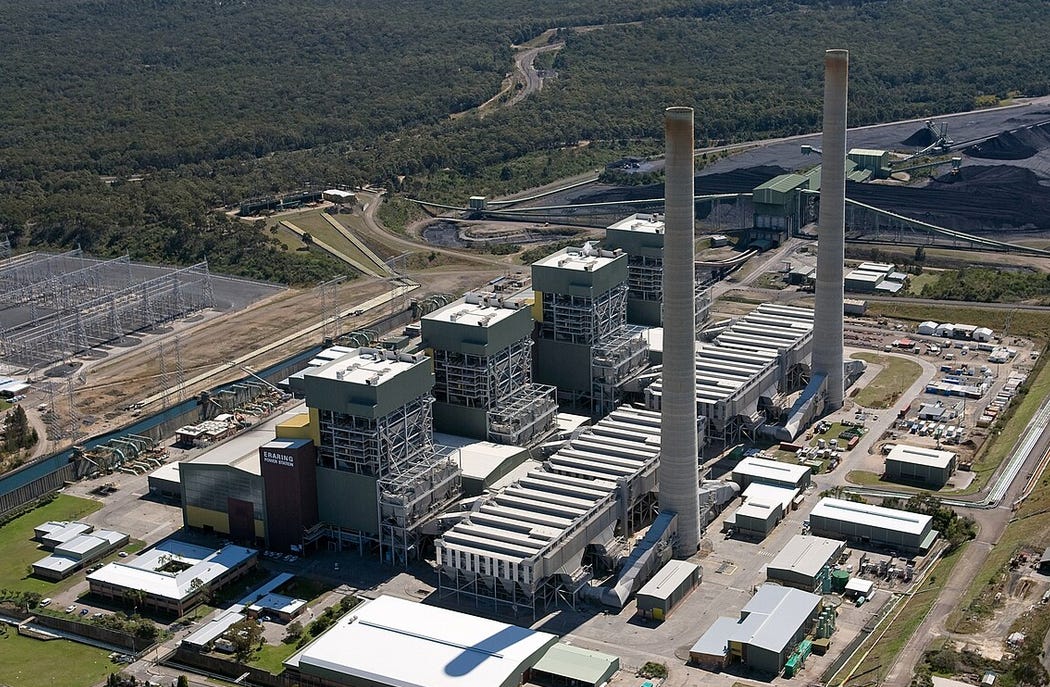
If Australia continues building AI Data Centres, then NSW alone will require 4 more Eraring-sized Coal-fired Power Stations - OR - gas-fired feedstock equivalents.
Take Home Messages
So far we have covered Land, Water, Noise & the Loss of Community Serenity.
The costs of supplying Power to AI Data Centres will be massive ~ there is currently no legislation to ensure that Data Centre owners will fund infrastructure costs.
Next up = the countries that said NO to Data Centres.