

▓ This Osprey report is framed within the Animal Farm allegory. ▓
In this report we introduce readers to Two YouTube videos, which read as if they describe two different tax systems.
In the first, Scott Kuru warns that the capital gains overhaul due in July 2027 will land hardest on people who do not think of themselves as investors: part-time workers, carers, people easing into retirement.1
In the second, Punters Politics argues that Australia’s gas exporters are banking a war windfall that the Commonwealth has chosen not to tax, and that a government short of revenue will look to everyone else.2
Both videos are opinion, and both contain claims Osprey could not verify. But their central arguments survive a check against the Budget papers, industry modelling and Senate evidence.
Together, they raise one question: when the government shifts the economic burden, who is protected and who is left exposed?
The policy mechanics are straightforward.
Starting 1 July 2027, the 50% capital gains tax [CGT] discount for individuals, trusts, and partnerships will be replaced by inflation indexation of the cost base, paired with a new 30% minimum tax on the resulting real gain.3
This change only applies to future gains, leaving pre-July 2027 gains protected under the old discount system. However, pre-1985 assets — previously exempt from CGT entirely — will now be taxed on gains accrued after the start date, and discretionary trusts will face a separate minimum tax.5
Meanwhile, negative gearing will be restricted exclusively to new property builds, grandfathering existing properties held on Budget night.3
The Government argues that taxing only real gains restores the system’s original intent.3 The legislation has now passed both houses, complete with Senate amendments that exempt testamentary trusts and allow certain small-business shareholders to opt into either the old or new regime.6
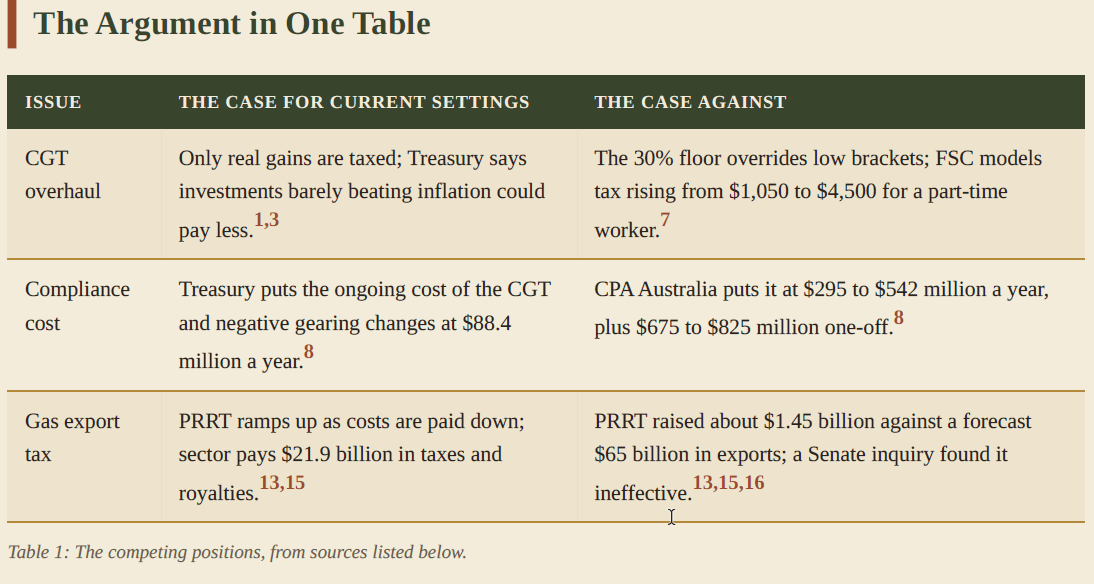
The real Policy Sting is the 30% minimum tax floor. While Treasury notes1 that indexation protects investors whose gains barely beat inflation, the 30% floor overrides lower personal tax brackets.
Consequently, low-income earners are the most exposed.
Modelling by the Financial Services Council highlights this impact:
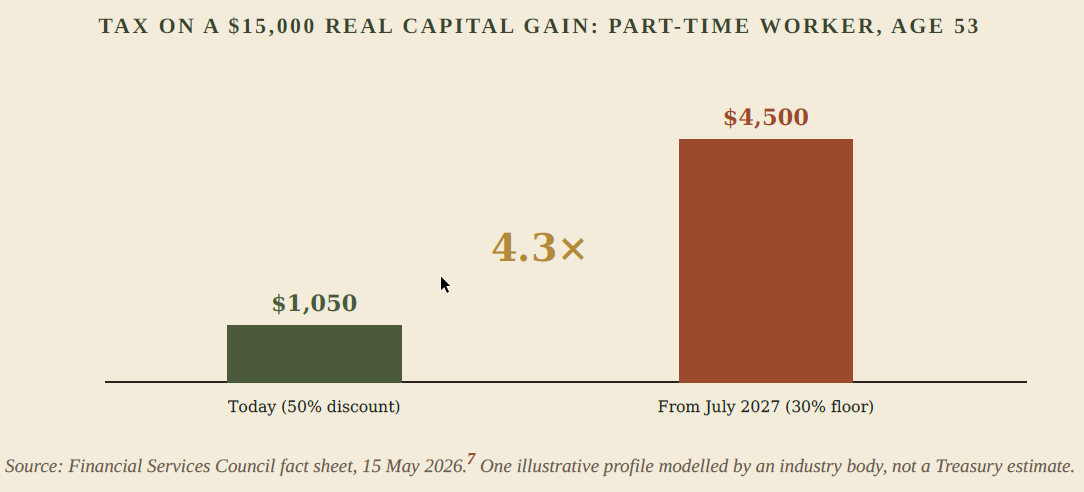
Part-time worker: A 53-year-old working part-time after a redundancy who realises a $15,000 real gain will see their tax jump from $1,050 to $4,500 solely due to the floor.
Young investor: A younger investor holding a diversified ETF portfolio will see their effective tax rate on long-term gains spike from 7% to 19.1%.

The Bill Nobody Counted
Scott Kuru’s second argument is about cost that never reaches the Treasury.
CPA Australia estimates that complying with the tax system costs about $60 billion a year, within a range of $54 billion to $70 billion.
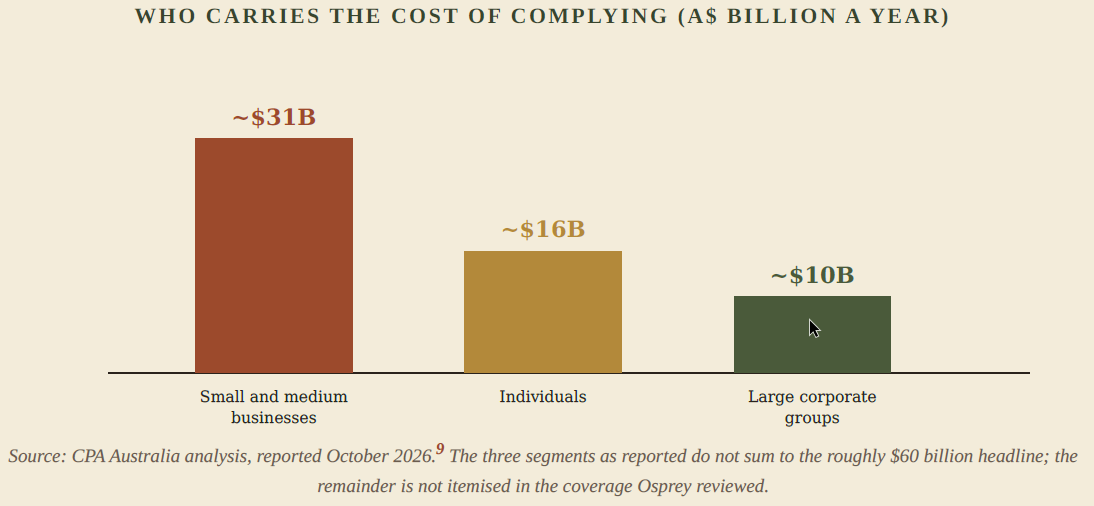
Businesses with turnover under $100 million carry about $31 billion of it, individuals about $16 billion and large corporate groups about $10 billion.9 That is roughly 2% of GDP, and taxpayers spend about $13 complying for every dollar the Government spends administering the system.10,11
A Board of Taxation review into cutting tax red tape, delivered to the Government in June, has still not been released.10
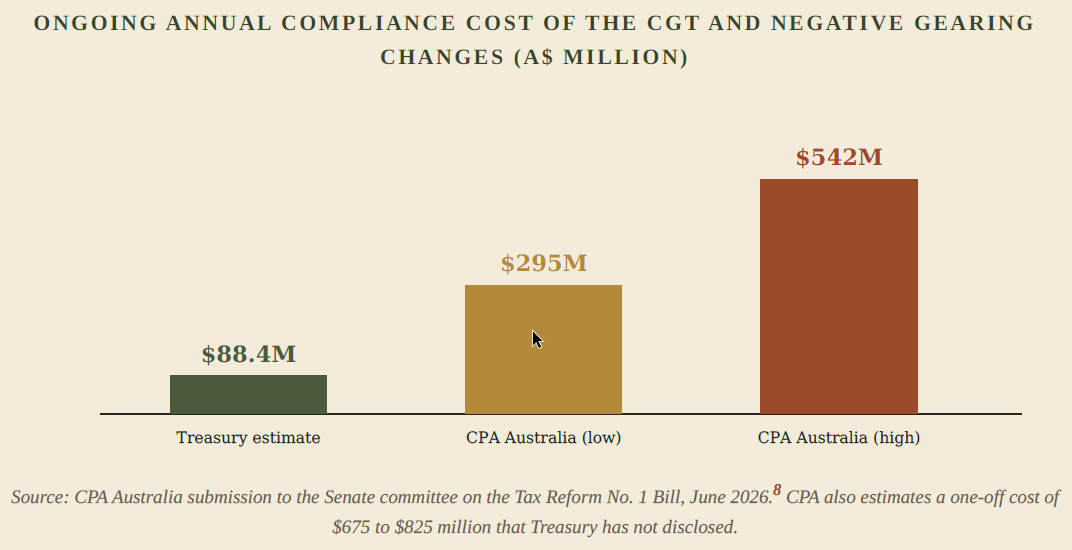
The new CGT rules add to that load, and here two official-looking numbers collide. Treasury’s regulatory impact assessment puts the ongoing cost of the capital gains and negative gearing changes at $88.4 million a year.
CPA Australia’s bottom-up analysis puts it at $295 million to $542 million a year, plus a one-off transitional valuation cost of at least $675 million to $825 million that it says Treasury has not disclosed.8

The Option on the Table
The second video is where the argument turns from Tax Burden to Bonanza alternative.
Punters Politics points to gas, and the numbers behind the claim are real.
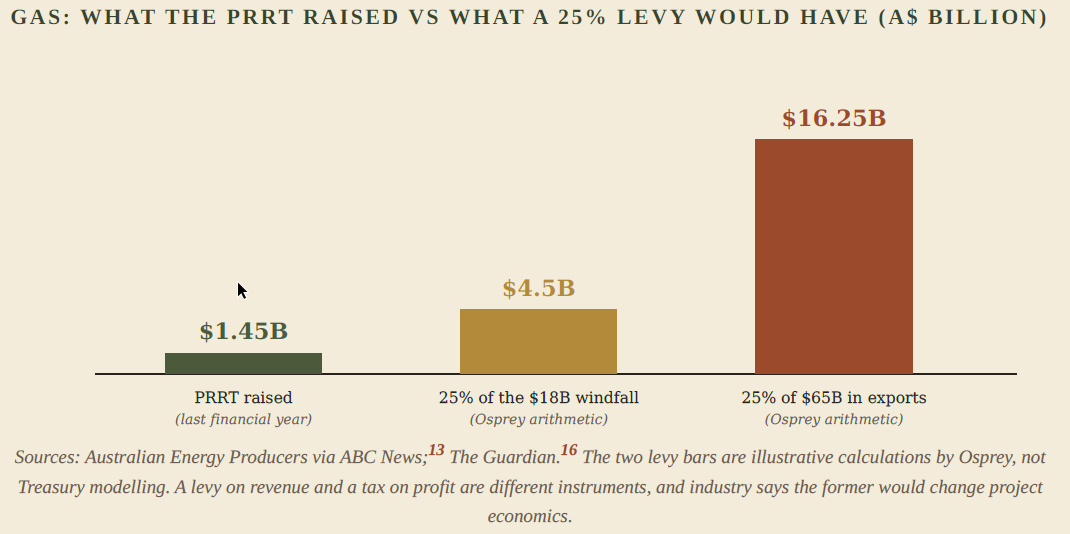
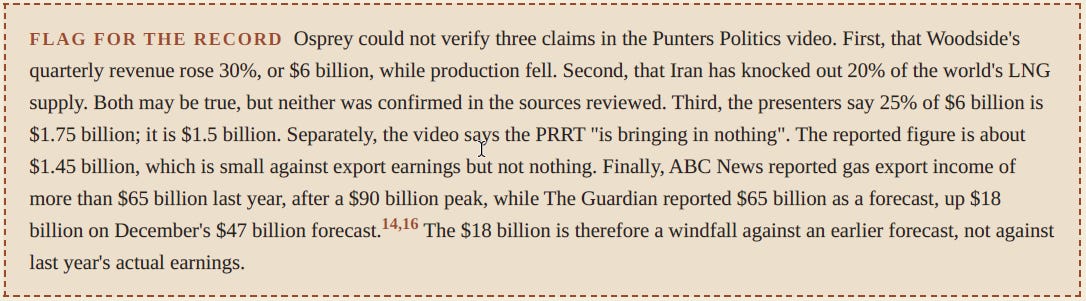
LNG export earnings are now forecast at $65 billion in real terms, against $47 billion predicted last December, an extra $18 billion attributed to the continuing Middle East Conflict - which continues to escalate.16
Against that, the Petroleum Resource Rent Tax, the main levy on offshore gas, raised about $1.45 billion last financial year, according to the industry body Australian Energy Producers.13 Independent senator David Pocock and the Australia Institute campaign for a flat 25% tax on gas exports.
The Prime Minister has called the claim that gas is exported tax-free “disingenuous”, and ruled out a levy before the Budget; a Senate inquiry found the PRRT ineffective, but the Government declined to touch it.13,15
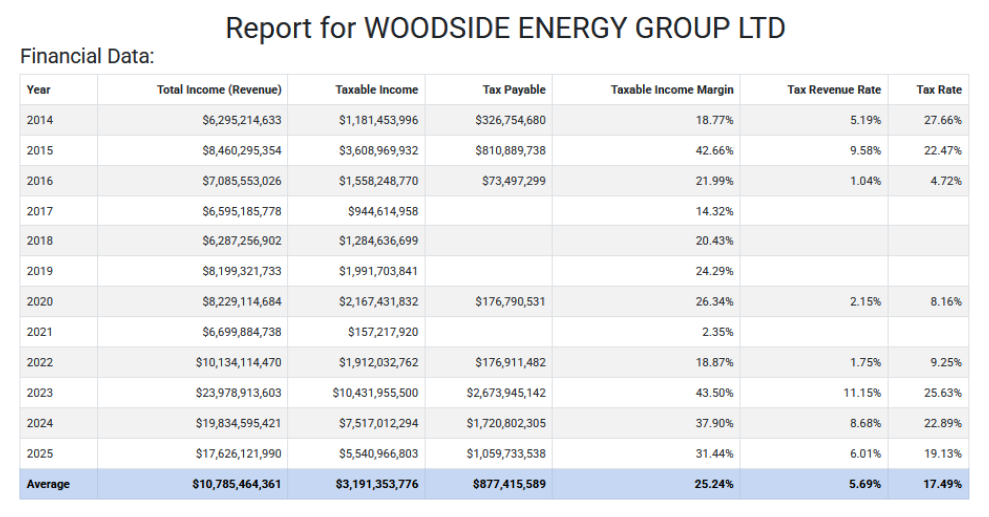
Woodside Energy - average Tax Revenue Rate of just 5.69% over 12 years.
Thanks to Michael West Media - we have the TaxData for Woodside Energy - the largest foreign-controlled participant in Australia’s North-west Shelf Gasfields.

Both sides have a case, and Osprey sets them out plainly. The industry says the sector is already Australia’s second-largest corporate taxpayer, paying $21.9 billion in taxes and royalties last financial year, and Woodside told the Senate a flat 25% export levy would be economically unsustainable and would make its Browse project uneconomic.13,14

The Prime Minister’s position is that the PRRT lets companies recover their investment first and will ramp up as costs are paid down.15
Critics answer that a profit-based tax on a business whose export earnings have been as high as $90 billion has yielded little, and that a windfall created by a war is a fair target.14
The Diesel Fuel Connection
This is where a tax argument becomes a fuel-security story. In the Budget, the Government did not raise gas export taxes, and it had ruled out changes beforehand. SBS reported that LNG exports were reportedly being used as leverage in negotiations with trading partners to shore up liquid fuel supplies, and that Labor was wary of angering key fuel suppliers who rely on Australian gas.15
Osprey’s earlier investigations showed why that logic has force: Australia imports roughly 90% of its diesel, mostly through Asian refiners in countries such as Japan and South Korea, which are also major buyers of Australian LNG.
That connection cuts both ways. If gas is a bargaining chip for diesel, then a gas tax decision is also a fuel decision, and the public deserves to see the trade-off stated openly rather than inferred from a report on what the Government is reportedly doing.
A windfall of this size, and a diesel market this tight, make the question harder to avoid. How much of Australia’s fuel security is being bought with revenue the Government has chosen not to collect, while other taxpayers are asked to supply more?
Does This Smell Like Blackmail?
Who Carries the Windmill?
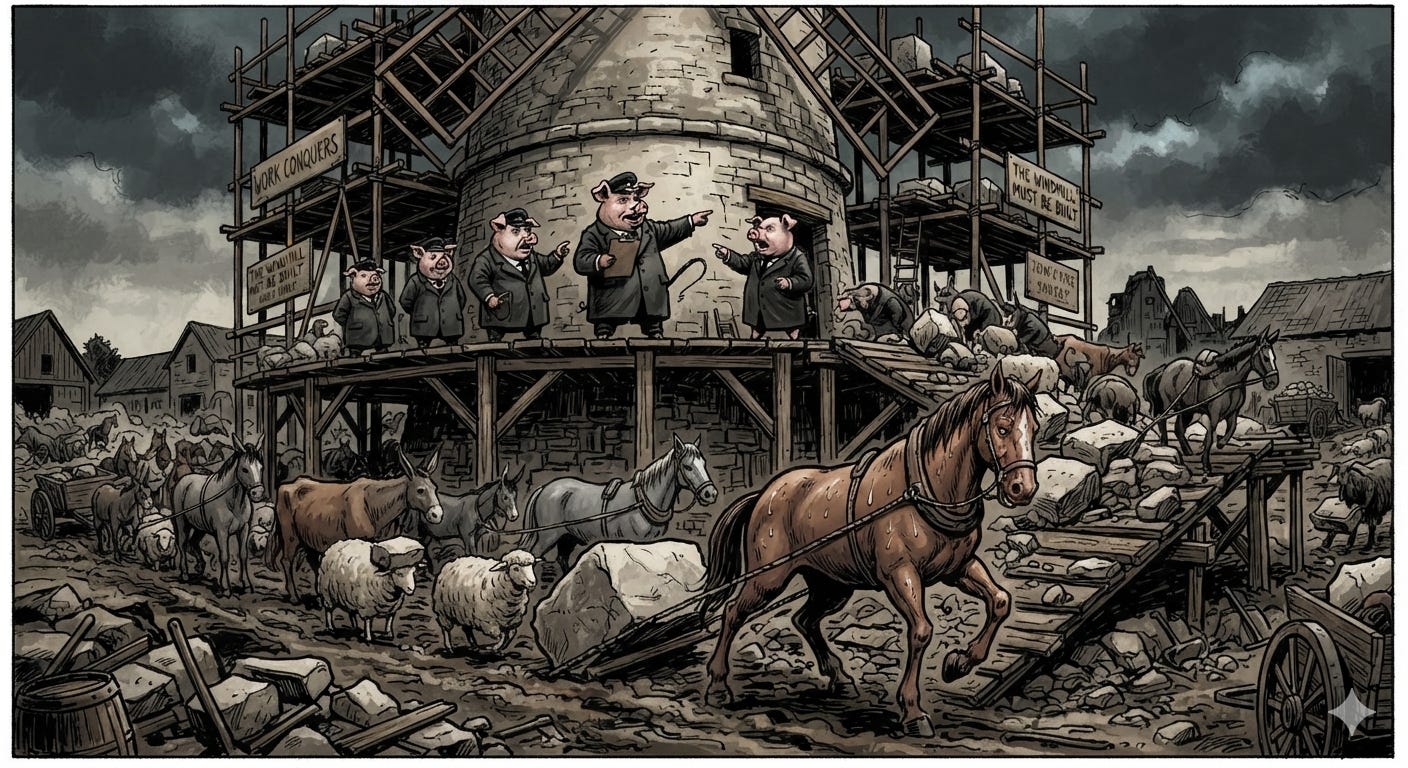

Osprey takes no position on the right rate for any of these taxes.
The question is consistency.
A system that puts a hard floor under the gains of a part-time worker, leaves the cost of its own tax-reporting complexities unmeasured, and declines to touch a war windfall, will always invite the charge that its principles are already crippled & it depends upon who is holding the the “Diesel Gun to Australia’s Head.”
The Government should answer that charge, and the evidence above suggests it has answers on at least two of the three counts, but chooses to keep the Voters in the Dark.
What it has not yet done is publish the Board of Taxation review, reconcile its compliance estimate with the accountants’, or explain in public what, if anything, gas tax policy is being traded for in the fuel market.
The Bedout Basin & Dorado Blueprint — Mapping the Sovereign Liquidation

Prologue: The Golden Egg and the Ledger of the Foxes
The Bedout Basin Dorado Oil Discovery —> Will this Hydrocarbon Bonanza be Handed over to Foreign Multinational Corporations, just like all of our others?
Sources
“What Is Canberra Thinking?! They Just Made It 400% More Expensive For Everyday Aussies To Invest!” Scott Kuru, YouTube. youtube.com
“Albo Is Doing Nothing While Gas Companies Cash In On THIS.” Punters Politics, YouTube. youtube.com
“Tax reform: A better tax system for workers, first home buyers and future generations.” Australian Government, Budget 2026-27. budget.gov.au
Treasury Laws Amendment (Tax Reform No.1) Bill 2026 and related Bill, Bills Digest. Parliament of Australia. aph.gov.au
“Federal Budget 2026-2027: tax snapshot: the game has changed, how to pick up the pieces.” Lexology. lexology.com
“The Treasury Laws Amendment (Tax Reform No.1) Bill 2026: Tax Update.” KordaMentha. kordamentha.com
“FSC Fact Sheet: Impact of CGT changes on investors.” Financial Services Council, 15 May 2026. fsc.org.au
“Submission to Senate Committee on Tax Reform No. 1 Bill.” CPA Australia Tax News, 11 June 2026. cpaaustralia.com.au
“Tax red tape costs Australians $60 billion a year, CPA Australia says.” Broker News, October 2026. brokernews.com.au
“Tax red tape taking ‘disproportionate’ toll on small businesses.” Financial Newswire, 8 October 2026. financialnewswire.com.au
“Tax reform measures risk adding to red tape burden: CPA Australia.” Accountants Daily, October 2026. accountantsdaily.com.au
“Multi-millionaire founder moves to Singapore to escape Aussie tax changes: ‘We’re done’.” Yahoo Finance Australia, October 2026. au.finance.yahoo.com
“Gas giant Woodside says additional tax on gas exports would kill projects at Senate inquiry.” ABC News, 24 April 2026. abc.net.au
“Why the gas tax momentum is building as Australia looks to properly cash in on its abundant natural resources.” ABC News, 24 April 2026. abc.net.au
“’No one seems to know’: Albanese dismisses gas export tax hike calls as ‘slogans’.” SBS News, May 2026. sbs.com.au
“Australia’s largest gas exporters set to reap $18bn war-driven windfall, reigniting calls for 25% gas tax.” The Guardian, republished by The Point, July 2026. thepoint.com.au