

Prologue: The Golden Egg and the Ledger of the Foxes
On the windswept coastal plains of the Pilbara, the animals of the Northern Ridge stood at the boundary line, staring out across the shifting gray waters of the Roebuck Shelf. Far out on the horizon, where the sea met the sky, the great steel ribs of the Dorado extraction rig rose like a foreign citadel.

The animals had cheered. They had willingly approved the clearance of the state pastures, authorized the construction of the deep-water harbor at Port Hedland, and watched in silence as the farm’s central committee quietly funneled eight hundred million bushels of public grain to pave the access roads and secure the logistics pipelines. They called it an “Investment in National Cohesion.”
But as the Final Investment Decision of 2026 approached, the gatehouse was no longer manned by the animals. It was occupied by the sleek, sharp-eyed foxes of the Santos Syndicate, alongside the silent, meticulous clerks of the OPIC Directorate who had flown in from across the northern seas.

“Comrades!” Squelcher the Fox cried, his tail whisking side to side with frantic enthusiasm. “A triumph of regional partnership! The Great Dorado Citadel is active. Wealth is pumping across the export flange this very hour!”
“But where is our share of the milk?” bleated a young ewe, peering over the fence at the massive foreign shuttle tankers hooking up directly to the floating production valves. “The silos are still empty. The price of fuel at the farm pump has doubled.”
Squelcher skipped nimbly from one foot to the other, a sympathetic smile plastered across his foxy snout. “Patience, comrades, patience! The laws of the Petroleum Resource Rent Ledger are clear, though admittedly too complex for the simpler minds among us. You see, the foxes had to spend immense capital exploring the distant, barren fields of the southern marshes years ago. Under the sacred rules of Tax Pooling, those old losses must be fully compensated before any new surplus can be recorded here.”
The lease costs are extraordinarily high — it takes every single drop of extracted revenue just to pay the rent! If we force them to pay a direct royalty on the gross value, the foxes will simply pack up their steel tower and leave us with nothing but empty ocean."
The animals looked from Squelcher’s ledger to the sleek, un-taxed tankers sailing effortlessly into the northern horizon, completely bypassing the mainland. Then they
looked back at the vast public debt incurred to build the harbor, and then at the sopping-wet chickens in their monsoon-damaged coops.

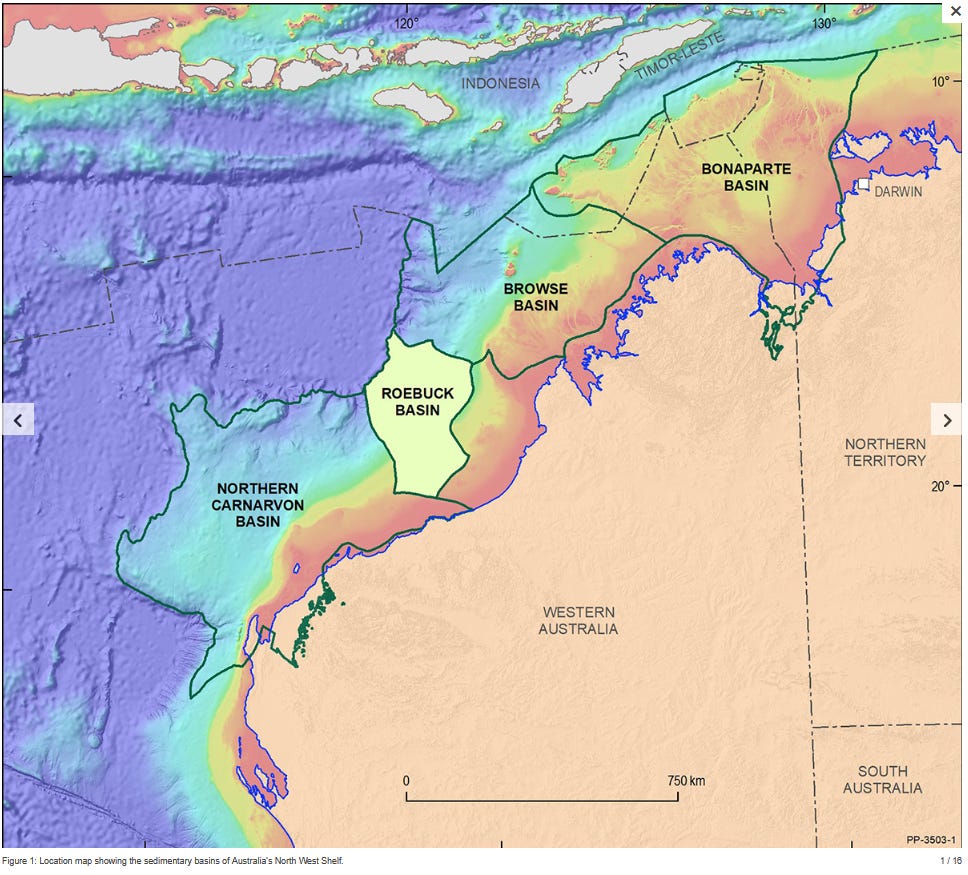
Located approximately 140 kilometres north-north-east of Port Hedland in Western Australia, the Bedout Sub-Basin hosts the Dorado discovery — Australia’s largest undeveloped offshore oil find in over three decades.
As the joint venture pushes toward a Final Investment Decision [FID], the geopolitical backdrop of September 2026 exposes a staggering reality — while global middle distillates collapse due to the ongoing maritime sieges at the Bab al-Mandeb, Australia continues to function on an artificial energy calm.
The nation celebrates the systematic destruction of its domestic refining sovereignty, while underwriting entirely private, untaxed resource ventures.
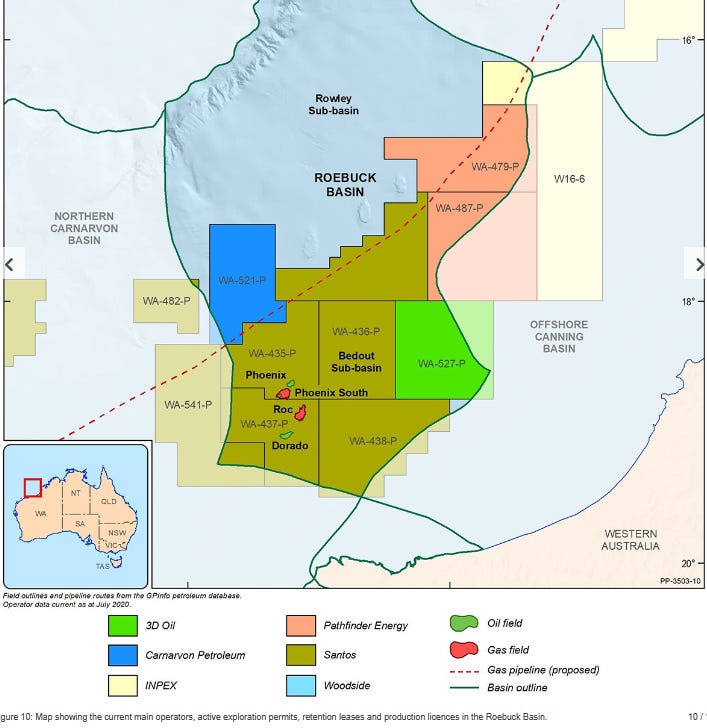
Source: geoscience australia
The Resource Profile
The Bedout Sub-Basin is not an experimental frontier; it is a proven, high-yield petroleum province.
The Dorado Core: Holds an estimated 250 million barrels of recoverable oil.
The Satellite Framework: Discoveries at the Pavo-1 and Roc structures have confirmed major shallow-water oil and gas tie-back capabilities, scaling the total economic potential of the basin significantly higher.
Other reports claim unrisked prospective resource estimates of 9 Tcf of gas and 1.6 billion barrels of liquids [Pmean, gross].
The Logistics Matrix: The crude is slated to be extracted via a dedicated Wellhead Platform [WHP] tied back to a permanently moored Floating Production Storage and Offloading [FPSO] vessel.
From the FPSO, shuttle tankers will hook up directly to the export flange, bypassing the Australian mainland completely to unload 100% of the asset directly into international trade routes.
Transfer Pricing via Floating Infrastructure
Because Dorado utilizes an FPSO-based extraction model, it creates an ideal vector for Transfer Pricing. The local operating joint venture can lease the specialized offshore infrastructure, rigs, and support vessels from their own international parent companies or shell entities based in tax-neutral jurisdictions.
By artificially inflating these intra-group marine logistics costs, the consortium drives local operating expenses up to the exact ceiling of gross revenues. Profits are successfully scrubbed out of the Australian legal jurisdiction and re-emerge as untaxed corporate income in global maritime havens.
Slaying the Golden Goose — The Three-Way Fiscal Mirage
To comprehend how Western Australia is being systematically positioned to receive zero meaningful royalties or taxes on this multi-billion dollar asset, we must directly contrast Australia’s tax structures against the global benchmarks of international resource management.
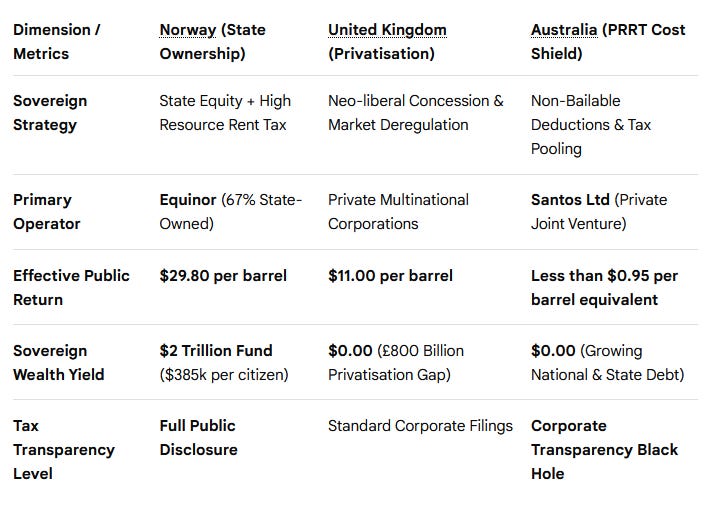
Direct Effective Tax Revenue Comparison
When multinational corporate syndicates extract a nation's finite resource wealth, the return to the public balance sheet is dictating by the fiscal regime's design.
The stark divergence in sovereign wealth retention is highlighted below:
The PRRT Exploded Loophole
The core engine behind Australia's complete fiscal failure is the Petroleum Resource Rent Tax [PRRT].
Unlike standard gross royalties, the PRRT is a profit-based tax.

Under this regime, Santos and its joint venture partners — Carnarvon Energy and OPIC Australia — are legally permitted to "pool" and compound exploration credits year-over-year.
This means Santos can take billions of dollars in failed or ongoing exploration costs from completely different basins across Australia and write them all off against the direct profits generated by the Dorado oil field.
The result is an artificial & cunning legal accounting loss that pushes any meaningful tax payments decades into the future, long after the primary reserves have been depleted.
The WA Resource Sovereignty Act — A Blueprint for Redress
To prevent the Bedout Sub-Basin from mirroring the catastrophic $800 million Perdaman taxpayer giveaway — where public money bears the loan infrastructure risks while billionaire family enterprises and invisible corporate entities reap
$77 Billion in untaxed lifetime revenue — Western Australia must deploy immediate statutory interventions.
Below is the definitive legal framework and legislative text required to insulate the state’s resources from corporate plunder.
### WESTERN AUSTRALIA RESOURCE SOVEREIGNTY ACT (2026)
#### PART II: FISCAL COMPLIANCE, PROPERTY TITLE, AND PUBLIC EQUITY MANDATES
An Act to establish non-negotiable state equity benchmarks, enforce gross value financial visibility over offshore hydrocarbon extractions, and invalidate transfer-pricing frameworks.
Clause 1.1: Absolute Inalienable Title of the Crown
(a) Notwithstanding any prior exploration permits, retention leases, or production licences granted under Commonwealth or State frameworks, all Hydrocarbons within the Bedout Sub-Basin [including exploration zones WA-437-P and contiguous areas] remain the exclusive, inalienable property of the State while in the ground.
b) Property and title to said Hydrocarbons shall not transfer to any corporate entity until the physical resources cross the wellhead flange of the designated production facility.
Clause 1.2: Mandatory Public Equity Pipeline
(a) No Final Investment Decision [FID] regarding the Dorado development or satellite discoveries shall be legally recognized or permitted to proceed without the mandatory insertion of a fifty-one percent [51%] public equity stake held directly by a newly established, State-run entity: Western Australia Energy Sovereign Holdings [WAESH].
(b) Funding for the State's equity allocation shall be financed exclusively through a "Carried Interest" structure, paid out entirely from the project’s future gross production share, requiring zero up-front capital exposure from the Western Australian taxpayer.
Clause 1.3: Anti-Shielding Gross Value Royalties
(a) A non-deductible Sovereign Resource Rent Royalty of twenty-five percent [25%] is hereby levied on the gross market value of all hydrocarbons extracted from the Bedout Sub-Basin.
(b) This royalty shall be calculated at the point of extraction before the application of any corporate deductions, intra-group equipment leasing expenses, accumulated PRRT tax pooling credits, or capital expenditure write-offs.
Failure to remit payment within thirty [30] days of extraction shall trigger an immediate suspension of operational permits.
Clause 1.4: Mandatory Domestic Market Obligation [DMO]
(a) The Joint Venture partners shall legally redirect twenty percent [20%] of daily physical crude oil extraction to domestic storage facilities located on the Western Australian mainland to shore up liquid fuel logistics and national defense security reserves.
(b) Pricing for this DMO volume shall be hard-pegged at fifty percent [50%] of the prevailing Singapore Gasoil front-month time spread index, eliminating international premium inflation for local infrastructure networks.
Enforcing the Doctrine of Frustration
Should the corporate consortium threaten legal litigation under existing fiscal stability clauses, the State can actively invoke the Doctrine of Frustration — Codelfa Construction Pty Ltd v State Rail Authority of New South Wales [1982] — as referenced in the historical regional precedents.
The state can legally assert that the September 2026 global energy grid collapse—marked by record nominal breakouts in distillate pricing, total maritime blockades around critical shipping routes, and the complete failure of the Department of Home Affairs’ national fuel risk models — constitutes a fundamental, radical change in geopolitical circumstances.
Because the baseline assumptions of domestic energy stability have been shattered, the original terms of the exploration concessions no longer reflect the public interest. The state holds the definitive legal leverage to declare the past agreements frustrated, demanding a total renegotiation of the Bedout Basin terms before a single drop of oil is plundered from Port Hedland or any other oil transit facility — onshore or offshore.
Authoritative Sources & Reference List
1. Project Specifications & Operational Frameworks
The Dorado Production Footprint: Review the official government geological, environment and safety approvals detailing the subsea infrastructure layouts via the NOPSEMA Dorado Development Offshore Project Proposal.
Joint Venture Resource Profiles: Track the commercial reserve estimates, drilling timelines, and regional tie-back strategies directly through the Carnarvon Energy Bedout Basin Project Hub and the operator’s portfolio via the Santos Limited Dorado Project Overview.
2. Fiscal Infrastructure & Subsidisation Precedents
The Public Underwriting Template: Examine the data tracking how public money is leveraged to de-risk multi-billion dollar private industrial ventures by reviewing the structural allocations on the Northern Australia Infrastructure Facility (NAIF) Project Registry.
Corporate Tax Transparency Datasets: Cross-examine the annual revenue declarations against actual corporate income tax paid by looking at the official tracking reports hosted on the Australian Taxation Office (ATO) Corporate Tax Transparency Portal.
3. Sovereign Accountability & Legal Precedents
The PRRT Policy Analysis: Read independent economic evaluations on how tax pooling and exploration compound credits systematically delay public revenue collection via the Australia Institute Research Library.
The Legal Precedent for Contract Frustration: Review the High Court of Australia’s definitive ruling on how radically altered external environments can invalidate original contract parameters via the Australasian Legal Information Institute (AustLII) - Codelfa Construction v State Rail Authority.