

In PART 4 of the Animal Farm series, we covered the sale of SANTOS to foreign interests.
In this report, we discover that the Gas pipelines and Electrical distribution networks have also been handed over to Foreign Entities.
Original Rule: « No animal shall sleep in a bed.»
Later: « No animal shall sleep in a bed with sheets.»
Later still: «Four legs good, two legs better.» — George Orwell, Animal Farm
There is a question Australians almost never ask, despite the answer affecting the price we pay for gas, the security of our energy supply, and the sovereignty of the ground beneath our feet.
Who owns the pipes?
Not who owns the gas fields — that story, as readers of this newsletter know, is grim enough. But who owns the infrastructure through which Australian gas travels from wellhead to household? Who controls the arteries of the east coast energy market? Who collects the tolls every time Australian gas moves through Australian land to reach an Australian stove?
The answer involves a Chinese state-owned enterprise, a Hong Kong billionaire’s conglomerate, American index funds, and a series of regulatory decisions made quietly enough that most Australians have no idea they happened.
The pipeline network was built by Australians, for Australians, on Australian sovereign land. It is now, in large measure, owned by foreign interests — some of them among the most powerful state and private actors on the planet.
« The animals built the roads. They just forgot to keep the title deeds.»
The Original Commandment
Original Commandment:
« Infrastructure built to serve the Australian people shall remain in Australian hands.»
Australia’s east coast gas pipeline network was built over decades through public investment, regulatory frameworks, and the patient work of state-owned utilities;
The South Australian Gas Company, est. 1861,
The Brisbane Gas Company, est,
The Moomba to Sydney Pipeline, connecting the Cooper Basin to the eastern seaboard.
These were public assets. They were built with public money, under public mandate, to serve a public need.
The commandment was simple: essential infrastructure serves the people.
Then came privatisation.
Then came the foreign buyers.
Then came the rewriting of the Rules and Commandments!
The Privatisation Decade (1990s–2000s)
Commandment — first amendment:
« Infrastructure built to serve the Australian people shall remain in Australian hands.»
« Infrastructure built to serve the Australian people shall remain in Australian hands, unless a private buyer can demonstrate efficiency gains, at which point the public interest shall be served by competitive market forces.»
The privatisation wave that swept through Australian state governments in the 1990s and early 2000s did not announce itself as a surrender of sovereignty. It announced itself as a modernisation ~ a clearing out of inefficient government-owned utilities, a liberation of capital, a commitment to markets.
State governments, often carrying large debt burdens and facing pressure from the same Washington Consensus ideology that was reshaping developing nations globally, sold off gas networks, electricity distributors, and pipeline infrastructure one by one.
Victorian gas networks. NSW gas distribution. South Australian assets. Queensland pipelines. All floated, sold, or leased — typically to infrastructure funds seeking long-duration, regulated returns: the most reliable toll roads in the energy system.
At the time, most buyers were Australian or at least Western. The first-generation buyers often included Australian superannuation funds, listed infrastructure vehicles, and international infrastructure managers with no particular strategic interest in the assets beyond their yield.
This seemed manageable. The commandment had been amended, but the new owners were at least legible.
That would not last.
The Li Ka-Shing Acquisition [2014–2018]
Commandment — second amendment:
“Infrastructure shall remain in Australian hands.”
« Infrastructure shall remain in responsible hands, as determined by the Foreign Investment Review Board, which shall apply a case-by-case assessment with no overarching framework for what constitutes critical sovereign assets.»
Hong Kong billionaire Li Ka-shing ~ through his infrastructure vehicle CK Infrastructure Holdings, a publicly listed conglomerate on the Hong Kong Stock Exchange ~ had been watching Australia’s privatisation wave with considerable interest.
CKI’s strategy was methodical. Patient. Entirely consistent with the Orwellian principle: don’t take everything at once. Take pieces.
Let each approval make the next one harder to refuse.
In 2014, CKI acquired Envestra ~ now Australian Gas Networks ~the distribution network delivering gas to over 1.4 million homes and businesses across South Australia, Victoria, Queensland, New South Wales, and the Northern Territory. FIRB approved it.
In 2017, CKI acquired the entire DUET Group ~ combining the Dampier Bunbury Pipeline, Australian Gas Networks, and Multinet into the Australian Gas Infrastructure Group ~ the entity now controlling around 34,000 kilometres of gas distribution network and over 3,500 kilometres of transmission pipelines across the country. FIRB approved it.
CKI’s Australian portfolio now included, among other assets, Powercor, CitiPower, United Energy ~ some of Victoria’s largest electricity distributors ~ alongside the gas distribution networks already acquired.
Then, in 2018, emboldened by repeated approvals and leading a consortium including CK Asset Holdings and Power Assets Holdings, CKI made its largest move: a A$13 billion bid for APA Group ~ Australia’s largest gas pipeline operator, owner of 15,000 kilometres of transmission pipelines representing 56% of the national gas transmission network, including 74% of NSW and Victorian pipelines.
Had it succeeded, a single Hong Kong conglomerate ~ ultimately controlled by one of Asia’s wealthiest families ~ would have owned the dominant share of Australia’s entire east coast gas pipeline grid.
The Foreign Investment Review Board split. The Treasurer blocked it.
Australia breathed again.
But look carefully at what was already in place before that bid was even lodged.
CKI had already acquired AGIG. If the APA bid had succeeded, Li Ka-shing’s vehicle would have controlled virtually the entire pipeline network — transmission and distribution — through which Australians access their own gas.
The blocking of the APA bid is cited as the system working.
It is better understood as the system catching the last domino before it fell — after letting every other domino tip.
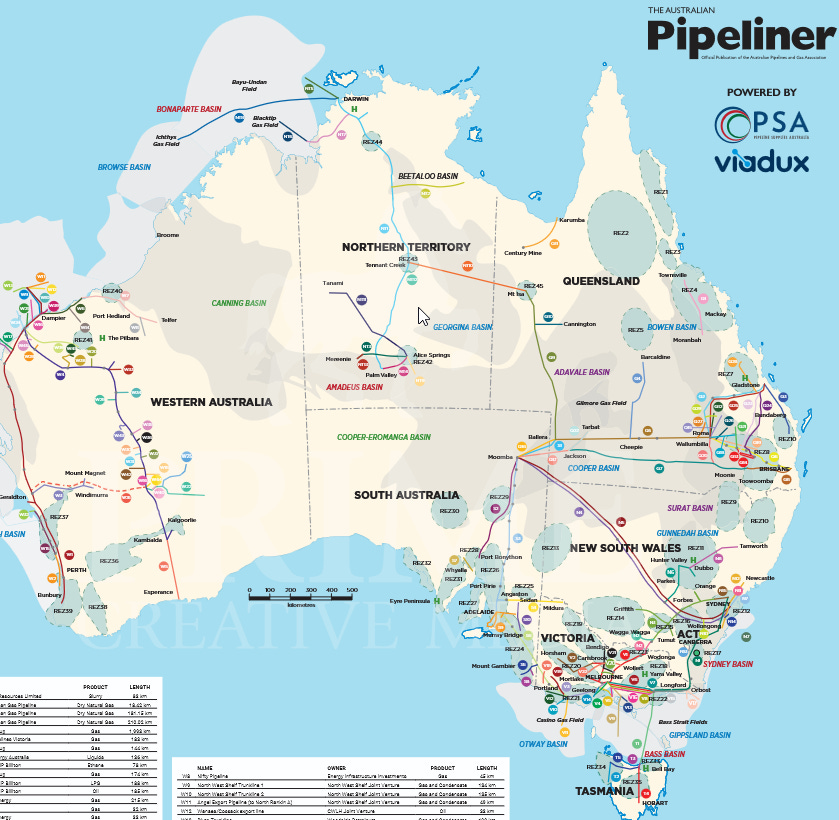
Every one of these pipelines ~ map above ~ is Privately Owned!

The Chinese State Pipeline [2014]
Commandment — third amendment:
« Infrastructure shall remain in responsible hands.»
« Infrastructure shall remain in responsible hands, including those of foreign state-owned enterprises whose governments maintain separate policies on sovereignty, national security, and the sanctity of private property.»
While CKI was assembling its Australian gas empire, a second and more strategically significant transaction was proceeding quietly.
Jemena ~ the company that owns the Eastern Gas Pipeline connecting Victoria’s Gippsland Basin to Sydney, the Queensland Gas Pipeline, the VicHub interconnect, and the 25,000-kilometre NSW gas distribution network serving 1.5 million customers ~ was partially sold to the State Grid Corporation of China.
Not a Chinese private company. Not a Chinese investment fund.
The State Grid Corporation of China: the world’s largest electric utility, a wholly state-owned enterprise of the People’s Republic of China, with ties to Chinese defence, intelligence, and strategic infrastructure planning.
In 2014, Singapore Power sold a 60% stake in Jemena to State Grid for A$5.05 billion. Singapore Power retained 40%. The entity was renamed SGSP [Australia] Assets Pty Ltd, operating under the Jemena brand. State Grid appointed directors and senior management into the Australian entity.
The Eastern Gas Pipeline ~ 797 kilometres from Victoria’s Gippsland fields to Sydney; the primary artery for gas supply to NSW and the ACT
The Queensland Gas Pipeline ~ 627 kilometres delivering gas from the Surat and Cooper Basins to Gladstone and Rockhampton markets
The Jemena Gas Network — 25,000 kilometres of distribution pipeline delivering gas to 1.5 million NSW homes and businesses
The VicHub — the interconnect enabling gas flows between the Eastern and Tasmanian Gas Pipelines and the Victorian transmission network
Every cubic metre of gas that travels from Victoria to Sydney moves through a pipeline 60% owned by the Chinese state.
Every home in NSW that receives piped gas receives it through a network 60% owned by the Chinese state.
This is not a conspiracy theory. It is a corporate structure, registered with ASIC, confirmed in annual reports, reported in the Australian Strategic Policy Institute, and documented by the Australian Energy Regulator.
It is simply a fact that most Australians have never been told.
It appears, as one analyst drily noted at the time, that major efforts were made to reduce political sensitivities to Chinese ownership of essential infrastructure by initially taking only partial shares.
The political sensitivity was managed. The acquisition was not.
The Blocked Bid That Changed Nothing (2018)
Commandment — fourth amendment:
« Infrastructure shall remain in responsible hands.»
« Infrastructure shall remain in responsible hands, provided no single foreign company group acquires sole ownership and control of the most significant gas transmission business, because that would be too much.
Significant foreign ownership distributed across multiple companies and asset classes is perfectly acceptable.»
When Treasurer Josh Frydenberg blocked CKI’s A$13 billion bid for APA Group in November 2018, his stated reason was precise: he objected to a single foreign company group having sole ownership and control of Australia’s most significant gas transmission business.
Not foreign ownership. Not the national security implications of Hong Kong’s political trajectory. Not the principle that critical energy infrastructure should be sovereign.
The concentration. The aggregation. The singleness of it.
This was, in its way, an admission of everything. The government was not defending the principle that Australian gas pipelines should be in Australian hands.
It was defending the principle that no single foreign entity should own too large a share of them. The distribution of foreign ownership across multiple foreign entities ~ Chinese state, Hong Kong conglomerate, American institutional funds ~ was apparently the acceptable version of the same outcome.
By the time of the blocked bid, the ownership picture was already this:
CKI owned AGIG ~ 34,000km of gas distribution, multiple states
State Grid owned 60% of Jemena ~ the Eastern Gas Pipeline, QGP, NSW distribution
State Grid held major stakes in Victorian and South Australian electricity networks
APA remained nominally Australian-listed, majority held by global institutional funds
Blocking the final piece did not restore sovereignty.
It preserved the existing level of foreign dominance and prevented it from becoming total.
The animals were told this was a victory.
The Toll Road Nobody Voted For
The commandment as it stands today:
« Infrastructure built to serve the Australian people shall remain in responsible foreign hands, distributed across an acceptable diversity of foreign owners, none of whom shall hold too dominant a position, as assessed case by case, without a published framework, by a Treasurer whose primary concern is not to discourage foreign investment.»
Here is what this ownership structure means in practice, every day, for every Australian who uses gas.
APA Group ~ the largest transmission system owner ~ generates its revenue from pipeline tariffs: regulated fees charged to gas producers and retailers for moving gas through its network.
The money leaves ~ to overseas owners.
Jemena charges distribution tariffs for moving gas through its NSW network. The regulated return flows to SGSP (Australia) Assets Pty Ltd, 60% of which is remitted to State Grid Corporation of China.
The money leaves ~ to a foreign state.
AGIG charges distribution tariffs across Victoria, South Australia, Queensland, and elsewhere. The regulated return flows ultimately to CK Infrastructure Holdings in Hong Kong.
The money leaves ~ to a foreign billionaire’s conglomerate.
Australia’s gas was extracted from Australian sovereign resources, with minimal royalty to the Australian public.
It arrived at Australian homes at prices that made Australia one of the most expensive gas markets in the developed world ~ in a country sitting on some of the largest gas reserves on earth.
« The animals grow the food.
Foreign interests own the roads it travels.
…..and the animals pay for the privilege of eating it.»
What Reclaiming the Pipes Looks Like
What the commandment should say:
« Critical energy infrastructure ~ the pipelines, networks, and interconnects through which Australians access their own sovereign resources ~ shall be owned by Australians, managed for Australian consumers, and subject to transparent public accountability.»
This is not a radical proposition. It is what Norway does with its gas infrastructure.
It is what most European nations did before the energy crisis of 2022 reminded them why sovereign control of energy matters.
It is what Australia did before the privatisation wave, when the Gas and Fuel Corporation of Victoria and the NSW gas distribution system served Australians without sending regulated returns to Hong Kong or Beijing.
The View From the Farmhouse Window
Step back and look at the full picture.

Australia sits on some of the world’s largest gas reserves. Its east coast gas fields — Cooper Basin, Gippsland Basin, Surat Basin — supply a market of 26 million people and export LNG to Asia at prices that have made shareholders extraordinary returns.
The gas itself is extracted by companies that paid zero corporate tax for a decade on $47 billion in sales — and are majority-owned by foreign institutional investors.
The pipelines that carry that gas are owned by the Chinese state, a Hong Kong conglomerate, and American index funds.
The farm was built by Australians. The harvest belongs to Australians in name.
The roads, the barns, the trucks, and the market stalls belong to foreign interests — acquired quietly, approved incrementally, explained away by Squealer at every stage as investment, efficiency, and partnership.
« And the animals, who built it all, pay full price at the meter.»
Take Home Messages
The Animal Farm allegory aligns perfectly with Australia’s Giveaway Paradigm.
Other nations ~ Norway & The Gulf States benefit from their Resource Bonanza!
The Australian govt. Prioritises Foreign Corporations over its own Citizens.
This is known as the C-GARA Principle.
Sources: Australian Energy Regulator | ASPI — The Strategist | The Conversation | Global Energy Monitor | Wikipedia: Jemena, Eastern Gas Pipeline, CK Infrastructure Holdings | Australian Pipeline & Gas Association | Business News Australia | Bloomberg | MinterEllison | Treasury Ministers (Frydenberg statement, 2018) | CKI Annual Report 2024