

This report continues from PART 3.
« The creatures outside looked from pig to man, and from man to pig, and from pig to man again; but already it was impossible to say which was which.» — George Orwell, Animal Farm
In George Orwell’s Animal Farm, the revolution doesn’t fail in a single dramatic moment. There is no battle, no coup, no midnight massacre.
It fails quietly ~ one commandment amended here, one privilege extended there ~ until the animals who built the farm find themselves staring at the farmhouse window, noses pressed to the glass, watching the pigs dine with the men they once drove out.
Australia’s Santos is that farm.
Not a hypothetical. Not a metaphor stretched thin.
A specific, documented, seventy-year story of how a company born from Australian soil, Australian capital, and Australian ambition was hollowed out ~ share by share, clause by clause, tax exemption by tax exemption ~ while being told at every stage that this was progress, this was investment, this was the future.
The animals built the windmill. They’re still waiting for the lights to come on.
The «Farm Is Founded» ~ 1954
Original Commandment:
« All Australian resources shall benefit the Australian people.»
Santos began the way all good Australian stories begin — with a couple of mates and an idea.
In 1954, school friends Robert Francis ‘Bob’ Bristowe and John Langdon Bonython registered South Australia Northern Territory Oil Search.
The acronym said everything: SANTOS. This was not a multinational venture.
It was not a foreign capital play. It was two Australians who believed there was oil beneath their own country, and who set out to find it.
They were right.
By the late 1960s, Santos was producing natural gas from the Cooper Basin — one of Australia’s most significant onshore energy fields.
The animals had built something real. The harvest was coming in.
The commandments were still painted cleanly on the barn wall.
It was a good commandment. It lasted, in any meaningful sense, about two decades.
The First Pig at the Trough ~ 1960’s
Commandment — first amendment:
« All Australian resources shall benefit the Australian people.»
« All Australian resources shall benefit the Australian people, subject to the participation rights of foreign capital partners.»
The erosion began modestly, as it always does.

French Petroleum Company — a subsidiary of France’s Total — invested around AUD $800,000 in Santos, taking a significant early shareholding. It was framed as what it superficially was: capital for exploration. More investment, more drilling, more discovery. Who could object?
But that first foreign foot in the door established something more important than cash. It established the principle: that Santos’s ownership was available to those with sufficient capital, regardless of nationality.
The farm had accepted its first outside investor.
The commandment had its first asterisk.
Total wouldn’t be the last.
The Institutional Creep ~~ 1990’s ~ 2010’s
Commandment — second amendment:
« All Australian resources shall benefit the Australian people, subject to the participation rights of foreign capital partners.»
« All Australian resources shall benefit the Australian people, subject to the portfolio allocation decisions of global institutional investors, whose ownership shall not require disclosure, intent, or accountability.»
No single foreign investor needed to stage a hostile takeover. Globalisation had invented something far more elegant.
As Santos listed on international indices and its market capitalisation grew, it became a component of the funds that institutional investors ~ American pension funds, European asset managers, global index trackers ~ buy automatically, passively, without intention or drama.

Today, Santos’s register reads like a directory of the world’s largest financial institutions. Vanguard ~ through its Total International Stock Index Fund and Developed Markets Index Fund ~ is among the largest shareholders.
It is joined by iShares (BlackRock), DFA Investment Trust, Fidelity International, State Street Global Advisors, and others.
These are not villains in the traditional sense. They do not sit in boardrooms stroking cats. They are algorithms, index weights, passive accumulation vehicles.
But collectively, they represent the quiet transfer of Australian energy ownership to foreign institutional capital ~ and with that ownership comes the expectation of returns, which shapes the behaviour of management as surely as any direct instruction.
The animals didn’t see the farm change hands because it happened in fractions of a percent, over decades, in the back pages of financial disclosures nobody read.
Squealer would have called it diversified global capital participation.
?file=Squealer%27s+Propaganda+.jpg)

Source: Squealer ~ representing propaganda ~ villians fandom
The Zero Tax Decade ~~ 2013 ~ 2024
Commandment — third amendment:
«All Australian resources shall benefit the Australian people.»
« All Australian resources shall benefit the Australian people, after the deduction of exploration costs, development costs, uplift factors, LNG project exemptions, and any other provisions determined by the industry in consultation with the industry.»
Here is where the story stops being merely concerning and becomes genuinely scandalous.
Over the decade from 2013–14 to 2023–24, Santos recorded approximately $47 billion in sales.
Over that same decade, Santos paid $3.1 Million dollars in corporate income tax.
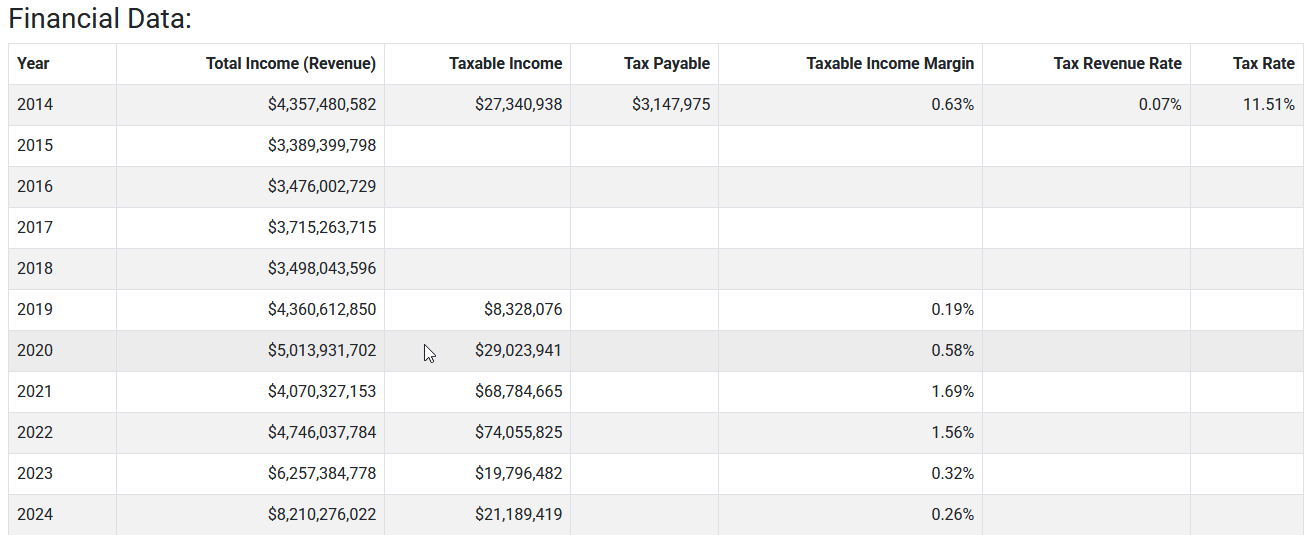
Source: Michael West Media ~ taxdata analytics
Confirmed by the Australian Tax Office’s own Corporate Tax Transparency data.
How? Through the architecture of the Petroleum Resource Rent Tax ~ a system so riddled with exemptions and deductions that it functions less as a sovereign revenue mechanism and more as a corporate tax holiday dressed in bureaucratic language.
The PRRT is a profits-based tax.
On paper, this sounds fair: companies pay more when they earn more.
In practice, it is a system designed by and for the industry it was meant to regulate. Companies can accumulate enormous « uplift» deductions ~ historical exploration and development costs, carried forward and compounded ~ that can shelter profits for decades.
LNG, Australia’s most valuable gas export, was for years not even subject to PRRT at the federal level.
The result was mathematically absurd.
Japan — the customer buying Australian gas — collected more tax revenue from that gas than Australia — the sovereign nation that owns it.
Japan’s gas import tax generates approximately A$1.8 billion per year. Australia’s PRRT generates approximately A$1.5 billion ~ from the entire offshore sector, across multiple major producers.
The country that owns the ground receives less than the country that buys the product.
This is not incompetence.
This is the architecture of extraction, built over years of industry lobbying, regulatory capture, and the revolving door between gas company boardrooms and the departments that write energy policy.
Santos Swallows PNG, Foreign Corps Devour Santos [2021]
Commandment — fourth amendment:
«All Australian resources shall benefit the Australian people.»
« All regional resources shall benefit the regional champion, which shall be headquartered in Adelaide, majority-owned by foreign institutional investors, and empowered to absorb the sovereign resource assets of neighbouring nations in the interests of scale, synergy, and shareholder returns.»
In December 2021, Santos completed its merger with Oil Search — Papua New Guinea’s dominant energy company and a stock that represented 31% of PNG’s entire national exchange.
Santos presented it as nation-building. CEO Kevin Gallagher spoke of « regional champions, balance sheets to fund major projects in PNG,» and « long-term wealth and prosperity for the people of PNG.»
The language was impeccable. Squealer himself could not have done better.
PNG’s Deputy Prime Minister Samuel Basil saw it differently. He warned the deal would harm the national interest, risk job losses, transfer domestic PNG resources to foreign control, and potentially cause capital erosion.
« With all of Oil Search’s oil and gas field portfolio in PNG under an Australian company,»
he said, « there is the real risk of capital erosion.»
Basil was right, but he was also missing the larger picture.
Santos was not simply an Australian company absorbing PNG resources.
Santos was itself a company whose register was already dominated by foreign institutional investors.
The merger transferred Oil Search shareholders ~ who took approximately 38.5% of the merged group ~ into a Santos register already thick with Vanguard, BlackRock, State Street, and Fidelity.
PNG’s sovereign gas resources were not absorbed by Australia. They were absorbed by a vehicle through which global capital extracts value from sovereign nations.
The flag on the farmhouse changed. The pigs remained.
The Abu Dhabi Bid:
The Final Commandment ~ 2025
Commandment — fifth amendment:
«All Australian resources shall benefit the Australian people.»
« All Australian resources shall be available for acquisition by foreign state-owned enterprises at a price unanimously recommended by the board, subject to regulatory approval, provided no better offer is received.»
In June 2025, the mask came off entirely.
Abu Dhabi National Oil Company — ADNOC, a state-owned enterprise of the United Arab Emirates — announced a takeover bid for Santos valuing the company at approximately A$29 billion, with an enterprise value of A$36.4 billion including debt. The consortium included ADNOC’s investment vehicle XRG, Abu Dhabi Development Holding Company, and American private equity giant Carlyle.
Santos’s board said it would unanimously recommend the deal to shareholders if no better offer emerged.
Read that carefully. The board of Australia’s second-largest oil and gas producer — the company that supplies a significant portion of Australia’s domestic gas needs — was prepared to recommend the sale of the entire enterprise to a foreign state-owned oil company, with private equity as a co-owner, for cash.
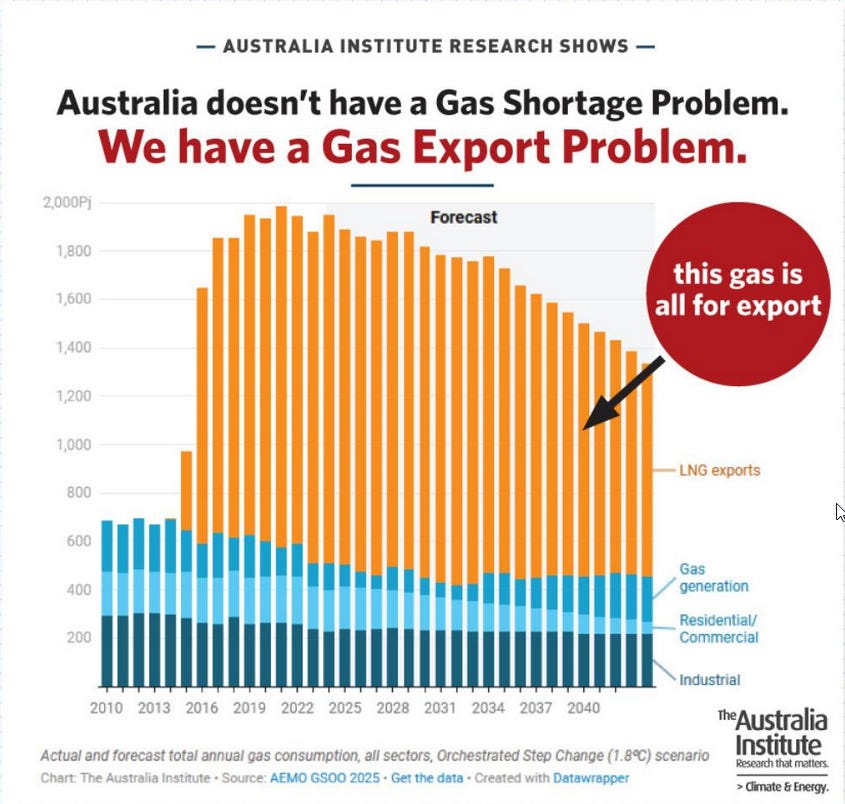
Treasurer Jim Chalmers faced the decision that Australian politicians had been avoiding for decades: would Australia protect sovereignty over its critical energy infrastructure, or would it honour the logic of the market it had spent forty years building?
Labor unions and trade groups ~ specifically the Offshore Alliance ~ did what Australian governments had declined to do. They publicly and loudly demanded the government block the sale. They put themselves at political and industrial risk to defend what governments had quietly surrendered.
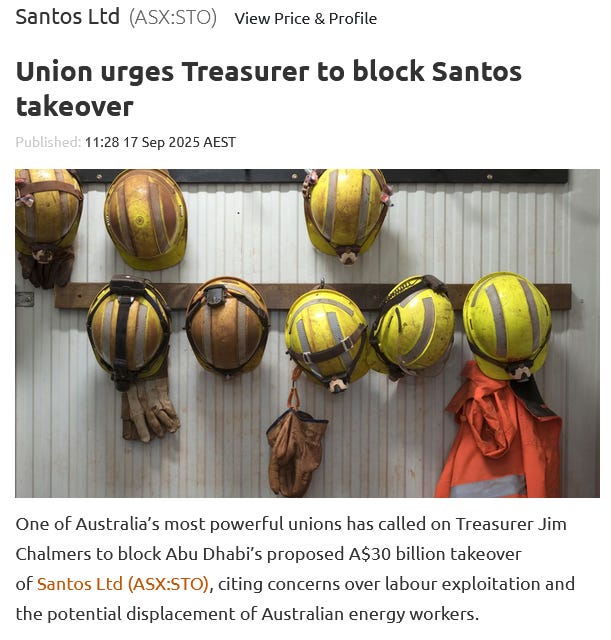
The ADNOC consortium eventually withdrew, citing commercial factors and the complexity of required approvals. It was described as the third unsuccessful attempt to fully acquire Santos — reflecting, as observers noted, the structural difficulty foreign investors face in completing large Australian energy acquisitions.
But note what nearly happened. Not what was blocked.
What was nearly sold.
Australia’s critical gas infrastructure — built on Australian sovereign resources, developed over seventy years on Australian soil — nearly passed into the hands of a Middle Eastern state oil company and an American private equity fund, recommended by the very board elected to protect shareholder and national interests.
« The animals looked from pig to man, and from man to pig.»
The Final Commandment
All animals are equal, but some animals are more equal than others.
The Santos story is not primarily a story about one company.
It is a story about the architecture of a system that was designed, over decades, to make extraction profitable and sovereignty expensive.
The pigs didn’t storm the farmhouse.
They were invited in — first by French Petroleum in the 1960s, then by index funds in the 1990s, then by the PRRT designers who built exemptions for LNG, then by the board that recommended selling the whole farm to Abu Dhabi.
At every stage, the language was development, investment, partnership, and progress.
At every stage, the animals kept working.
The difference between Animal Farm and the Santos story is this:
Orwell’s animals eventually stopped believing Squealer.
Australia hasn’t quite got there yet.
Sources: Australian Tax Office Corporate Tax Transparency Data | IEEFA Australia | The Australia Institute | The Conversation | Queensland Parliamentary Research | ABS Labour Force Data | Gulf News | Bloomberg | Business Advantage PNG | Michael West Media | Upstream Online | compilation was assisted by AI.