

In Chapter 1, Osprey set out why Australia’s newly announced Perdaman refinery — privately owned, subsidised only on the downside — repeats the mistake Norway, Brazil and even Angola all avoided: building resource infrastructure without the state holding an equity stake in it.
This chapter sets out, in concrete and enforceable terms, what a genuinely sovereign alternative would need to contain.
Every one of Napoleon’s amended commandments in Animal Farm started as a real, defensible principle. What corrupted them was never the wording — it was the absence of anyone with the power to hold the pigs to account, once they’d walked back inside the farmhouse.
Australia’s problem with resource governance is not that nobody has ever proposed strong terms. It is that every strong term proposed so far has arrived with a loophole attached, a sunset clause, or no enforcement mechanism at all.
Below are five principles — drawn from how the world’s more careful resource nations actually write their contracts — applied directly to the Perdaman refinery and the gas fields, — including Beetaloo — that would feed it.

Commandment One
In principle, Australia already has a version of this. Petroleum and minerals remain Crown property under state and territory law until they are severed from the ground — the same starting position Norway, Brazil and Angola all started from.
The difference is what happens next. In Australia, the moment resource crosses the wellhead flange, full commercial ownership transfers outright to the company, in exchange for nothing more than a royalty and a tax liability the PRRT has repeatedly failed to collect in practice.
In Norway, the state’s ownership does not end at the flange — the SDFI continues to hold a direct, undiluted financial interest in the produced hydrocarbons themselves, all the way through the sales chain.
Commandment Amended
The Crown owns the Resource until it is extracted.
The Crown owns a stake in the resource for the life of the project,
not just up to that moment, before it leaves the ground.
Applied to Perdaman: any new refining capacity approved from here forward should carry a mandatory state equity stake — not a subsidy, an actual ownership percentage — in both the refinery itself and the field supplying its crude, modelled on Petoro’s role in Norway rather than the Fuel Security Services Payments current downside-only guarantee.
Commandment Two — The Fiscal Revenue Waterfall
This is where Australia’s Royalties & Taxation regime is most visibly broken, and the numbers are not contested — they come from the Australia Institute, the Australian National Audit Office, and Treasury’s own PRRT Review.
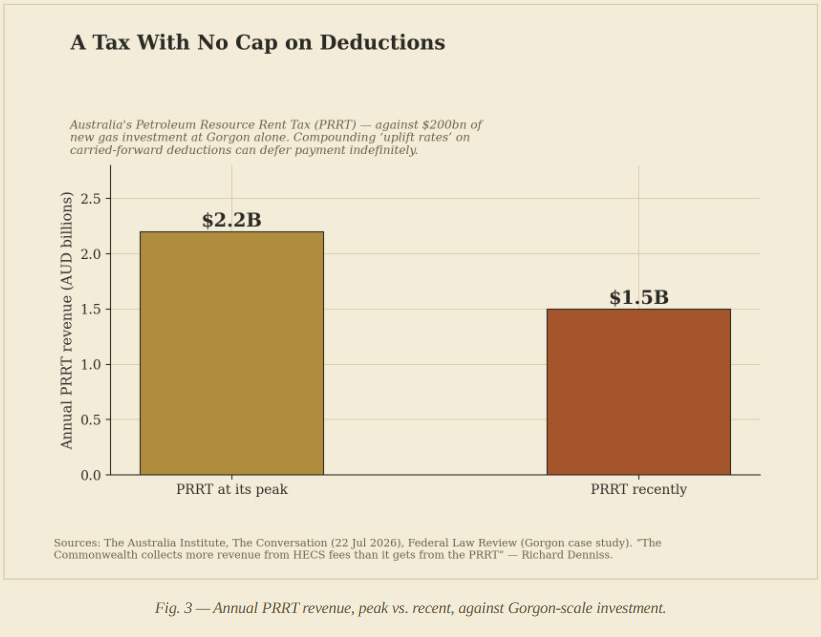
Note: Figures vary slightly by source, depending on measurement year.
The Petroleum Resource Rent Tax [PRRT] was introduced in 1988 as a 40% tax on the “super profit” or economic rent from petroleum extraction.
It does not work as intended, for a specific, well-documented structural reason: companies are permitted to carry forward capital and exploration costs as deductions indefinitely, compounding each year through an “uplift rate” — functionally identical to compound interest working in the company’s favour rather than the State..
As economist Richard Denniss has observed;
“the Commonwealth collects more revenue from HECS fees than it gets from the Petroleum Resource Rent Tax.”
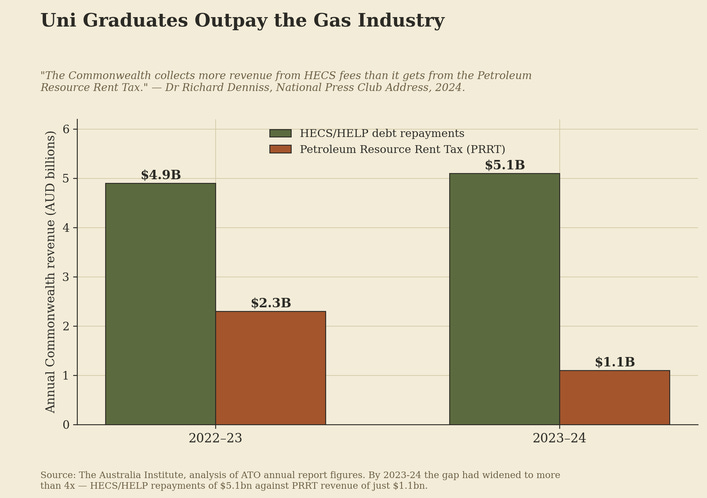
Following the collapse in PRRT revenue after 2002–03 — despite over $200 billion in new integrated gas investment, including the Gorgon project alone — the government’s own 2023 Treasury Review estimated that capping deductible expenditure could raise an additional $7 billion in receipts to 2033–34.
A genuine revenue waterfall, of the kind Norway, Angola and most serious resource-rent regimes use;
«pays gross value royalties before any cost recovery calculation begins — not after an unlimited, compounding stack of carried-forward deductions has already reduced the taxable base to near zero.»
Commandment Amended
Companies pay tax on their Profits.
The state is paid first, off the top, before any company
gets to argue about its profit numbers.
Commandment Three — Cost Recovery Caps & Auditing
This is the direct enforcement mechanism behind Commandment Two, and Osprey has already documented what happens without one.
In The Beetaloo Trap, this publication reported the INPEX average tax rate of just 0.70% over a decade, using Michael West Media’s own tax transparency data.
That outcome is not an accident or an aggressive one-off — it is what an uncapped, unaudited deduction regime is exactly designed to produce.
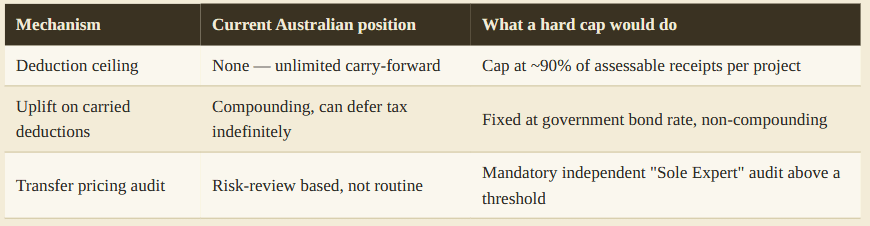
Treasury’s 2023 PRRT Review recommended exactly the fix this Commandment calls for: capping deductible expenditure at 90% of assessable receipts per project, with any denied deductions carried forward at a fixed government bond rate rather than an open-ended uplift — alongside a “Sole Expert Audit” style mechanism to stop the kind of related-party transfer pricing this publication has previously documented in Chevron’s Australian operations, where a Delaware financing subsidiary lent to the local entity at 9% while borrowing at 1.2%, artificially inflating deductible Australian expenses.
Commandment Amended
Expenses are whatever the company reports them to be.
Expenses are capped, audited by an independent expert,
and cannot be manufactured through a related-party loan.
Commandment Four — Domestic Market Obligations
Western Australia is the only Australian jurisdiction with a domestic gas reservation policy at all — the DomGas policy, requiring LNG exporters to make 15% of export volumes available to the WA market.
On paper, that is a real protection. In practice, it has a hole in it large enough to steam an Ultra-Large Crude Carrier [ULCC] export tanker through, sideways!
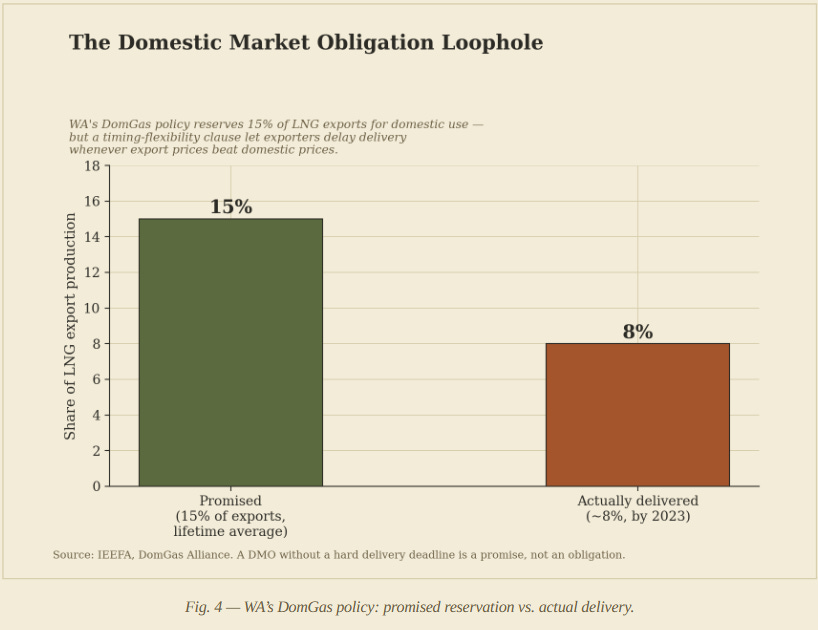
The 15% figure is calculated as a lifetime average across a project’s operating life, and producers retain full flexibility over when they deliver it. When export prices exceed domestic prices — which they reliably have in recent years — exporters have a direct financial incentive to delay their domestic obligation as long as possible.
The result, according to IEEFA analysis, is that WA LNG exporters were delivering only around 8% domestically by 2023, roughly half of the policy’s headline promise.
Commandment Amended
A dedicated percentage of gas is reserved for Domestic use.
A percentage of gas is delivered domestically on
a fixed annual schedule, with no financial incentive to delay.
Commandment Five — Hybrid Stabilisation Frameworks
Resource contracts in many jurisdictions include “stabilisation clauses” — legal guarantees that the fiscal and regulatory terms a company signed up to won’t be unilaterally changed part-way through a multi-decade project.
These exist for a legitimate reason: nobody invests billions in infrastructure they expect the rules to change on halfway through. The risk is what corporate legal teams routinely try to freeze alongside the fiscal terms — changes in labour standards, environmental protections, and human rights law, locked in at whatever - often weaker - standard existed on the day the contract was signed, immune from any future strengthening of Australian law.
A hybrid model — increasingly the standard recommended by international resource-governance bodies — explicitly carves out labour, environmental and human rights protections from any stabilisation guarantee, while still protecting the fiscal terms investors need certainty on.
Fiscal stability without legal stability of everything else is not sovereignty.
It is a permanent exemption from the country’s own evolving standards, sold as an investment incentive.
Commandment Amended
The contracts terms can never be changed.
The fiscal terms cannot be changed. Australian law can always be strengthened.
Applying All Five Commandments — Together
None of these five Commandments is radical in isolation — every one of them already exists somewhere in the world, in a functioning resource economy, protecting a government’s return on a national asset.
What makes Norway, and even lower-capacity Angola, different from Australia is not that they invented a clever idea Australia lacks access to.
It is that they wrote the protections into the contract before signing it, with enforcement attached, rather than discovering the gap afterward in a tax transparency dataset.
The Perdaman refinery is still at the pre-feasibility stage. That is precisely the window in which these terms are cheapest to negotiate and hardest to walk back from later. Once construction begins, once a Final Investment Decision is signed, the leverage moves permanently to the other side of the table — exactly as it already has at Beetaloo, at Gorgon, and at every other Australian gas project currently returning the country a 0.70% effective tax rate on a public & sovereign resource.
“The windmill will get built either way.
The only open question left, is who owns it when it’s finished.”

Sources & Further Reading
What is the PRRT? The Australia Institute.
The way Australia taxes gas production is stuck in the past, The Conversation, 22 July 2026.
Administration of the Petroleum Resource Rent Tax, Australian National Audit Office.
Petroleum Resource Rent Tax: Review of Gas Transfer Pricing Arrangements, Australian Treasury, 2023.
Review of Australia’s Petroleum Resource Rent Tax: The Gorgon Gas Project, Federal Law Review.
Gas reservation policy design critical as conflict hits global supplies, IEEFA.
WA State Policy, DomGas Alliance.
Australia’s gas reservation scheme, Allens, May 2026.
East Coast Gas Reservation Scheme: Key Design Risks Explained, Discovery Alert.
Tax Data, Michael West Media.
Richard Denniss: National Press Club Address, The Australia Institute, 2024.
In 2023-24 Australians paid more than 4 times on HECS/HELP than gas companies did on PRRT, The Australia Institute.
The Beetaloo Trap: A Northern Territory..., Osprey on Overwatch, Graham Bates.
Norway - The Clever Country, Osprey on Overwatch, Graham Bates.
~~observe - analyse - adapt - evolve - survive - thrive ~~