

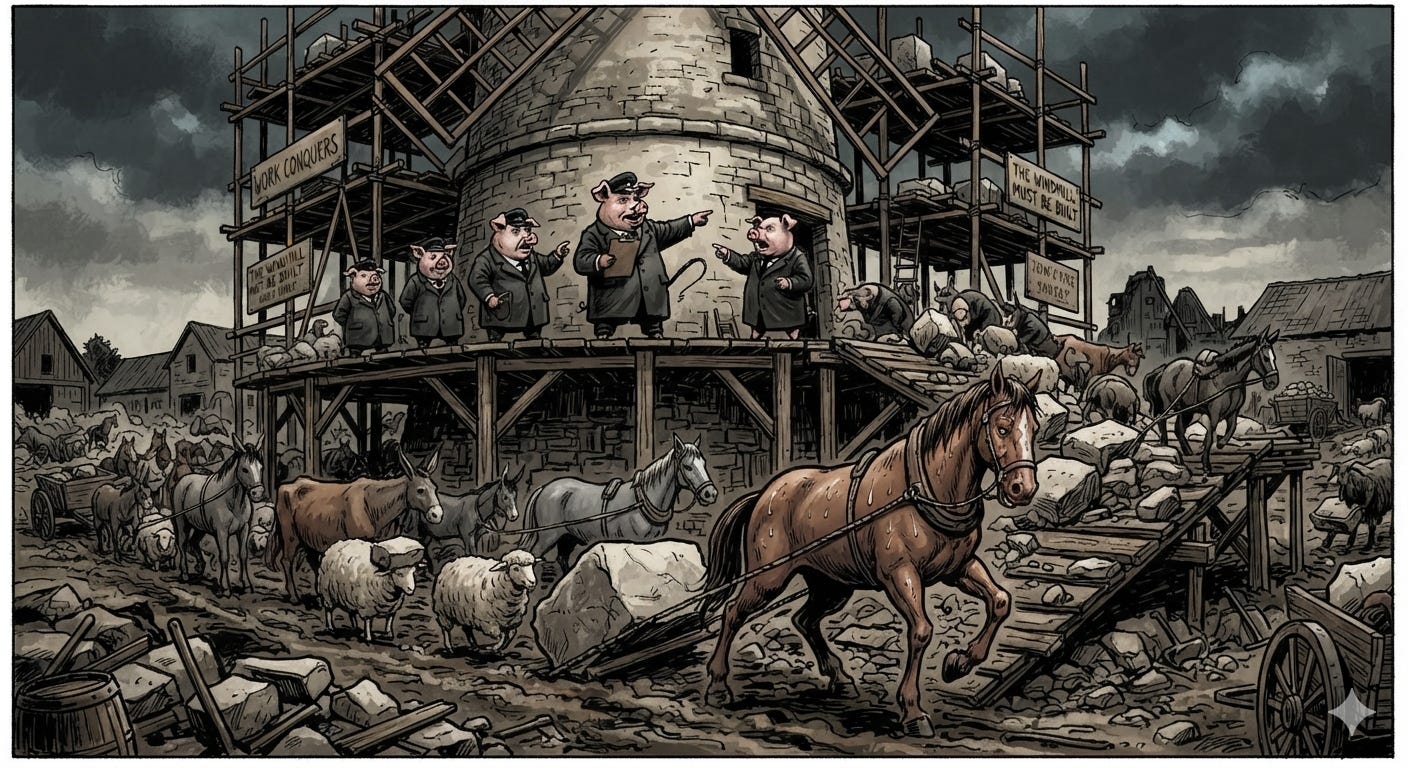
Napoleon’s pigs never actually stopped building the windmill. What changed, chapter after chapter, was who it was built for.

Australia is at exactly that moment now — the government has just announced its first new oil refinery in sixty years, funded by public money, justified by “fuel security” and “sovereign capability.”
On paper, that is the right instinct. In practice, we are about to build the windmill and hand the keys to someone else, exactly as we did with Commonwealth Oil Refineries, exactly as we do today with the gas beneath the NT’s Beetaloo Basin.
Norway shows there is a different way to build it. So, less obviously, do Brazil and Angola — two countries with far less bargaining power than Australia, who still refused to make the mistake we are about to repeat.
A Refinery, Finally — But Whose?
In late July 2026, Prime Minister Anthony Albanese and WA Premier Roger Cook traveled to Karratha WA, to announce a jointly funded $4 million pre-feasibility study for what would be Australia’s first large-scale new oil refinery since the 1960s.
The proposed builder is Perdaman, a Perth-headquartered fertiliser and industrial chemicals company with, by its own critics’ account, little prior experience in refining.
The announcement sits inside a much larger $15 billion federal fuel security package;
$7.5 billion for a Fuel and Fertiliser Security Facility,
$3.2 billion to establish a government-owned Australian Fuel Security Reserve of roughly one billion litres, and a temporary uplift to the Minimum Stockholding Obligation.
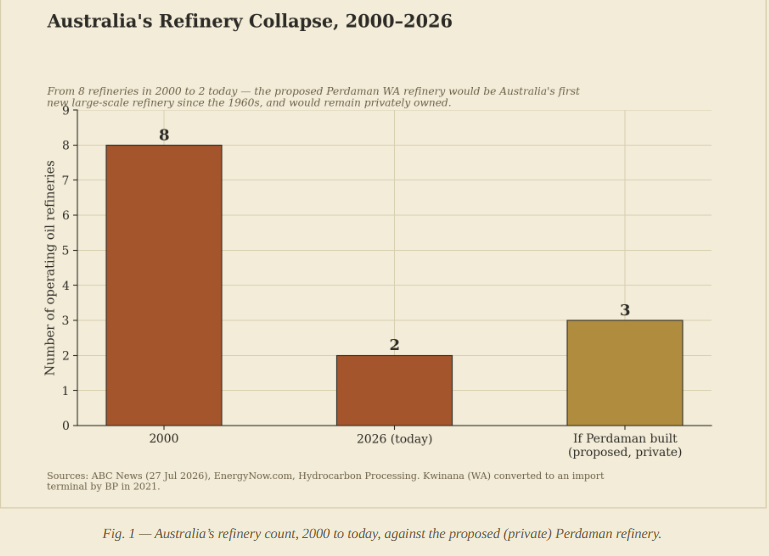
The scale of the collapse this is meant to correct is stark. Australia had eight operating oil refineries in 2000. Today there are two — the Ampol Lytton refinery in Queensland and Viva Energy’s Geelong refinery in Victoria — after BP converted its 146,000-barrel-per-day Kwinana plant into a fuel import terminal in 2021.
Even if the Perdaman refinery is built, Australia will still have fewer refineries than half of what it had at the turn of the 21st century, and every one of them privately owned.
Kevin Morrison, an analyst with the Institute for Energy Economics and Financial Analysis, put his finger directly on the structural problem within days of the announcement:
“Australia will still be importing crude oil to process at any new refinery — it is hard to see how it improves Australia’s fuel security position.”
He is right, and the reason he is correct is the same reason Norway does not have this argument at all — because refining capacity without upstream ownership just moves the vulnerability one step down the supply chain.
A refinery you do not own the crude for, built by a company the state has no equity stake in, is not sovereign capability.
It is a second toll booth for someone else’s product and the Aussie citizens will pay for it. Yet, another “Animal Farm” commandment confronts Australians

The Norwegian Answer: Total Ownership, Not Just the Infrastructure
Osprey has covered the headline numbers before — Norway’s $209 billion in annual government oil and gas revenue against Australia’s $16 billion, Norway’s industry expense ratio of 21% of revenue against Australia’s 90%.
What that comparison under-states is why the gap exists. Norway’s state oil company, now Equinor, is 67% owned by the Norwegian state through the Ministry of Trade, Industry and Fisheries, with a separate State’s Direct Financial Interest [SDFI] giving the government its own direct stake in fields, pipelines and facilities on top of that, managed by the state company Petoro.
Net cash flow from the SDFI alone is projected at roughly NOK 262.8 billion in 2026.
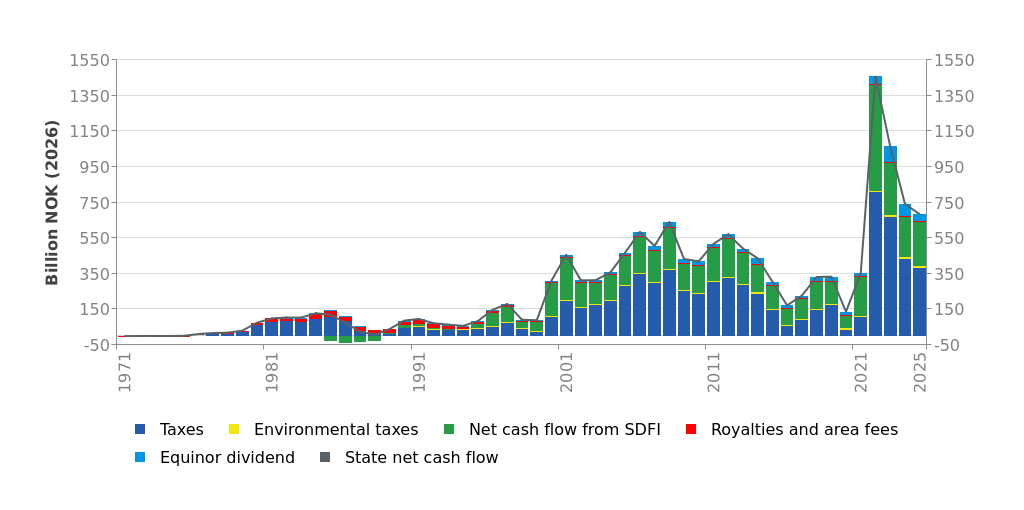
NOTE: Calculated Value: NOK 262.8 Billion == $39.36 AUD Billion!
This is Income from the Norwegian SDFI for 2026 ONLY!
Crucially, Norway’s early state planners understood something Australia’s policymakers still have not even come close to comprehending.
Extraction alone was never going to be enough.
As Yale’s own case study on Equinor’s history records, the company’s leadership recognised early that;
“the company would have to be vertically integrated... Statoil’s ability to turn a profit would depend on having market power in the refining and sales part of the value chain as well.”
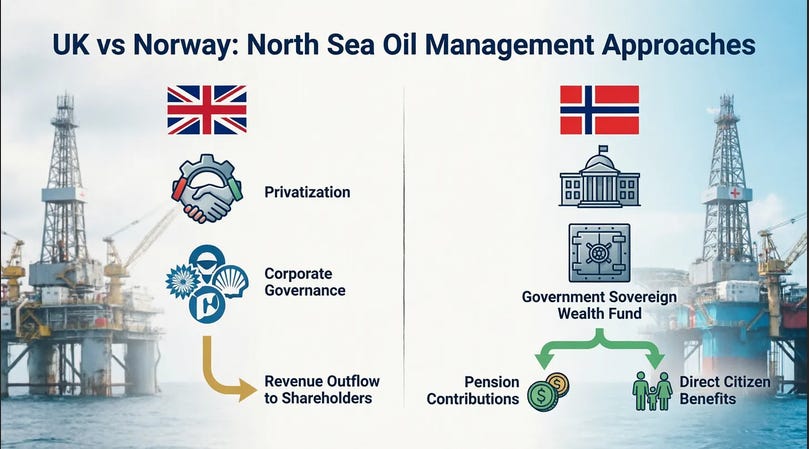
Australia adopted the UK Privatized model—Vs—Norway — the State-owned Model!
Equinor’s nine onshore plants in Norway, Germany and the UK generated NOK 11.4 billion in goods and services deliveries in a single year, sustaining over 9,055 person-years of employment — ninety percent of those deliveries sourced from Norwegian companies.
This is what vertical integration, under state ownership actually buys, a vibrant country — not just royalties from a hole in the ground, but a vibrant domestic industrial base, built on the top of it all.
What Brazil and Angola Already Know
Here is the part of the Norwegian story most commentary leaves out: Norway is not an isolated case of enlightened self-interest.
Equinor itself operates internationally — including in Brazil and Angola — and in both countries, it has never once taken outright majority ownership of the resource.
In Brazil, Equinor operates as a strategic partner to Petrobras — Brazil’s own state-controlled oil major — in the Roncador field, and to PRIO in the Peregrino field. Equinor’s largest single asset outside Norway, the Bacalhau field, sits inside a $25 billion, 2030-horizon investment program projected to create over 100,000 direct and indirect jobs — but Brazil’s own state company remains the anchor of the country’s upstream sector, not a passive royalty collector watching a foreign major run the show.
In Angola — a country with a fraction of Australia’s institutional capacity, GDP per capita, or global bargaining leverage — the pattern is even clearer, and Equinor’s own website states it in numbers.
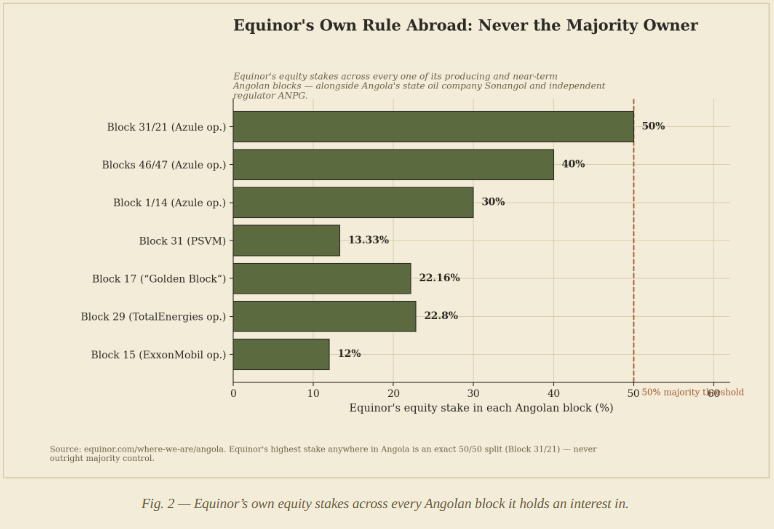
Across every Angolan block Equinor holds a stake in, its equity interest never exceeds fifty percent;
12% in Block 15,
22.8% in Block 29,
22.16% in the prolific “Golden Block” 17,
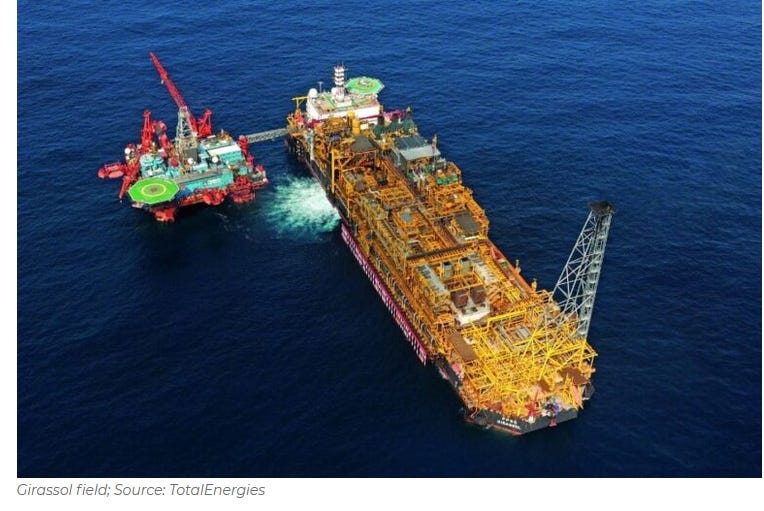
13.33% in the PSVM development,
30% in Block 1/14,
40% in Blocks 46 and 47, and,
an exact 50/50 split at its highest, in Block 31/21.
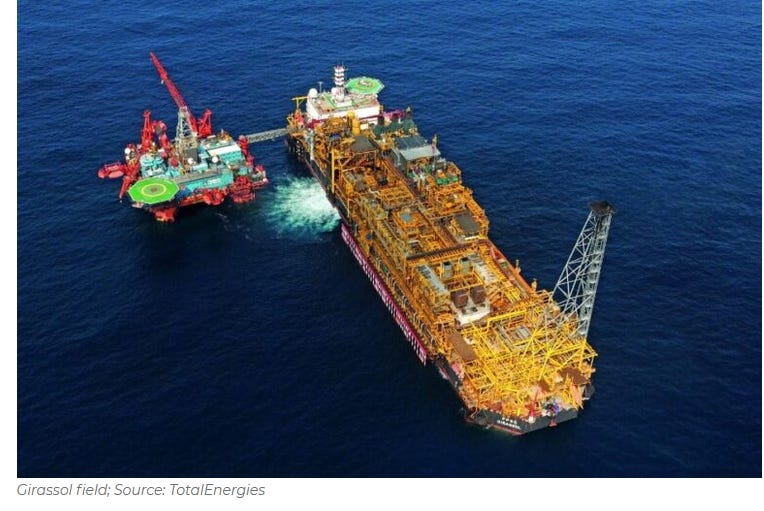
Angola’s own state oil company, Sonangol, sits across all of it, alongside an independent regulator, the National Agency of Petroleum and Gas [ANPG] — a structure Equinor’s own public materials describe as deliberately modelled on lessons from the Norwegian Continental Shelf.

Pause for reflection — Angola — not a wealthy nation, not a nation with Australia’s diplomatic weight, not a nation anyone holds up as a governance benchmark — still insisted on a state oil company with equity in every block, and a regulator independent of that company, before it let Equinor anywhere near its continental shelf.
Australia’s gas fields have neither. There is no Australian state oil and gas company holding equity in the North West Shelf, in Ichthys, in Barossa, or in the Beetaloo Basin gas INPEX is drilling right now, at the 0.70% average tax rate Osprey documented in The Beetaloo Trap.
Australia’s only claim on any of it is a royalty and a tax rate a foreign company’s own transfer pricing arrangements can quietly whittle down to almost nothing.

The Trap We Are Falling Into — Again!
None of this means the Perdaman refinery shouldn’t be built. Fuel security is real, and the case for domestic refining capacity is real. What Norway, Brazil and Angola demonstrate — three governments with wildly different wealth, institutions and leverage — is that the refinery is not the thing that secures a nation.
The ownership structure underneath it is. Build the Perdaman refinery as a wholly private asset, subsidised only on the downside through the Fuel Security Services Payment and never sharing the upside, and Australia will have spent public money building infrastructure it still does not own, to process crude it still does not control, on behalf of a company incorporated somewhere the Australian Taxation Office cannot easily follow the money.
That is not fuel security.
That is the windmill, rebuilt again, for someone else’s harvest.
Tune in for Part 2 — Osprey sets out a five-point framework — drawn from how serious resource-endowed nations actually structure their contracts.
This is what a genuinely sovereign Australian refinery and gas ownership-model would need to thrive.