

Animal Farm’s Windmill is never actually finished. It is built, blown down, rebuilt, blown down again — and each time, Napoleon’s pigs explain that the delay is temporary, that prosperity is one more harvest away, that the animals must simply work harder until the Windmill machinery is standing.
The windmill is not a lie exactly. It is a postponement dressed as an “almost-there-project.”
Seven months into the closure of the Strait of Hormuz, the world is being sold a version of the same promise: that the day the Strait reopens, the oil comes back, the prices fall, and the crisis is over. According to a detailed engineering-and-financial model now circulating among analysts, that promise is not simply optimistic.
It is wrong by years, and by more than a trillion dollars.
The Strait Reopens. The Gulf Does Not.
The report driving this reassessment comes from an analyst identified only as Karl Miller, whose work is normally kept behind a paywall. It was summarised and published on 4 September 2026 by Larry C. Johnson’s Sonar21 — a distinction worth holding onto, since the analysis belongs to Miller, and Johnson’s own framing of the conflict — he is a committed critic of US Middle East policy — is a separate matter from the numbers themselves.
The model’s central claim is that the market has been counting the wrong number. Most forecasts use a headline 8.3 million-barrels-per-day loss figure, which captures a temporary rebound in Gulf production, rather than the true scale of what has actually been lost.
Corrected, the prewar Hormuz system moved 20 million barrels per day of crude, condensate, products, and LPG.
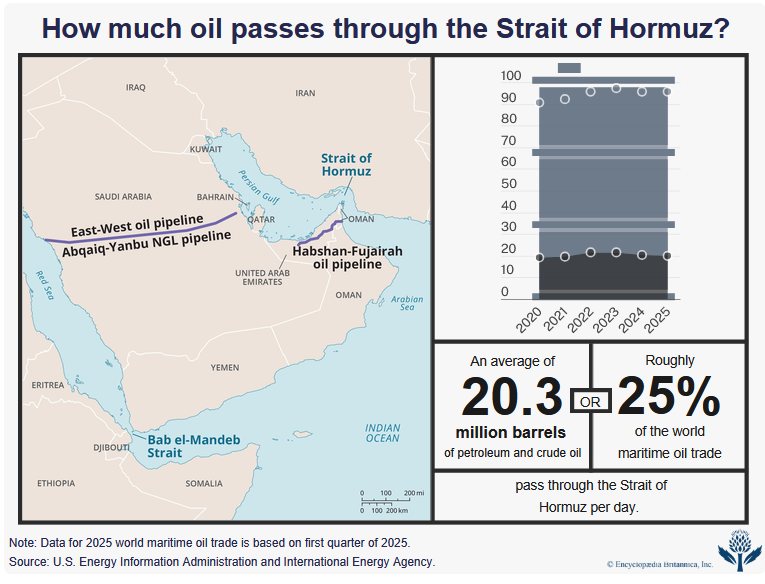
As of early September 2026, barely 1.5 million barrels per day is still getting out.
Karl Miller’s model separates two figures the market keeps treating as one: an 18.5 million barrels per day [mb/d] exportable-supply deficit — the market-facing shortfall — and a 13.5 mb/d upstream outage — production capacity actually shut in, due to the Strait Closure.
The five-million-barrel gap between them is the tell. It is not oil sitting in the ground waiting for a green light. It is oil that cannot move, because the processing plants, storage tanks, pipelines, terminals, and loading berths between the wellhead and the tanker are damaged or offline.
Reopening the shipping lane addresses none of that.

For some, the engineering case that explains the Why, may appear boring and unglamorous. However, oil extraction engineering operations are Vital!
When wells sit dead for months, static fluids separate, reservoir pressure redistributes, and scale, wax, and asphaltenes form inside the pipes, tubing and the rock itself.
In the Gulf’s sour fields, hydrogen-sulfide fluids attack tubing, casing, and safety equipment the moment corrosion control stops. Every barrel that does eventually flow must clear five serial gates — mechanical, reservoir, process, product, and export — and a single failed-gate leaves everything behind stranded in Stasis.

A one-day flow test proves a well can produce.
It proves nothing about whether it can do so for thirty days, at export quality, repeatably.
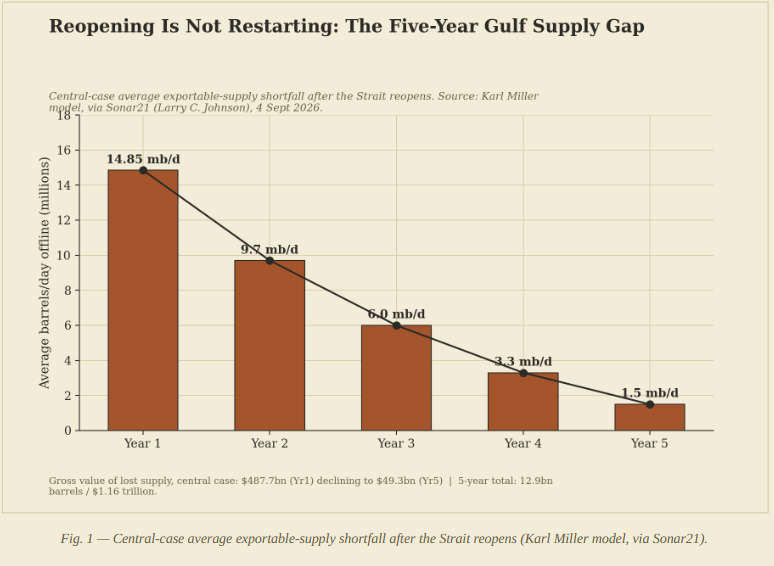
Put in front of a calendar, the central-case curve shows 14.85 mb/d still offline in Year 1, easing to 9.70 mb/d in Year 2, and not falling below 1.5 mb/d until Year 5.
The cumulative loss over that period is 12.9 billion barrels — roughly $1.16 trillion in gross sales at $90 a barrel — against a restart-funding requirement Miller puts at $380–870 billion.
Two worse-case scenarios are not tail risk so much as plausible variants: a “constrained” case losing $1.57 trillion, and a “structural damage” case losing $1.98 trillion and still 6.0 mb/d short at the end of Year 5.

It’s worth being precise about how contested this picture actually is. In the same comment thread beneath the Sonar21 report, a rebuttal citing Bloomberg trader data claims 7–8 mb/d is already moving through the Strait — roughly three-quarters of pre-war volume, a far cry from near-total shutdown. That claim is unverified here and directly disputes Miller’s baseline. What is independently confirmable, via live shipping-transit tracking, is that as of 30 August 2026 the Strait was running at approximately 6 vessel transits per day against a pre-crisis baseline of 85 — a monitored figure, not a modelled one, and one that sits far closer to Karl Miller’s account than to the optimistic rebuttal.
AlJazeera data also supports the above statistics — average of 7 Oil tankers have passed through the Strait since the War started.
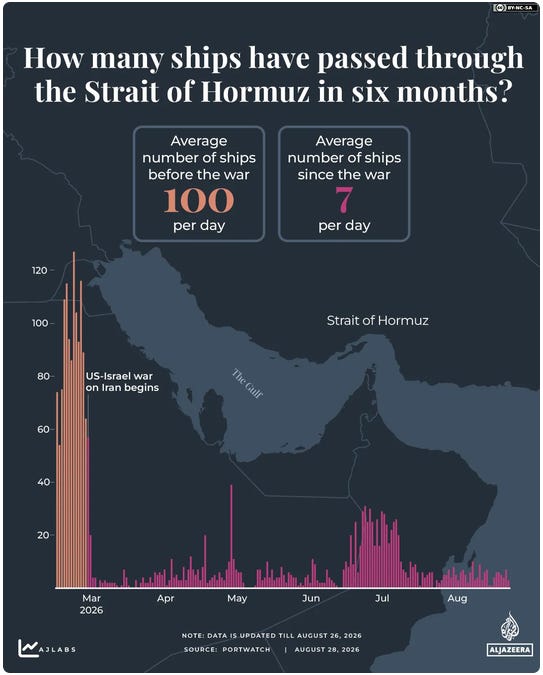
Readers should treat the exact current flow rate as a live dispute, not a settled fact, while noting which side the hardest available data currently supports.
The Sulfur Nobody Is Pricing In
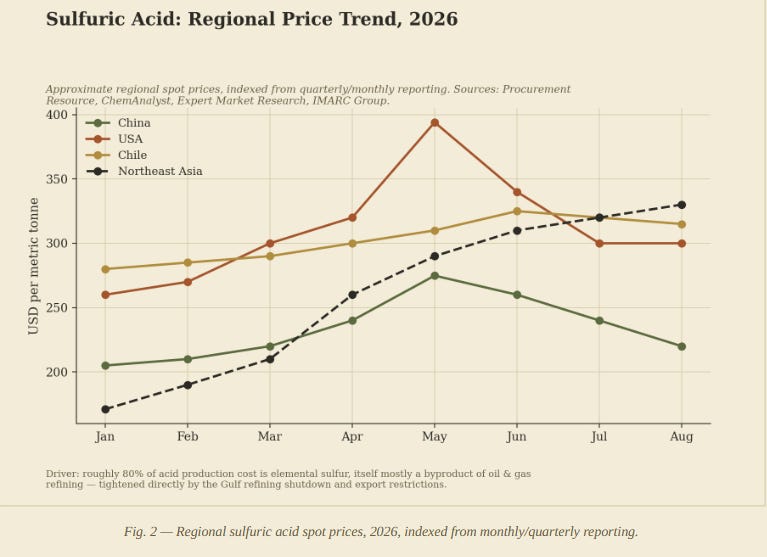
The Gulf refining shutdown is not only an oil story. Roughly 80% of the cost of producing sulfuric acid is elemental sulfur — and elemental sulfur is overwhelmingly a byproduct of oil and gas refining. Shut down the refineries, and you shut down a large share of the world’s sulfur supply at the same time, with a lag before the market notices.
Now, the markets have begun noticing the Sulfur Shortfall.

Copper, Data Centres, and a Deficit Nobody Ordered
Sulfuric acid has a second customer competing for the same tight supply: copper.
It takes sulfuric acid to leach copper ore, and 2026 has been the year copper stopped being a dull and boring industrial metal.
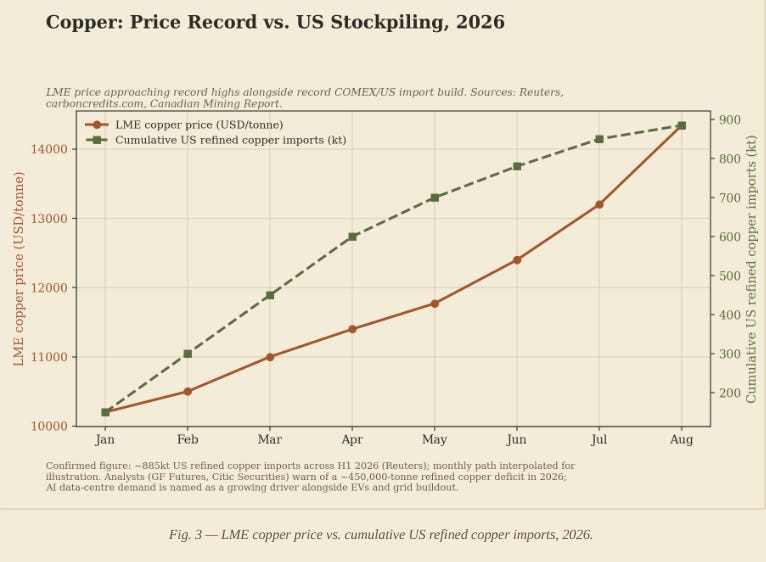
LME copper touched roughly $14,343 per tonne on 25 August 2026, within reach of its record high of $14,527.50.
US refined copper imports hit approximately 885,000 tonnes in the first half of 2026 alone — a build driven partly by genuine demand and partly by traders front-running possible US tariffs, pushing COMEX inventories to record levels even as stocks elsewhere on the LME network tightened.
Analysts at GF Futures and Citic Securities are warning of a refined copper deficit of roughly 450,000 tonnes in 2026, with Citic suggesting prices may need to average above $12,000/tonne to justify new mine investment at all.
Data centres are named, consistently and by sector name, as a fast-growing new source of demand sitting on top of electrification, EVs, and grid modernisation — though it’s worth being precise rather than breathless here: multiple market analysts are explicit that the exact scale of AI-driven incremental demand is still debated, even as the direction of travel is not.
What is not in dispute is that a metal essential to every AI data centre currently under construction is being squeezed by the same sulfuric acid shortage that a stalled Persian Gulf refining sector helped create.

The Windmill at Home: Debt - Reaching for the Sky
There is a second windmill in this story, and it predates the war by two decades. While the Gulf rebuild is measured in years, the US and global debt trajectories underneath it are measured in decades of uninterrupted climb — and the interest bill compounds regardless of who is fighting whom in the Strait of Hormuz.
US federal debt has run from $8.2 trillion in 2005 to roughly $38.9 trillion in March 2026, tracking toward the $40 trillion mark by the end of this year at current growth rates of approximately $7.5 billion per day.
The interest bill on that debt has moved in lockstep: $573.6 billion in 2021, $724.2 billion in 2022, $938.4 billion in 2023, $1.119 trillion in 2024, and $1.183 trillion in 2025.
The Congressional Budget Office projects net interest costs reaching $1.0 trillion in 2026 and $2.1 trillion by 2036 — a fiscal trajectory entirely independent of oil, sulfur, or copper, but one that leaves the US with dramatically less room to absorb a multi-year, trillion-dollar energy shock without consequence.
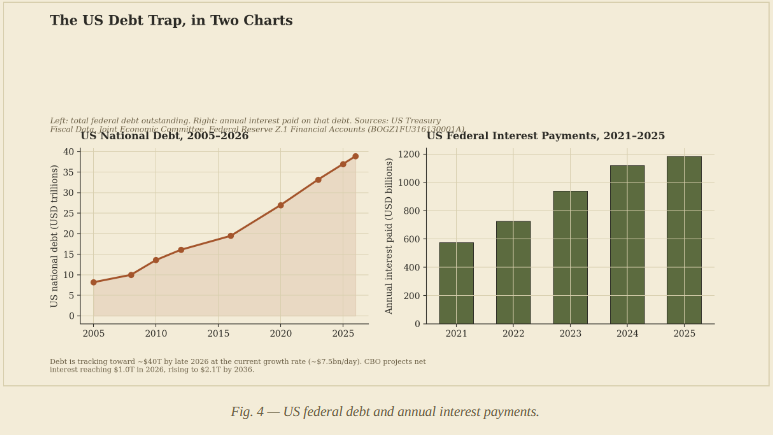
US federal debt has run from $8.2 trillion in 2005 to roughly $38.9 trillion in March 2026, tracking toward the $40 trillion mark by the end of this year at current growth rates of approximately $7.5 billion per day.
The interest bill on that debt has moved in lockstep: $573.6 billion in 2021, $724.2 billion in 2022, $938.4 billion in 2023, $1.119 trillion in 2024, and $1.183 trillion in 2025.
The Congressional Budget Office projects net interest costs reaching $1.0 trillion in 2026 and $2.1 trillion by 2036 — a fiscal trajectory entirely independent of oil, sulfur, or copper, but one that leaves the US with dramatically less headroom to absorb a multi-year, trillion-dollar energy shock without consequences.
Four Windmills, One Farm
None of these four threads — the Gulf’s five-year rebuild, the sulfur squeeze, the copper deficit, the debt trajectory — was caused by the other three.
That is precisely the point.
They are four separate, independently documented pressures converging on the same household budgets and the same balance sheets at the same time, each one compounding the others’ timing rather than their cause.
The Gulf’s oil will eventually flow again. The sulfur market will eventually rebalance. Copper supply will eventually catch up to demand, at some price.
But the debt does not wait for any of that to resolve, and neither does the interest bill.
Sources & further reading: Link Here: