

Primary Report - Napoleon’s Windmill: Why the Gulf Won’t Rebuild Itself
I have been using the The Animal Farm Allegory for several of my Resource Sovereignty reports.
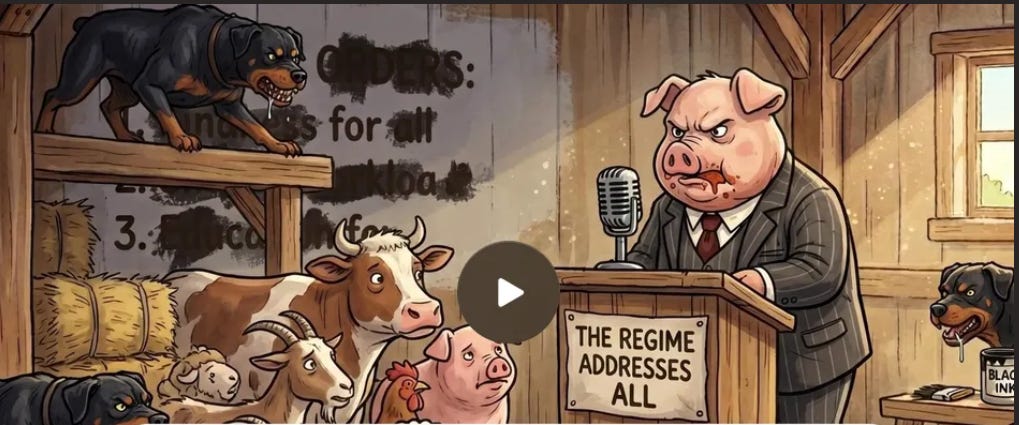
Here is a synopsis provided via an AI Overview, as a reminder.
Animal Farm by George Orwell is a direct allegory of the 1917 Russian Revolution and the rise of Stalinism, explicitly illustrating how revolutionary promises of equality and freedom can be systematically stolen by a new ruling class.
The story begins with Old Major’s dream of “Animalism,” where all animals are equal, and the fruits of their labor belong to them. However, after the successful rebellion against Mr. Jones — the capitalist/Tsarist regime — the pigs—led by Napoleon (Joseph Stalin) and Snowball (Leon Trotsky) — gradually but inevitably usurp power.
They take control of the decision-making process under the guise of intellectual necessity, slowly eroding the utopian promises made to the working animals.
The Anatomy of Stolen Promises
The betrayal of the revolution’s ideals is executed through specific, calculated and recurring strategies:
The Seven Commandments Altered: The core principles of the revolution are secretly rewritten overnight to justify the pigs’ growing privileges.
“No animal shall sleep in a bed” becomes;
“No animal shall sleep in a bed with sheets.”
Eventually, all commandments are erased and replaced with a single, paradoxical law: “All animals are equal, but some animals are more equal than others.”The Weaponization of Language: Squealer — the propaganda machine — uses sophisticated manipulation, fear tactics, and shifting statistics to convince the animals that their memories are faulty.
He gaslights the working class into believing that promises were never actually broken, or that the changes are for their own protection.The Exploitation of the Working Class: Boxer, the loyal and hardworking horse who represents the proletariat, operates under the mantras “I will work harder” and “Napoleon is always right.”
Instead of receiving his promised comfortable retirement, he is betrayed and sold to a knackery — glue factory — when he becomes too weak to work, proving that the regime views the workers as disposable tools.The Illusion of Shared Prosperity: The animals endure starvation and grueling labor to build the Windmill, which was promised to bring them electricity, warmth, and a three-day working week. Once completed, the windmill is used for milling corn to generate profit for the pigs, while the average animal’s quality of life remains miserable.
By the end of the novella, the pigs are walking on two legs, carrying whips, and wearing human clothes. The final, chilling image shows the pigs playing cards and drinking with human farmers. When the remaining animals look from pig to man, and from man to pig, they realize they can no longer tell the difference. The revolution did not destroy the oppressor; it merely replaced them.
Source: AI agent - google this query = Provide a synopsis of the Animal Farm Allegory - relevant to stolen promises
Reference List for the report:
Napoleon's Windmill: Why the Gulf Won't Rebuild Itself

Animal Farm’s Windmill is never actually finished. It is built, blown down, rebuilt, blown down again — and each time, Napoleon’s pigs explain that the delay is temporary, that prosperity is one more harvest away, that the animals must simply work harder until the Windmill machinery is standing.
Here is the final Chapter;
«Napoleon’s Windmill: Why the Gulf Won’t Rebuild Itself!»
In the book, the animals eventually stop counting how many times the windmill has been rebuilt.
They just accept that the work continues, and that the promised prosperity is always one harvest away.
The lesson of Miller’s model, and of the sulfuric acid, copper, and debt data sitting alongside it, is a more sober version of the same warning: reopening is not restarting, and a ceasefire is not a recovery.
Anyone pricing in an overnight return to normal — in oil markets, in fertilizer costs, in server-rack copper, or in the federal budget — is pricing in a windmill that was never actually finished the first time.
This is a Field Note, synthesising third-party financial modelling — Karl Miller, via Sonar21 — and independently sourced commodity and fiscal data.
Numbers attributed to named analysts or institutions are reported as their claims, not verified independently by Osprey on Overwatch unless stated otherwise.
Where a figure is disputed — as with current Strait of Hormuz flow volumes — both figures are presented rather than one being adopted as fact.
Sources & Further Reading
Karl Miller (analysis), summarised by Larry C. Johnson, “Reopening Is Not Restarting: Why Gulf Oil Won’t Come Back When the Strait Does,” Sonar21, 4 September 2026.
Strait of Hormuz Live Tracker — IMF PortWatch-sourced daily transit data, accessed 5–6 September 2026.
“Iran says the Strait of Hormuz stays closed until the U.S. meets its terms,” The Washington Times, 26 August 2026.
Sulfuric Acid Price Trend 2026, Procurement Resource.
Sulphuric Acid Price Trend, Chart, News and Forecast 2026, ChemAnalyst.
Sulfuric Acid Price Trend 2026, Expert Market Research.
Sulfuric Acid Supply Crisis 2026: The Sulfur Shortage, Alliance Chemical.
Copper Price Hit New Record at $11,771/Ton: What Ignites the Rally? Carbon Credits.
Impact of AI on Copper Prices in 2026: Data Centers & Demand, The Info Hatch.
Copper Above $14,200 as Inventories Tighten, Canadian Mining Report.
Historical Debt Outstanding, U.S. Treasury Fiscal Data.
Monthly Debt Update, March 2026, Joint Economic Committee.
Federal Government; Interest Paid (IMA), Transactions, FRED / Federal Reserve Z.1 Financial Accounts.
The Current Federal Deficit and Debt, Peter G. Peterson Foundation.
Government spending lifts global debt to a record $348 trillion in 2025, Reuters / Kitco, 25 February 2026.