

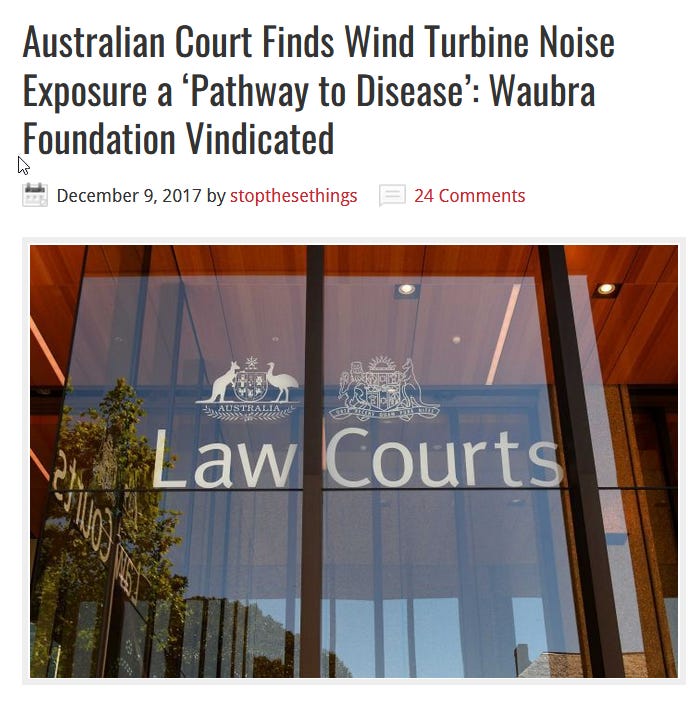
In a World first, Australia’s Administrative Appeals Tribunal (AAT) has declared that the « noise annoyance » caused by wind turbine generated low-frequency noise and infrasound « is a plausible pathway to disease.»
This is based on the;
« established association between noise annoyance and some diseases, including hypertension and cardiovascular disease, possibly mediated in part by disturbed sleep and/or psychological stress/distress.»


« The loss of amenity for a surrounding landowner due to wind turbine noise can form the basis of a successful claim in private nuisance. This is the first time a successful claim has been made on these grounds against a wind energy facility operator in Australia.»
Source: minterellison.com
Detailed elements that led to this finding by the Australian Administrative Tribunal include;
A significant proportion of the sound emitted by wind turbines is in the lower frequency range, i.e. below 20 Hz;
The dB(A) weighting system is not designed to measure that sound, and is not an appropriate way of measuring it. It is even acknowledged in the International Standard, ISO 1996-1 that the A-weighting system alone is « not sufficient to assess sounds characterized by tonality, impulsiveness or strong low-frequency content » – Exhibit A29, T43/8; Section 6.1; « Acoustics – Description, measurement and assessment of environmental noise – Part 1: Basic quantities and assessment procedures,» International Standard ISO (1996-1).
The most accurate way of determining the level and type of sound present at a particular location is to measure the sound at that location;
The best way of accurately measuring Wind Turbine Noise [WTN] at a particular location is through ‘raw’ unweighted measurements which are not averaged across time and are then subjected to detailed “narrow-band” analysis;
When it is present, due to its particular characteristics, low frequency noise and infrasound can be greater indoors than outdoors at the same location, and can cause a building to vibrate, resulting in resonance;
Humans are more sensitive to low frequency sound, and it can therefore cause greater annoyance than higher frequency sound;
Even if it is not audible, low frequency noise and infrasound may have other effects on the human body, which are not mediated by hearing but also not fully understood. Those effects may include motion-sickness-like symptoms, vertigo, and tinnitus-like symptoms. However, the material before us does not include any study which has explored a possible connection between such symptoms and wind turbine emissions in a particular population.
Source: stopthesethings ~ copy from para 467 of the AAT judgement
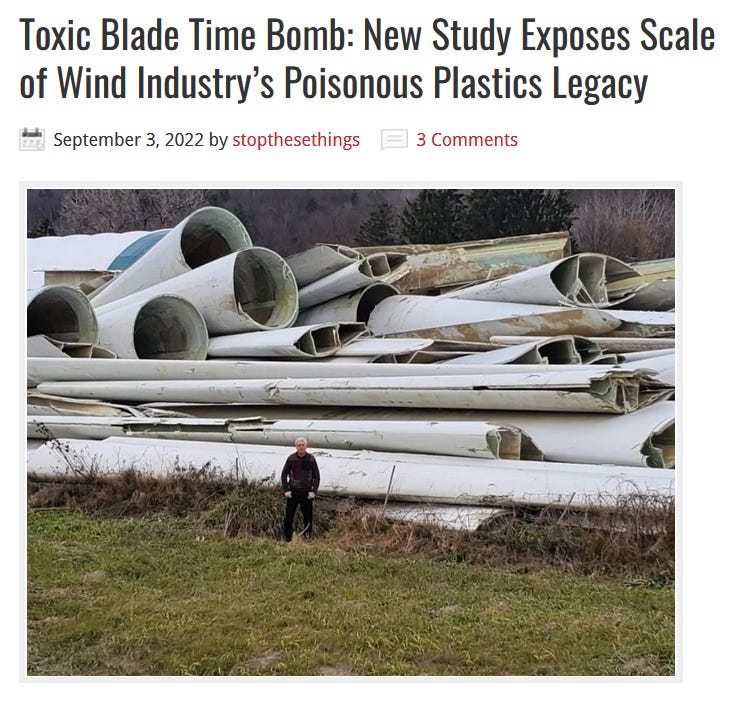
According to this report from the Stop These Things website;
Landfills are the final destination for millions of worn-out wind turbine blades.
Toxic plastics will be left to rot for the « benefit » of generations to come.
These 10-20 tonne, 40-60m long chunks of plastic, fibreglass, balsa wood and resins can’t be recycled.
The wind industry has been dumping them quietly for years now; often illegally.

Bisphenol A ~ Used in Turbine Blades
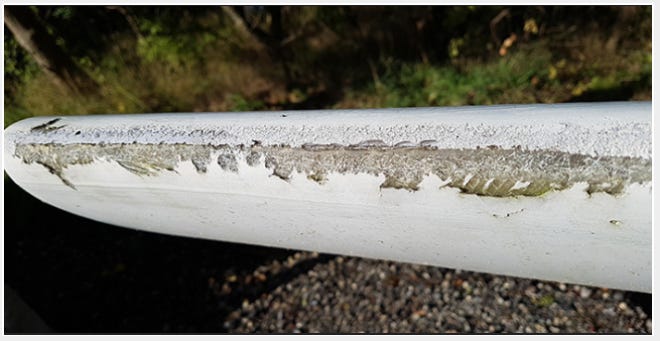
Damaged turbine blade with protective coating chipped and flaking - exposing bisphenol layer
Bisphenol A [or BPA] is a synthetic organic compound whose reactant is phenol.
Used in the production of all kinds of plastics.
The attached letter A indicates = acetone as the second reactant.
Highly suspicious that Bisphenol A = endocrine disruptor.
Endocrine disrupting chemicals, with links to about 80 diseases.
Foetuses and young children are especially vulnerable, because;
Their hormonal system is still developing.
In 2012, the World Health Organization warned about the potentially carcinogenic properties of endocrine disruptors and concluded that these substances pose a global threat to public health.

Bisphenol A ~ Global Production
Wind turbine blades are the largest consumer of epoxy plastics.
Wind turbine blades ~ fiberglass impregnated with epoxy to make them stronger.
Global production of blades is more than 10 million tonnes.
Epoxy contains 30-40% of Bisphenol A.
Result: the particulate matter that comes from eroding windmill blades therefore contains a high content of Bisphenol A.
These particles end up in creeks and then aquifers.
1 gram of Bisphenol A makes 10 million liters of water unusable.

Global Wind Energy Investments ~ 2011 - 2021
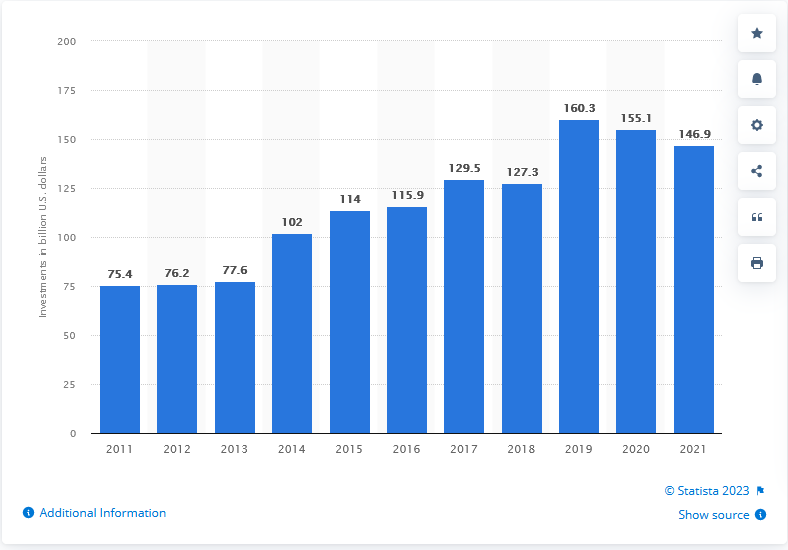
Investments in US$ Billions

Up Next ~ Focus upon the « Net Zero by 2050 » debate with the latest developments.
