

In Chapter 1, I exposed how INPEX pays just 0.70% tax on $billions in Northern Territory gas extraction.
In Chapter 2, I revealed the legal weapon — Force Majeure — that could save the Territory from fiscal collapse.
Now, Western Australia [WA] is about to make the same catastrophic error.
The WA Labor government, in partnership with the Federal Labor government, is planning to pour over $800 million in taxpayer money into a privately-owned corporate oil refinery near Karratha — owned by billionaire Vikas Rambal — his Perdaman company.
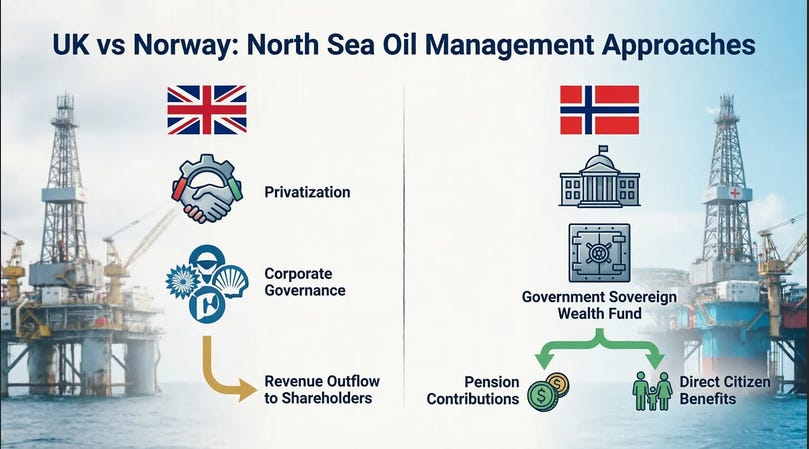
This won’t be a state-owned wealth generator like Norway’s model.
It will be another giveaway to private interests, following the UK’s failed privatization path that cost Britain £800 billion.
While taxpayers guarantee the loans, private shareholders will reap the profits.
And just like INPEX, we have no idea what tax Perdaman will pay — because they don’t appear in the ATO corporate tax transparency data.
This is the UK’s North Sea oil disaster, replaying in Western Australia.
The Perdaman Deal: Public Risk, Private Profit
The Numbers Don’t Lie
Project Scale:
Total project cost: $6 - 6.5 billion.
Estimated lifetime revenue: $77 billion
Location: 20km north-west of Karratha, WA.
Product: Oil refinery + urea fertiliser plant.
Taxpayer Funding:
NAIF loans: $220 million federal loan
Infrastructure loans: $255 million — Pilbara Ports Authority $159M + Water Corporation $96M.
Export Finance Australia: $269 million loan.
WA Government direct funding: $50+ million for infrastructure.
Total taxpayer exposure: Over $800 million in government-backed loans.
Ownership:
Perdaman: Family-owned multinational — Vikas Rambal, billionaire.
NOT state-owned — unlike Norway’s 67% government stake in Equinor.
Profits flow to: Private shareholders, not citizens
The Tax Transparency Black Hole
Here’s where it gets disturbing.
I searched through Michael West Media’s TaxData database — which contains ATO corporate tax transparency data for 1,274+ companies from 2014-2024.
Perdaman does not appear.
This means one of three things:
They’ve paid ZERO tax — below taxable income thresholds.
They’re structured to avoid tax reporting.
They’re still in development with no profitable operations.
Given that Perdaman’s existing operations should be generating revenue, their absence from the tax data is a massive red flag.
The Historical Pattern: Rambal’s Tax Dispute
The $20 Million ATO Battle
Vikas Rambal, Perdaman’s owner and chairman, has an ATO history.
In 2014, the Australian Taxation Office pursued Rambal over $20 million in unpaid taxes from a previous business venture.
Rambal disputed the ruling, arguing he owed less than $10 million.
The case was eventually settled, but the details remain confidential.
It is worth being precise about what this dispute was — and wasn't.
It concerned Rambal's personal tax position on a settlement he received in 2007 after exiting his stake in Burrup Fertilisers, not Perdaman's corporate tax conduct, and it predates the current urea project entirely.
It doesn't tell us how Perdaman itself is taxed today. But it does establish that Rambal has form disputing ATO assessments at the multi-million-dollar level — which makes Perdaman's complete absence from the ATO's corporate tax transparency data, on a project now worth $77 billion in lifetime revenue, a question worth Western Australians asking directly, not assuming.
This history raises critical questions:
Will Perdaman pay fair tax on $77 billion in lifetime revenue?
Are taxpayer-backed loans being used to subsidize private wealth?
Where is the transparency?
UK vs Norway: The Template for Disaster
The Privatization Trap
Let me show you exactly what WA is repeating.
UK Model — Privatization:
Government: Gave away North Sea oil to private corporations.
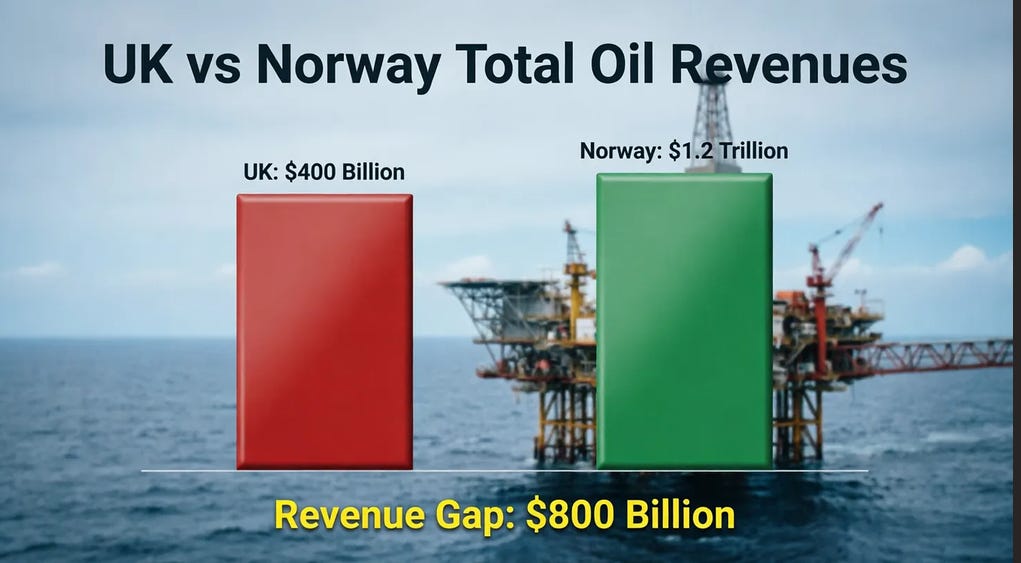
Tax revenue: $400 billion total — 1975–2025.
Effective tax rate: $11/barrel.
Result: No sovereign wealth fund was built. Had Britain invested its oil tax revenue the way Norway did, analysts estimate it would hold a fund worth £500–700 billion today — wealth that instead went to private shareholders.
Who benefited: Private shareholders — many foreign.
Norway Model — State Ownership:
Government: Kept 67% state ownership via Equinor.
Tax revenue: $1.2 trillion total — 1971–2025.
Effective tax rate: $29.80/barrel — nearly 3x higher than the UK.
Result: A $2 trillion sovereign wealth fund — worth roughly $385,000 per citizen.
Who benefited: Norwegian citizens.
This is the $800 billion mistake — the gap between what Britain’s oil wealth actually built (nothing, for the public) and what it could have built under a Norwegian-style model. It’s a separate question from the UK’s broader national debt, which has its own causes — the point here is the wealth Britain chose not to keep, not the debt it later ran up.
The £800 Billion Gap represents the difference between privatization and public ownership.
WA Is Following the UK Path
Perdaman/WA Model:
Government: Providing $800M+ in taxpayer loans
Ownership: 100% private — Rambal family.
Tax transparency: NONE — not in ATO data.
Risk: Taxpayers guarantee loans
Profit: Private shareholders
Norway Model — What WA Should Do:
Government: State ownership + control.
Ownership: 67% government stake.
Tax transparency: Full public disclosure.
Risk: State manages risk.
Profit: Citizens via sovereign fund.

Who’s laughing here Aussies? The Clever Country, that is who!
The Legal Weapon: Force Majeure Applies Here Too
The Same Doctrine, Different Context
Recall the Force Majeure pathway I outlined in Part 2?
China, Singapore, South Korea, and India successfully invoked Force Majeure in 2026 due to the Strait of Hormuz closure.
They’re thousands of kilometers away, but the indirect economic disruption was sufficient.
WA can invoke the same principle:
The 2026 geopolitical shock + WA fiscal pressures + Perdaman’s unclear tax contribution = fundamental change of circumstances
Under the Doctrine of Frustration (Codelfa Construction Pty Ltd v State Rail Authority of NSW), WA can argue:
The 2026 global environment makes the original loan terms radically different.
Taxpayers shouldn’t guarantee private profits while the state struggles.
Public interest demands renegotiation.
Three Demands for Western Australians
The Road to Prosperity
1. Demand Transparency
WA must immediately disclose:
The Perdaman company’s complete tax history - ATO records.
All loan terms and conditions.
Risk assessments for taxpayer exposure.
Expected tax revenue over the project’s life.
2. Halt the Giveaway
Before spending another taxpayer dollar:
Conduct a full public inquiry into the Perdaman tax records.
Compare state-owned vs private ownership models.
Assess Norway’s success vs UK’s failure.
Require 51% state ownership minimum.
3. Legislate for the Future
Pass a WA Resource Sovereignty Act requiring:
Minimum 51% state ownership of all major resource projects
Full tax transparency (public disclosure of all payments)
No fiscal stability agreements or corporate immunity clauses
Revenue dedicated to a WA sovereign wealth fund
The Next Test: The Bedout Sub-Basin
Perdaman is not an isolated case. It’s a template — and Western Australia is about to be handed a second chance to prove whether it learned anything.
Offshore from Port Hedland, the Bedout Sub-Basin is emerging as one of the nation's most prospective untapped gas frontiers — home to the Dorado discovery, Australia's largest undeveloped oil find, holding an estimated 250 million barrels of recoverable oil.¹⁵
As geologist-run channel OzGeology put it bluntly: Australia found the oil, and so far, has done nothing with it. Santos, Carnarvon Energy, and Taiwan's state-owned CPC (via its subsidiary OPIC Australia) are now advancing exploration and drilling programs there through 2026 and beyond — building toward the kind of final investment decisions that, on past form, trigger exactly the pattern this investigation has documented: public loans, private ownership, and a tax outcome nobody can see coming until it's too late to fix.
This is the difference between Chapter 3 and what comes next.
Perdaman’s financing is already locked in — the $800 million is committed, the structure is set.
Bedout isn’t.
The ownership terms, the tax transparency requirements, and the public stake — if there is to be one — are still being decided.
The Three Demands above apply here with more force, not less, because this time WA has the chance to set the terms before the money moves, not after.
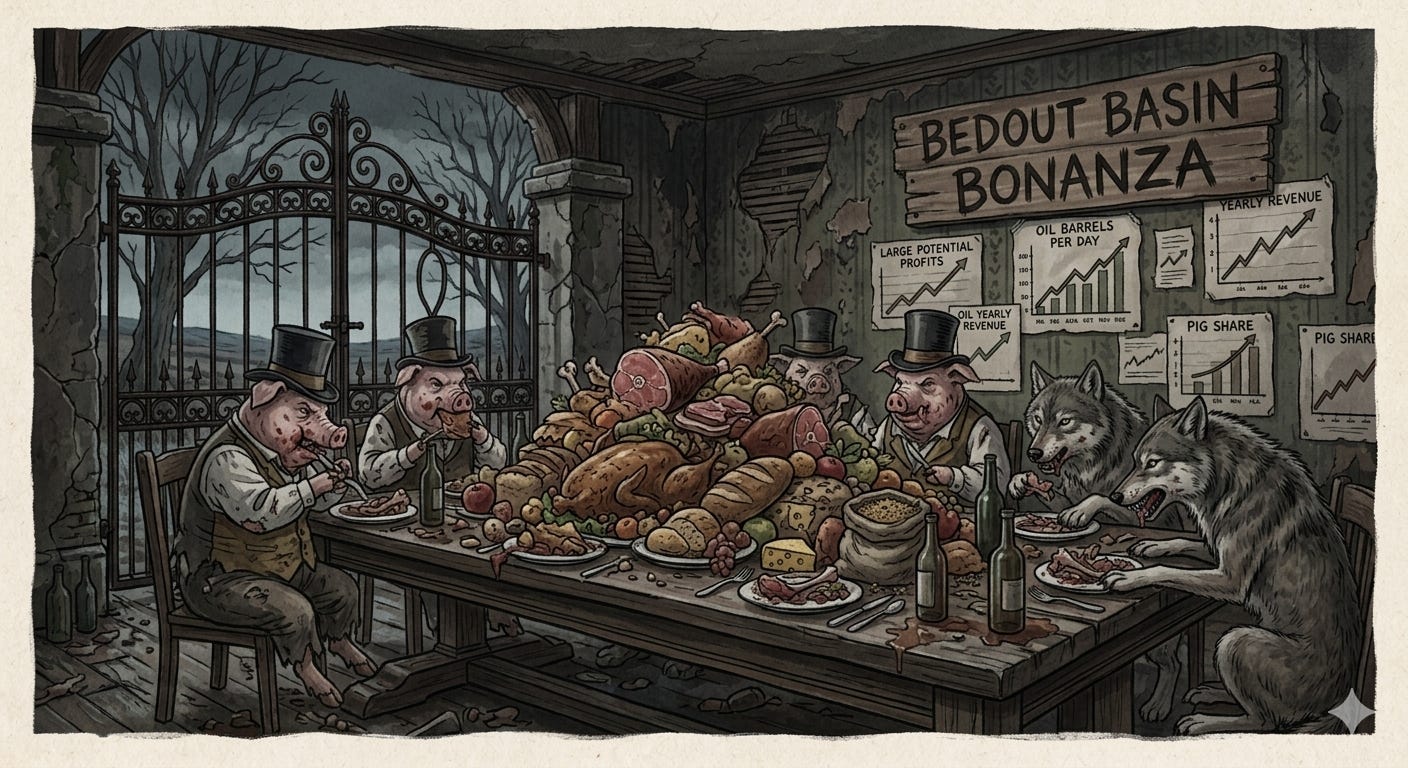
The pigs learned to walk on two legs once. Western Australia has now watched them do it twice. The question this series will keep asking is whether anyone in Perth is taking notes.
There is a massive new Oil & Gas development in the Northwest Shelf area.
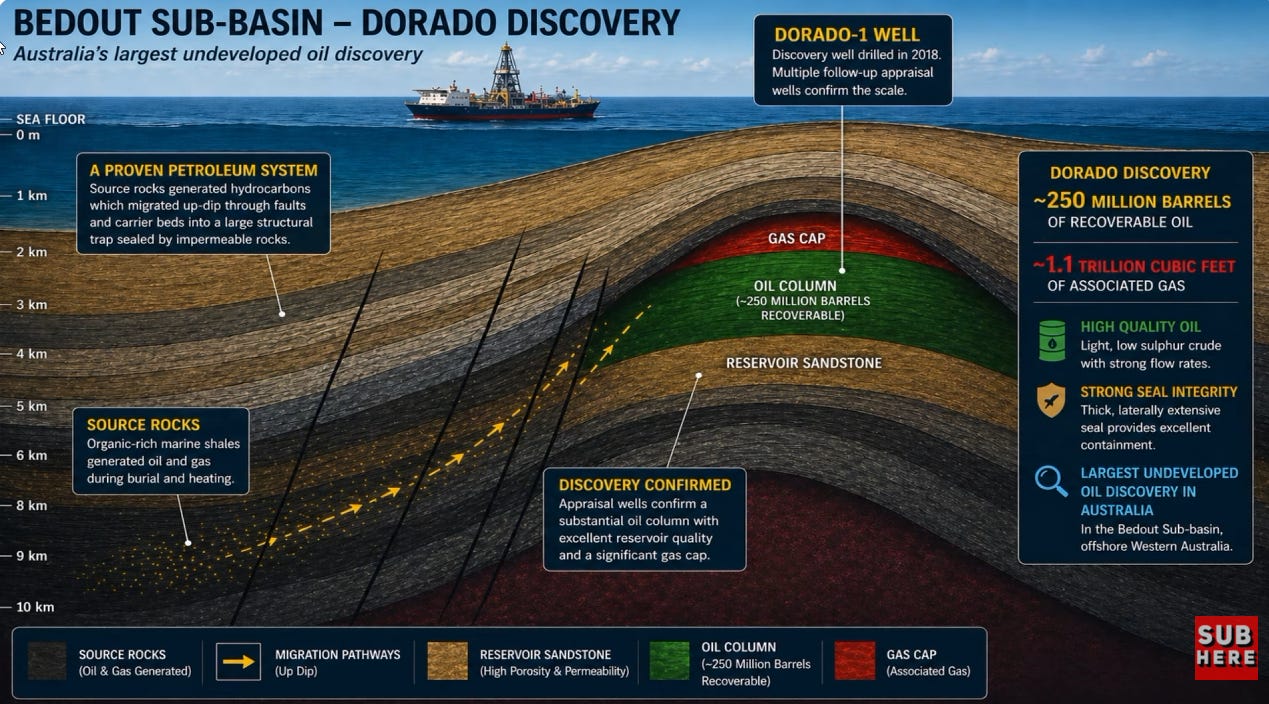
Source: OzGeology, "Australia Found 250 Million Barrels of Oil... Then Did Nothing," April 2026.
Here is how the Bedout sub-basin developed over millions of years.
West Australians have yet another opportunity to ensure that they — and not pigs & corporate wolves — get to reap this Bonanza for their State and future generations.
References & Further Reading:
Michael West Media TaxData: https://taxdata.michaelwest.com.au/
Perdaman Project Details: https://www.naif.gov.au/our-projects/perdaman-urea-project-and-supporting-infrastructure/
UK vs Norway Analysis: https://michaelwest.com.au/the-800-billion-mistake-how-britain-gave-away-north-sea-oil/
ATO Corporate Tax Transparency: https://www.ato.gov.au/about-ato/research-and-statistics/in-detail/taxation-statistics/taxation-statistics-2023-24/
Vikas Rambal Tax Dispute: https://thewest.com.au/business/finance/rambal-ato-end-tax-tussle-ng-ya-369650
Force Majeure Precedent: https://energynow.com/2026/03/charted-oil-trade-through-the-strait-of-hormuz-by-country-visual-capitalist/
Professor Steve Keen on Strait of Hormuz:
NT Budget & Debt Crisis: https://www.abc.net.au/news/2025-05-13/nt-budget-2025-treasurer-bill-yan-debt-police-corrections/105280812
OzGeology — "Australia Found 250 Million Barrels of Oil... Then Did Nothing": [YouTube link]