

Spying is often called the world's second oldest profession.
Espionage has been recognized as of critical importance in military affairs since ancient times.
The oldest known classified document was a report made by a spy disguised as a diplomatic envoy in the court of King Hammurabi, who died in or around 1750 BC. The ancient Egyptians had a developed secret service, and espionage is mentioned in the Iliad, the Bible, and the Amarna letters.[3]
Espionage was also prevalent in the Greco-Roman world, when spies employed illiterate subjects in civil services.[4][5][6]
Sun Tzu in Chapter 13 of his famous Art of War, stated;
« Thus, what enables the wise sovereign and the good general to strike and conquer, and achieve things beyond the reach of ordinary men, is FOREKNOWLEDGE.»
General Sun Tzu describes the 5 different Types of Spies necessary to gather Foreknowledge;
Local Spies: Recruited from the local population of the enemy territory.
They are used to gather intelligence on the terrain, local conditions, and weaknesses of the opposing forces.Inside Spies [or Inward Spies]: Officials, advisors, or officers serving within the enemy’s government or military.
They provide insider access to the enemy’s plans and vulnerabilities. [1]Reverse Spies [or Double Agents/Converted Spies]:
Enemy spies who have been captured, bribed and turned to work for your side instead. [1]Dead Spies [or Doomed Spies]: Used for deception. You intentionally let these spies learn false information or participate in cover operations, ensuring they pass this false intelligence to the enemy.
Surviving Spies: Spies who infiltrate the enemy camp and successfully return with accurate intelligence about the enemy’s status.
Many of the Boomer Generation will recall this Spy Vs Spy cartoon series ~ 1960s era.
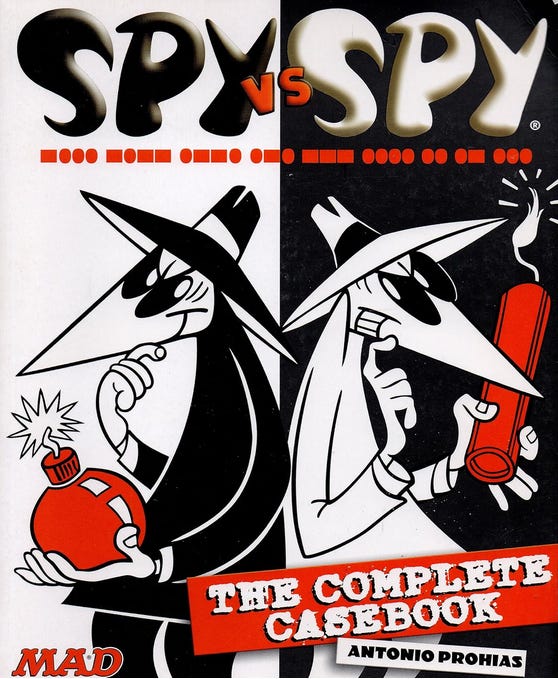
Source: Spy Vs Spy ~ the complete casebook by Antonio Prohias
For seventy years, the spy business ran on patience.
A case officer. A mission. A target.
Months, sometimes years, of trust built by one coffee or cocktail at a time.
A hollow coin dropped in a New York gutter or left beneath a park bench on the Unter-Den-Linden.
A message left in a hollowed-out brick, retrieved hours later by someone who’d never met the person who left it.
These famous Spy Thrillers kept the movie studios booming and the film aficionado public enthralled for decades, as they tried to determine Friend from Foe ~ Spy Vs Spy.

How will Movie studios pivot from the familiar & classic Spy Thriller Genre of the past, into new villainy , where Good Data Centres battle with the Bad?
Or will Movie Studios simply bypass the AI Data Centres altogether and produce Spy Thriller Science-fiction classics, similar to Isaac Asimov’s, I Robot.

That craft ~~ HUMINT, Human Intelligence ~~ hasn’t changed much in the basics since the Cold War. It still can’t be automated.
No algorithm has ever talked a foreign official into betraying his country over a quiet dinner.
But everything around it just did change.

Cold War Era ~ Left panel ~ Soviet KGB === Right panel East German Stasi
The New 6th Spy ~~ The machine enters the trade
Every major Western intelligence agency is now using the same careful phrase to describe what’s happening inside their walls: artificial intelligence isn’t replacing their people, it’s «augmenting» them. The UK GCHQ calls it that.
So does the CIA’s public messaging. So, unofficially, does everyone else.
It’s true, as far as it goes. But notice how many of them felt the need to say it out loud ~~ in the same year they tripled their computer budgets.
What AI actually does inside an intelligence agency is unglamorous and enormous: it fuses HUMINT reporting, intercepted signals, and open-source material ~ social media, satellite feeds, commercial data brokers ~ into a single machine-searchable pool, and finds patterns a human analyst would take weeks to spot, if they ever did.
The front half of the intelligence cycle ~ the part that used to take a case officer months of manual cable traffic ~ is being compressed into minutes.
That’s the pitch, anyway.
It comes with its own quiet failure modes, and they don’t get the same press release.
Today they are called «AI Agents.»
They have to « live » somewhere
Welcome to the New Home for AI Intelligence Agents ~ with a planet-wide reach.
No Nvidia Chips Needed! Amazon’s New AI Data Center For Anthropic Is Truly Massive
« On 1,200 acres in Indiana, Amazon’s biggest AI data center is now operational, with half a million AWS Trainium2 chips entirely devoted to powering OpenAI rival Anthropic.
Just over a year ago, the whole site was nothing but dirt and cornfields.
Seven buildings are operating now, and once complete, the site will have around 30 buildings and consume some 2.2 gigawatts of power.»
Here’s the part most coverage of «AI and spycraft» skips entirely: none of this floats in the cloud out of goodwill.
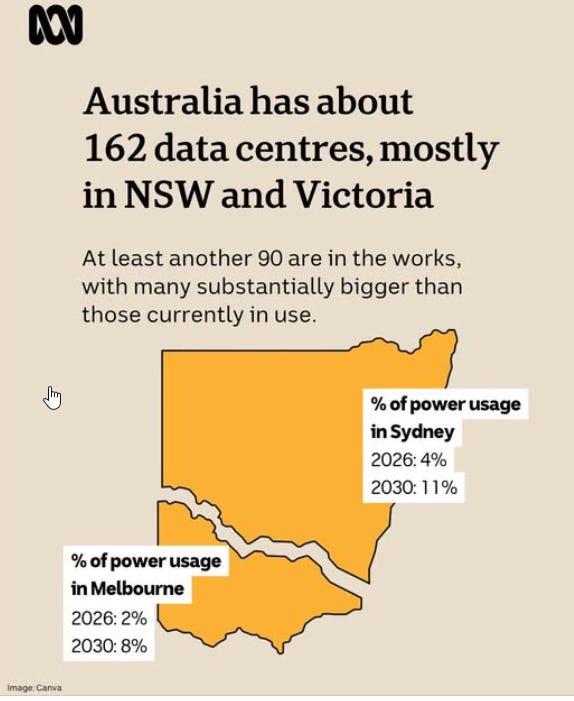
It runs on physical infrastructure ~ the same gigawatt-hungry, water-drinking, foreign-financed data centres this publication has spent five investigations pulling apart.
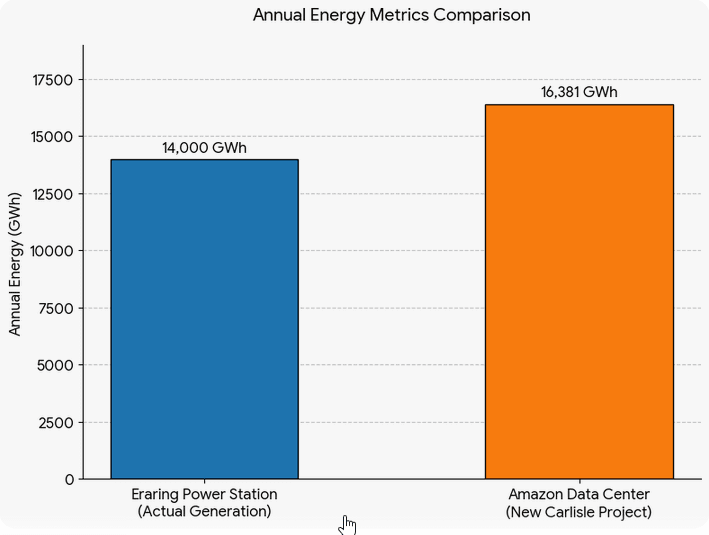
Comparison ~ Available Power for NSW ~~~ Vs Hyperscale AI Data Centre demand.
Eraring Power Station, NSW represents about 21% of New South Wales' total power grid requirements. Should a hyperscale AI Data Centre like the Amazon New Carlisle Project in Indiana, USA, be built in NSW, it would require another Eraring-sized Power Station to fulfill reliable power generation obligations to NSW residents.
Building a brand new coal-fired power station identical in capacity to the Eraring Power Station in NSW 2,880 MW [from its four main 720 MW units] would require an estimated capital expenditure [CapEx] between AUD $10.1 Billion and $17.4 Billion in today’s dollars. [1, 2, 3]
When Eraring was originally constructed by the NSW Electricity Commission between 1976 and 1984, the total historical nominal cost was AUD $1.653 Billion.
The NSA’s own Utah Data Center ~ the one Edward Snowden made infamous ~ was built for a pre-AI world: a filing cabinet for intercepted communications, searchable by keyword, running on a technical load of around 65 megawatts.
The hyperscale AI campuses now being built to do this kind of work run at more than ten times that energy drawdown, on a single site.
A «filing cabinet» that stores your data is one kind of problem.
An «AI Agent Analyst» that never sleeps, never forgets, and runs on someone else’s power grid is a different animal entirely.
And it’s already been bought
This isn’t speculative. In the last eighteen months: One US defence contractor signed a $10 billion enterprise agreement with the US Army, consolidating 75 separate contracts into a single all-source intelligence fusion platform.
The Pentagon’s original AI-for-surveillance pilot got promoted to a permanent, department-wide «program of record.»
In the first half of this fiscal year alone, the US Department of Defense committed north of $32 billion in contract ceiling to AI, cloud and data-fusion programs.
Closer to home, Australia’s own signals directorate ~ The Australian Signals Directorate [ASD] ~ has committed $9.9 billion over the decade to exactly this shift ~~ new AI capabilities, doubled analytic workforce, quadrupled global footprint ~ under a program with a name that reads like it was generated by the same acronym committee that named everything else in Canberra.
Nobody is answering the critical question!
Where will new reliable Power Generation Stations come from to power these centres?
The earlier Resource Sovereignty Series solutions to «Funding the Farm» have already been provided ~ but Napoleon & Snowball have no interest in charging royalties from the Plundering Multinational Corporations.
The sovereignty question the Osprey keeps asking about gas, pipelines and water applies here with even sharper talons: when the AI layer sitting astride a national intelligence function is procured commercially, and the computer data underneath it sits inside someone else’s data centre, on someone else’s supply chain ~ who actually holds the leverage?
