

Pay Attention here Possums!
Somewhere between a US Gulf Coast refinery and a wheat paddock in the Western Australian wheatbelt, sits a number most Australians have never heard of;
The Crack Spread — this is the price difference between the cost of a Barrel of Oil and the added cost of a Barrel of Refined Diesel.
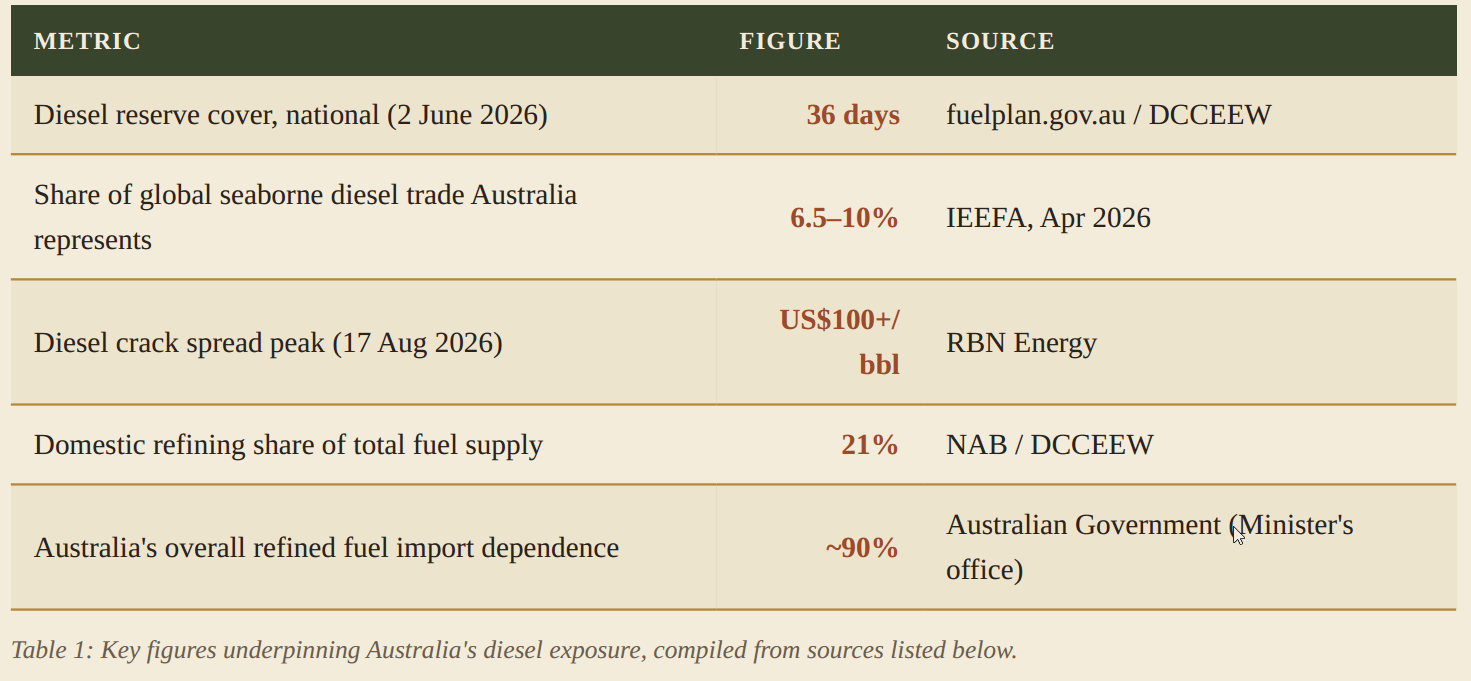
On 17 August 2026, the U.S.Gulf Coast diesel crack spread — the margin a refiner earns turning crude oil into diesel — broke US$100 a barrel for the first time in history.1
Crude oil itself is not critically scarce. What is really scarce, is the world’s ability to turn Oil into the fuel that moves Australia’s freight, runs its mines, and — with the 2026 crop harvest bearing down upon us — brings in the grain.
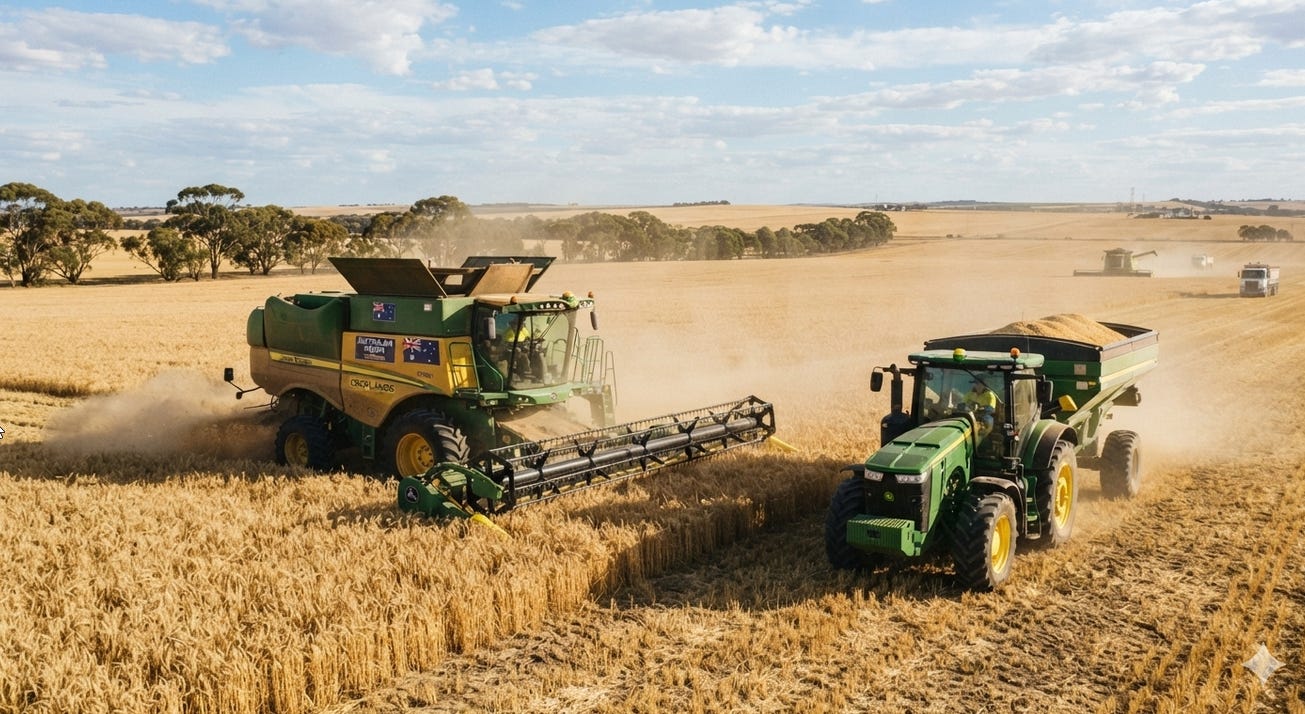
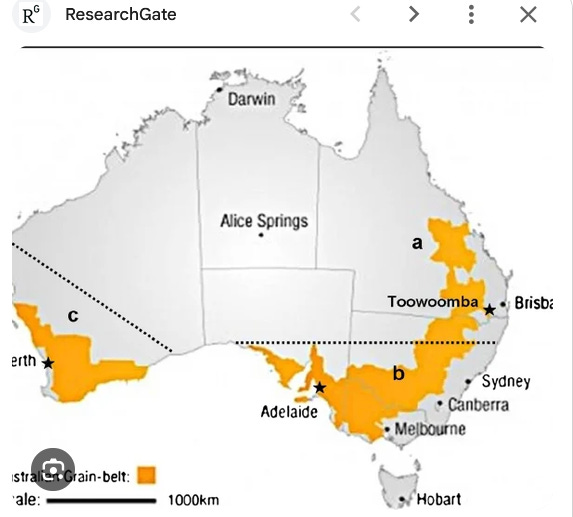
Australia’s grain belt map — it is simple — No Diesel = No harvest - Get it?
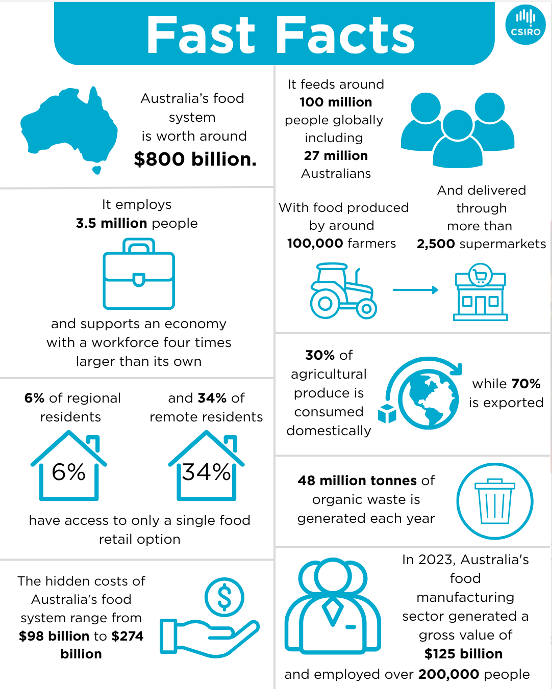
If there is No Diesel — How will food get harvested & how will it get to the supermarket?
This is not a story about a shortage of oil. It is a story about a shortage of refining capacity, and about how exposed a country becomes when it has spent three decades closing its own refineries and outsourcing that capacity to Asia. 2
For Australian grain growers heading into the next harvest, with seeding windows measured in days, not months, the distinction is not academic. It is the difference between a paddock harvest completed on time and a crop written off for an entire year.
The Margin, Not the Oil
A crack spread is simple arithmetic: the wholesale price of a refined product minus the cost of the crude that produced it. Diesel is harder to refine than petrol — it requires specific hydroprocessing and catalytic cracking stages — so when refining capacity disappears from the global system, diesel prices respond faster and more sharply than petrol prices do. 3
For comparison, the broader NYMEX 3-2-1 crack spread sat around US$69 a barrel on the same day in August — itself already well above the pre-2026 range of roughly US$19 to US$25. 4
Two geopolitical shocks removed a material slice of global refining capacity at almost the same time. Russia suspended diesel and petrol exports through January 2027 after Ukrainian drone strikes crippled its refining infrastructure. 4
Conflict-related disruption around the Strait of Hormuz has simultaneously taken Middle Eastern refineries offline, tightening regional processing capacity further. 4
As Hedgeye Risk Management’s Daryl Jones put it, crude is not the scarce input — the ability to refine it is. 4

Australia’s Exposure: What the Government’s Own Data Shows
Australia closed six of its eight oil refineries between 2003 and 2021, leaving the Ampol Lytton plant in Brisbane and Viva Energy’s Geelong refinery as the country’s last two — both dependent on government subsidy to keep operating. 2
The consequence, laid out in the government’s own petroleum statistics and confirmed independently by NAB Economics, is stark: domestic refining now covers only 21% of Australia’s total refined fuel supply.
The remaining 79% is imported, up from roughly 30% in 2011. 5
Of the countries supplying that imported diesel, South Korea is the single largest identified source, accounting for 25% of Australia’s total diesel supply. 5
Domestically refined fuel now covers barely a fifth of Australia’s needs. The rest is bought on the open international market, at whatever the crack spread demands.
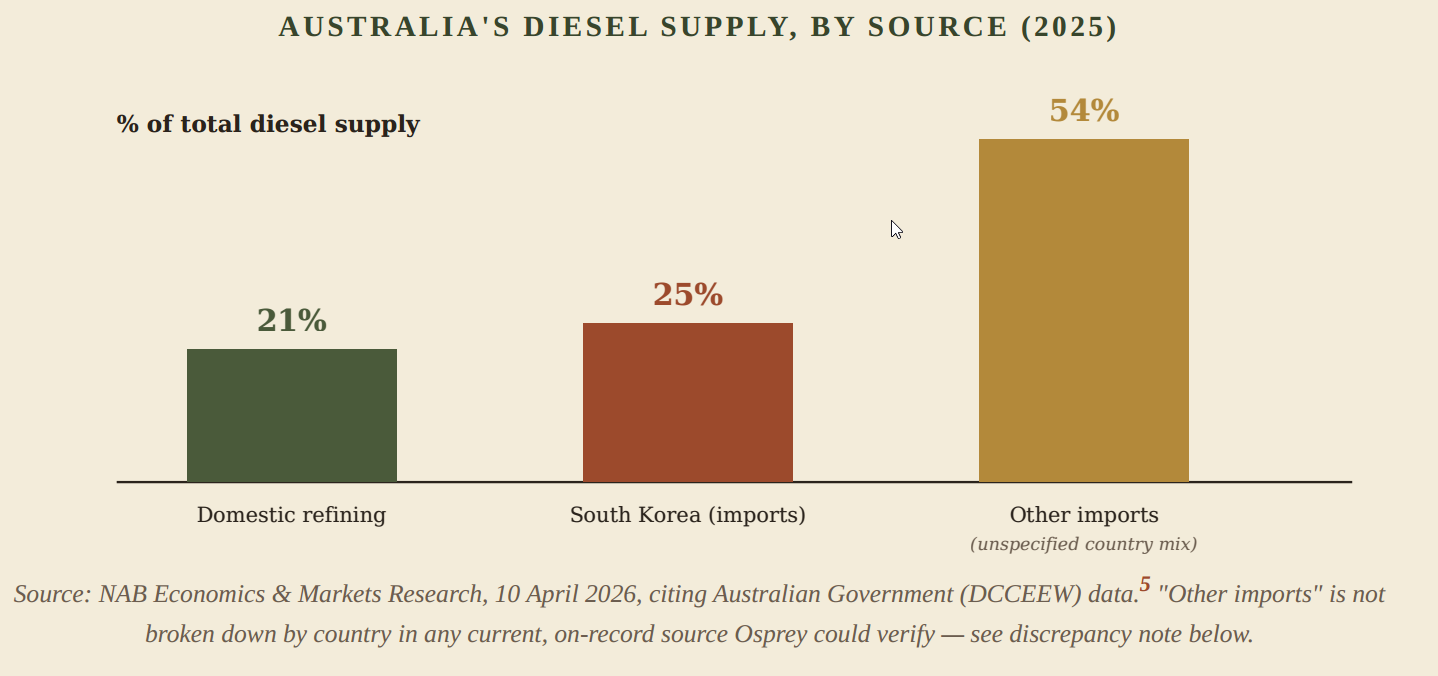
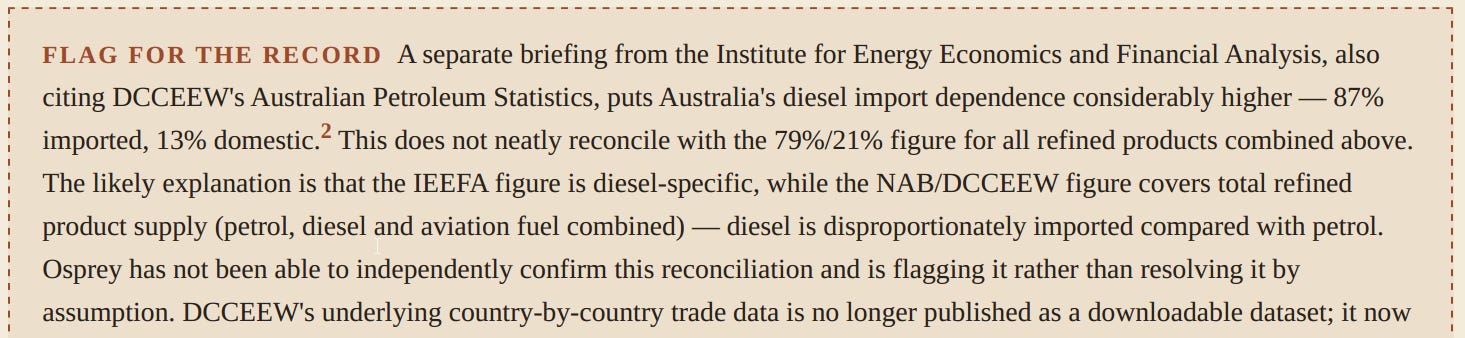

What is not in dispute is the direction of travel and the mechanism. Asia-Pacific refiners supply 96% of Australia’s imports, and those refiners overwhelmingly source their crude from the Middle East — meaning Australia is exposed twice over: once to Middle East crude supply, and again to Asian refining capacity. 5
With so little diesel produced onshore, Australian pump and bulk prices move with the international crack spread directly, not with the crude oil benchmark most price commentary still leads with. 8
Thin Reserves, Tight Timing
Australia’s buffer against exactly this kind of shock is thin by international standards. As of 2 June 2026, the government’s own Minimum Stockholding Obligation reporting showed 36 days of diesel reserve cover nationally. 9
Australia held the lowest oil stocks of any IEA member country in net-import-days terms in 2025, and remains the world’s largest single importer of diesel — representing an estimated 6.5% to 10% of global seaborne diesel trade despite having just 0.3% of the world’s population. 2
That reserve cover matters most against the calendar of the farm, not the calendar of the market. Western Australia delivered a record grain harvest in 2025, and the state’s Nationals have warned that record means nothing if growers cannot get fuel into paddocks to plant, spray and harvest in 2026 — noting diesel is the backbone of the entire agricultural supply chain, from tractor to truck to processor.10
A delay of even a few days during a seeding window can materially reduce yield; a two-week delay can make a crop non-viable, with no second chance within season parameters.11
The Harvest Under Pressure
This is no longer a hypothetical risk. National Farmers’ Federation president Hamish McIntyre has said growers are already seeing tightening supply and rising costs for fuel and fertiliser, and warned that some may be forced to scale back plantings if that persists.12
The Federation has since called for a ministerial roundtable specifically on fuel supply, timed ahead of the harvest season beginning in late 2026.12
Treasury’s own modelling, cited separately, suggests a seven-day fuel shortage during peak harvest could cut agricultural GDP by 2.3% for that quarter alone.13
Geography compounds the risk. Large-scale Australian agricultural operations sit, by definition, at the end of long, thin regional supply chains. When national fuel supply tightens, distribution concentrates around metropolitan hubs first, and independent regional distributors — the ones actually serving farms — tend to be rationed first.13
The Australian Convenience and Petroleum Marketers Association has advised growers to check now whether their local supplier holds a contracted supply agreement or is exposed to spot pricing, precisely because peak demand periods like harvest and sowing are when that distinction bites hardest.14
Russia’s export suspension runs through January 2027. Middle Eastern refinery restarts depend entirely on political and military developments with no reliable timeline.4
Releasing strategic crude reserves — the standard policy lever for an oil price spike — does little to fix a refining capacity problem, since those reserves hold crude, not finished diesel.4
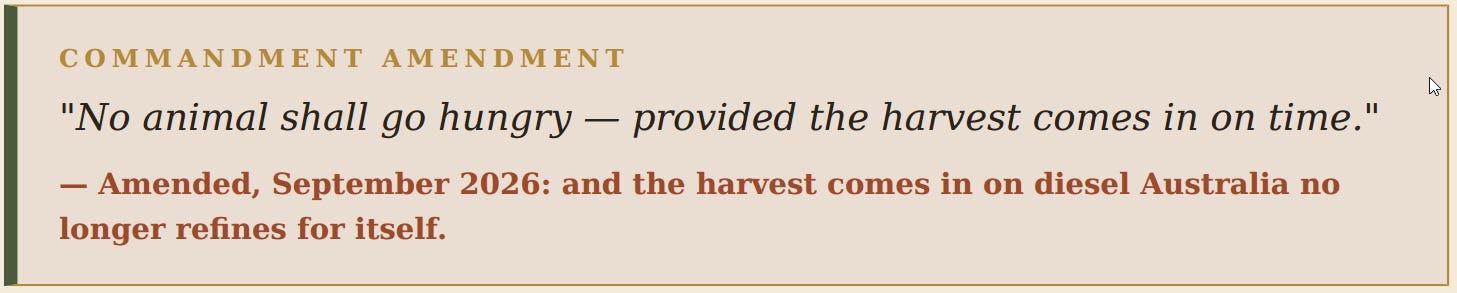
For a nation that closed most of its own refineries and now buys the finished product on the open market, that is a critical structural vulnerability and potentially an existential National Fuel Security Threat, not just a passing price cycle.
Osprey on Overwatch will continue to track the DCCEEW petroleum statistics, the diesel crack spread, and the National Farmers’ Federation’s fuel-supply advocacy as the 2026 harvest approaches.
Readers with on the-ground visibility into regional fuel contracts, allocation practices, or supplier rationing are encouraged to make contact.
Take Home Message
NO Diesel == Farming and Food Transport STOPS!
Sources
“$100/bbl Diesel Crack: How 2026 Exposed Fragility in Global Refining.” RBN Energy. rbnenergy.com
“Managing Australia’s diesel squeeze: How acting now can save fuel and protect essential services.” Institute for Energy Economics and Financial Analysis (IEEFA), April 2026. ieefa.org
“Diesel refining margins hit US$100 before Australian harvest.” Bushletter, 21 September 2026. bushletter.com
“Diesel Crack Spread Analysis.” Hedgeye Risk Management, 2026. app.hedgeye.com
“Explainer: Fuel in Australia — where it comes from.” NAB News, Economy and Markets, 10 April 2026. nab.com.au
Australian Petroleum Statistics. Department of Climate Change, Energy, the Environment and Water (DCCEEW). energy.gov.au
Australian Petroleum Statistics dataset. data.gov.au. data.gov.au
Fuel statistics — weekly reserve and supply reporting. fuelplan.gov.au, data as at 2 June 2026. fuelplan.gov.au
Interview transcript, 2GB. Minister for Energy and Emissions Reduction. minister.industry.gov.au
“Fuel shortage putting WA farmers and food supply at risk.” The Nationals WA. nationalswa.com
“Diesel Procurement for Australian Agriculture.” Trace Consultants, March 2026. traceconsultants.com.au
“Statement on Ministerial Roundtable on Fuel Supply.” National Farmers’ Federation. nff.org.au
“Harvest diesel supply jitters ahead as global reserves dwindle.” Farm Online / ACM Agri, 21–22 July 2026. farmonline.com.au
“Australian farmers: ACM Agri tracking live diesel imports now.” The Canberra Times. canberratimes.com.au