

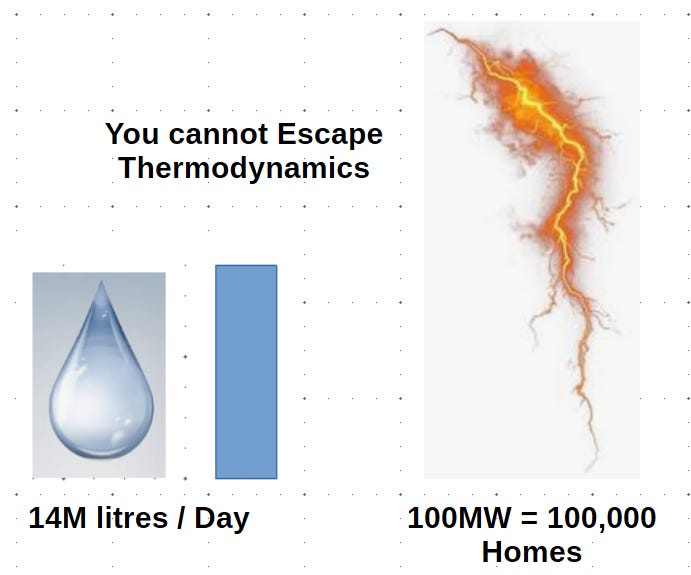
Current - 2026 - UK data shows that AI Data Centres [DCs] water-cooling operations use 14 Million litres per day.
Because of increasing community concerns about this water usage, some DC owners are proposing to use air-cooling and/refrigeration systems.
INTRODUCTION: The Industry’s “Solution”
“We don’t need water anymore.”
That’s the promise from AI data centre builders facing community backlash over millions of litres drained from drought-stricken aquifers.
Their answer? Switch to “dry/air cooling” and “refrigeration systems.”
Could this be a Lie?
They’re not solving the resource crisis. They’re shifting it — from your local water table to the national power grid. From one public utility to another.
And the math doesn’t add up.
The Water Cooling Trap
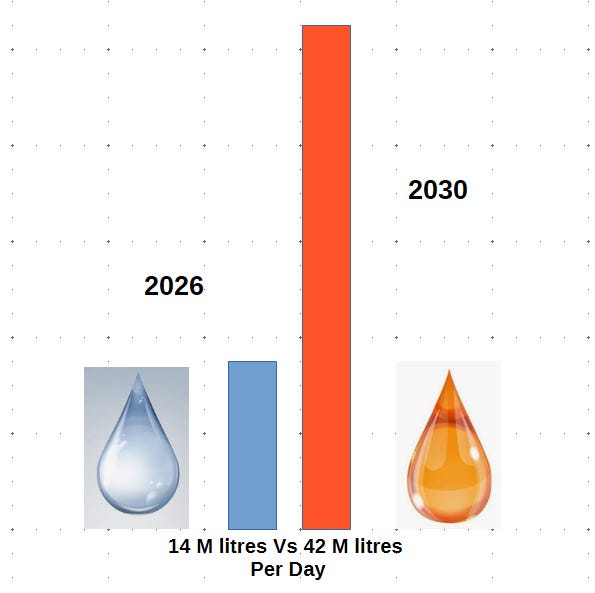
“By 2030, AI expansion hits 42 million litres/day”
Current Reality:
UK data centres already use 14 million litres/day — enough for 20,000 homes
By 2030, that swells to 42 million litres as AI expands
Water companies warn: The UK DOES NOT have enough water
The Industry Response:
“We’ll use closed-loop liquid cooling - AND/OR - refrigeration systems that eliminate high-use water evaporative systems.”
The Truth:
These closed-loop liquid cooling / refrigeration systems might save water — but at what cost to the energy grid?
AI Data Centre Cooling — Extremely Challenging & Dynamic Industry Issue
As the Compute Power of new GPU chips increases, so does the heat they generate & the cooling necessary to ensure stable rack operating temperatures.
Global data centre water consumption is currently estimated at 560 billion litres per year — roughly equivalent to flushing every toilet in Germany for a year.
By 2030, that figure is projected to roughly double, to over 1 trillion litres annually.These numbers appear in policy documents, trade press, and sustainability reports with some regularity, and they are broadly defensible. They are also incomplete if one wants to analyze or estimate a particular facility or make data-driven decisions.
People split water use in data centres into three categories;
Direct water: the water a facility consumes through evaporation or humidification systems. It is the most accessible metric and is usually the one disclosed.
Indirect water: kilowatt-hours drawn from a power plant that carries associated water costs in steam and cooling, none of which appear in any operator’s disclosure.
Per-query water: meaning “a GPT response uses X litres,” a largely journalistic invention, not without significant caveats and broad assumptions.
Source: impakter.com
problem in determining the Total Water Usage for the entire AI Data Centre Market is the already massive variations between the earlier AI DC builds, with the newer models.
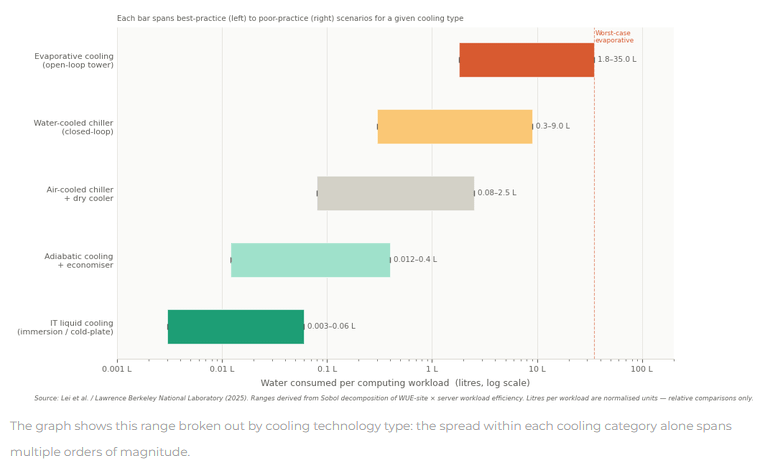
This logarithmic scale graph shows this clearly - the red - evaporative - type consumes massive amounts of water.
Author Fedor Sukhoi gathered significant data for his report - Is Water Usage in AI Data Centres Sustainable? - using England & the data compiled by WRc and MOSL covering 208 of 453 registered data centres in England between 2020 and 2024.
« Why pick England? Because it represents something close to a best-case scenario: temperate climate, relatively low-carbon grid, and a functioning non-household water market that generates metered records. What the data reveals from that best case is not reassuring. What it implies for almost everywhere else is worse.»
The AI DC Industry is moving toward Large Hyperscale Types of AI Data Centres as this graph below shows.
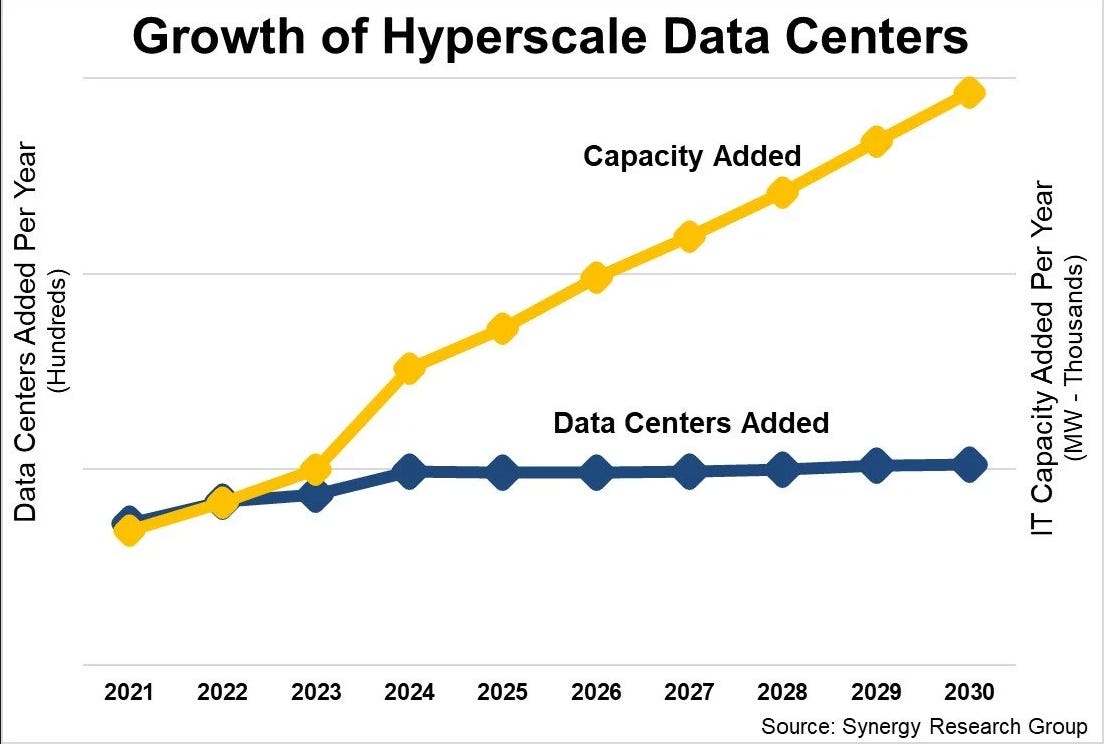
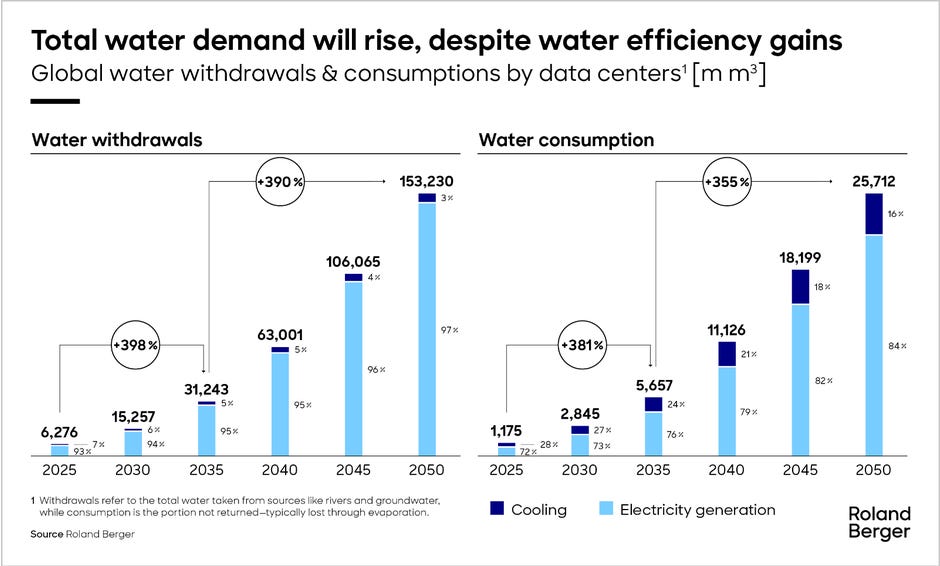
According to Roland Berger, total water demand will rise, despite water efficiency gains.
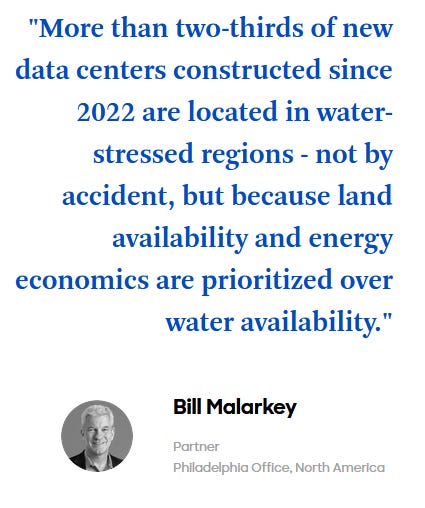
Another critical element in AI Data Centre Farms, is the way these DC build sites are chosen.
The Energy Grid Crisis
“A typical hyperscale data centre uses 100 MW — as much electricity as 100,000 households”
The Power Demand:
Traditional — Air-Cooled Data Centres:
Cooling absorbs 38-50% of total energy load
Average rack: 7 kW = $30,000/year in electricity
AI Workloads — Liquid-Cooled:
Single AI rack: $150,000/year in electricity
5x the power cost per rack
Energy consumption could double or triple by 2028
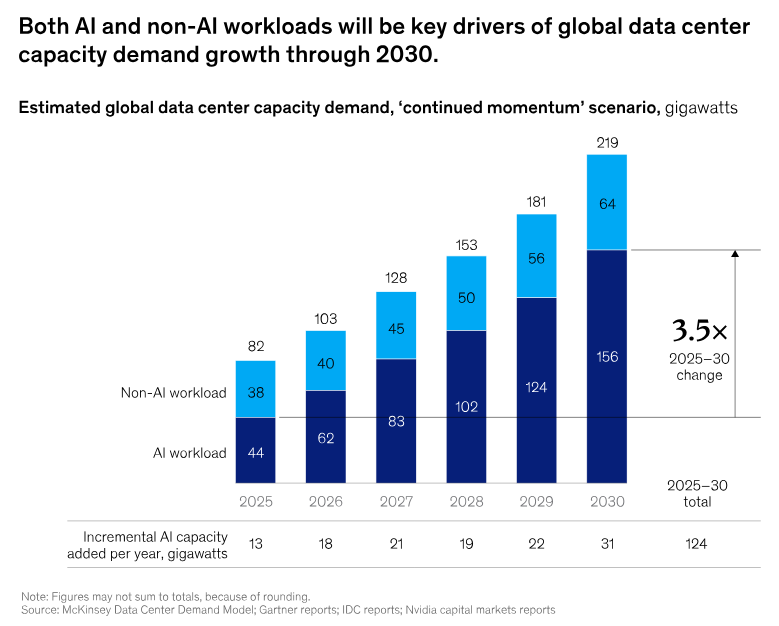
As AI products proliferate and inference delivery models change, data center stakeholders will have to strike the right balance between edge and cloud computing capacity.
The Math:
If the UK builds enough AI data centres to hit 42M litres/day capacity using liquid cooling:
Grid demand increases 300-400%
Infrastructure costs: Billions
Who pays? You do.
How the UK is Tackling AI Growth Zones
The UK is working on a new Term in the language of AI Data Centres.
Earlier this year, the UK Government announced the establishment of ‘AI Growth Zones’ [AIGZs], with the dual objectives of accelerating the build-out of data centres, while also helping to drive local rejuvenation.
Regional authorities, local authorities and industry were invited to bid for sites that can host at least 500 MW of data‑centre capacity by 2030, with an announcement expected on the first tranche of AIGZs this summer. Submissions for future AIGZs re-opened last month.
Here is a link to a Map Derived Resource that shows Infrastructure Necessary for Hyperscale IA DCs. This UK map below is one an example - available water!
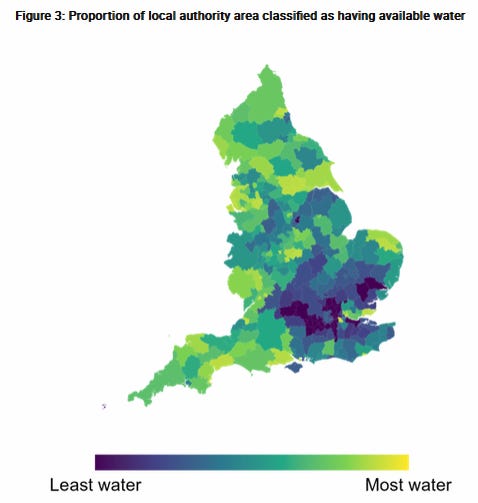
Other maps include high-voltage energy grid transmission lines,
Fiber-optic internet connections,
Water capacity & pipelines,
Waste heat dumping facilities — and more
The Sovereignty Theft
“Privatize the profits. Socialize the scarcity.”
The Pattern:
Step 1: Multinational corporations secure land and grid connections
Step 2: They extract resources - water & electricity - at subsidized rates
Step 3: They sell AI services offshore, paying zero royalties!
Step 4: Communities bear the cost: depleted aquifers AND/OR blackouts.
The Orwellian Rewrite:
“Innovation” = Extracting public resources for private gain
“Sustainability” = Shifting extraction from one resource to another
“Progress” = Communities paying for corporate infrastructure
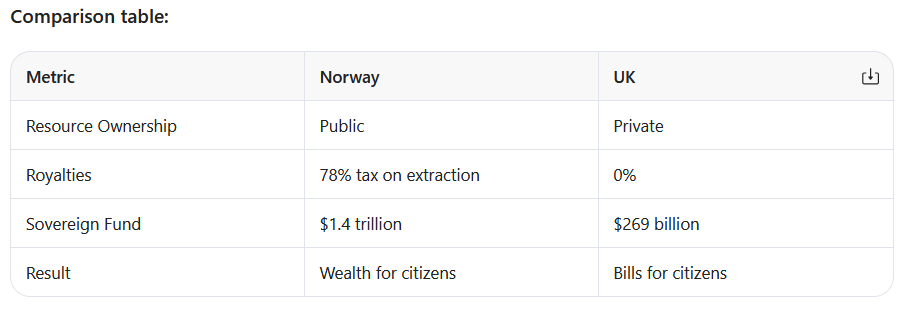
The Norway Comparison:
While the UK gives away resources:
Norway’s sovereign wealth fund: NOK 21.4 trillion — AUD 3.2 trillion.!
UK’s approach: Zero royalties, zero sovereignty, zero control
📢 Call To Action
Demand Resource Sovereignty:
Royalties on extraction — whether water or electricity
Public ownership stakes in critical infrastructure
Transparency on total resource consumption (water + power)
Community veto power over facilities that drain local resources
This isn’t anti-technology. It’s pro-sovereignty.
