

Major General Sir Charles Rosenthal, a frontline commander who survived Gallipoli and the Western Front, watched this transformation from the floor of the New South Wales Parliament.
While his peers celebrated “modernisation”, Rosenthal recognized a structural trap.
He warned that by phasing out draught-horses & bullocks, in favour of combustion engines without building local refineries or fuel reserves, Australia was creating a catastrophic vulnerability in Petrol, Oil, and Lubricants [POL].
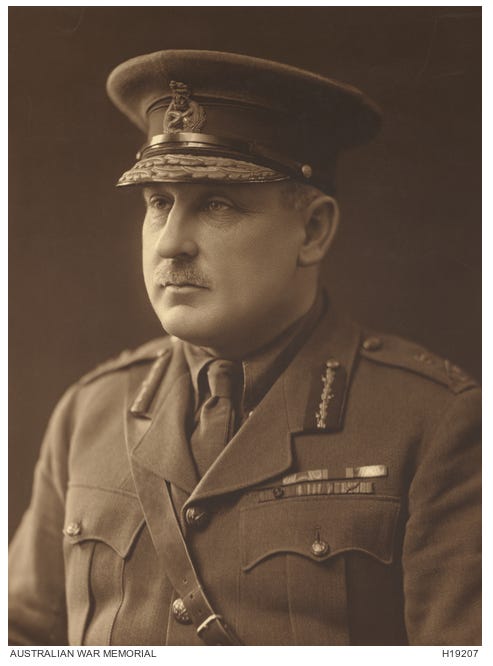
Portrait of Major General Sir Charles Rosenthal KCB CMG DSO VD, who saw action at Gallipoli and subsequently commanded the 2nd Australian Division during 1918/19.
His calls for energy self-sufficiency were ignored as uneconomic. Today, as geopolitical choke points tighten and Australia operates with an exceptionally lean domestic fuel reserve, Rosenthal’s mid-1920s legislative warnings remain highly relevant.
The Interwar Shift — The Trajectory of Liquid Fuel Dependence
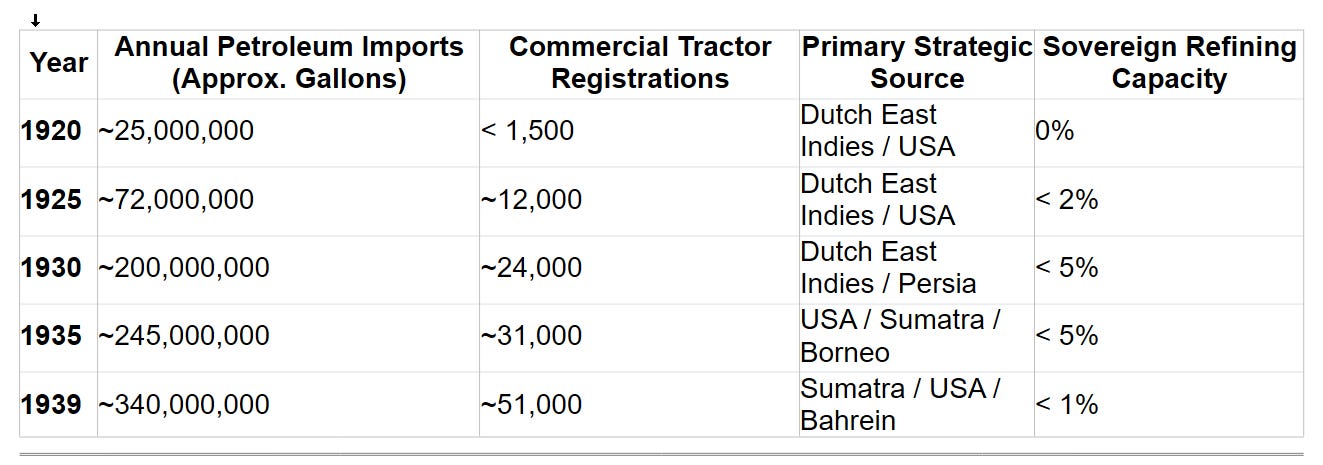
Between 1920 and 1939, Australia’s reliance on imported petroleum products shifted from a localized urban convenience into the primary energy backbone of national industry and food production.

These underlying statistics reveal the speed at which Australia’s energy independence, dramatically eroded as agrarian mechanisation advanced.
The Three Pillars of Societal Mechanisation
1. Agricultural Mechanisation: Trading Oats for Kerosene
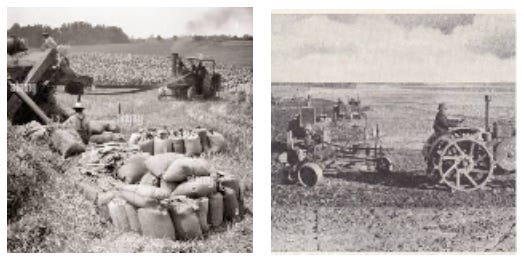
Prior to 1920, Australian food production was fueled entirely by our domestic soil [with golden soil and wealth for toil] , using draught horses sustained by local oats, hay, and water.
The rapid adoption of kerosene and petrol tractors transformed farming yields but fundamentally shifted the sector’s risk profile. By 1939, over 50,000 tractors were operating across the nation’s wheat belts. This structural pivot meant that if foreign tankers were disrupted, the agricultural sector faced immediate paralysis.
2. Civil Aviation: Defying Australian Distance
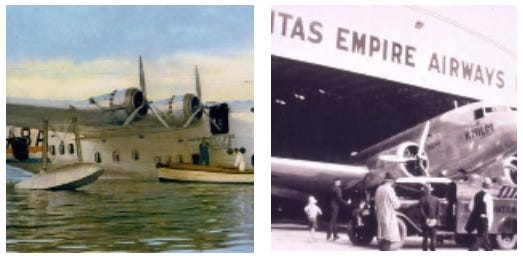
The interwar period saw the development of Australia’s commercial aviation sector, led by early routes from Qantas and West Australian Airways. Aircraft quickly became essential for regional logistics, connectivity, mail and medical support across the outback.
However, this entire network depended on specialty imported high-octane aviation spirit, leaving the nation’s fastest transport links extremely vulnerable to fuel supply disruptions.
3. The Merchant Marine: Transitioning from Coal to Oil
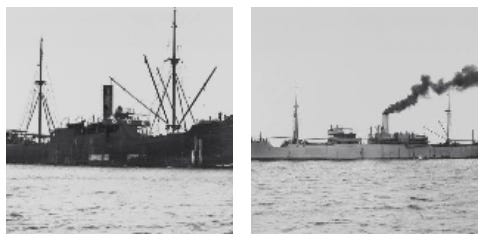
During the 1920s and 1930s, global shipping rapidly converted from domestic coal-fired steam engines to heavy fuel-oil internal combustion systems.
While oil-fired merchant vessels offered greater speed and efficiency, the shift stripped away Australia’s greatest natural maritime advantage — its extensive, sovereign coastal coal bunkering networks
The 1940 Emergency — The “Power-Without-Petrol” Reality Check
The structural vulnerabilities MAJ GEN Rosenthal identified materialized clearly in October 1940. Following the outbreak of the Second World War, international tankers were reassigned, and Australia implemented strict fuel rationing.
The response was the “Power-Without-Petrol” National Campaign — a widespread effort to substitute liquid petroleum with domestic timber and charcoal.
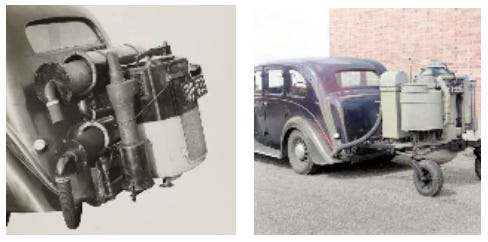
Tens of thousands of Australian motorists, bus lines, and farmers resorted to bolting heavy, dangerous charcoal gas producers onto their vehicles. These contraptions superheated charcoal or wood blocks to generate carbon monoxide gas, which was then plumbed directly into the vehicle’s modified carburettor.
It was a literal, visual manifestation of the exact industrial vulnerability Rosenthal had predicted fifteen years earlier — and ignored by a complacent legislative assembly.
The Modern Parallel — A Systemic Blind Spot — Again!
The core issue of the interwar period remains unresolved today. In 1939, Australia relied on foreign suppliers for 99.1% of its liquid fuels. Today, the nation operates on a similarly narrow margin, importing over 90% of its National Fuel Security requirements. The structural vulnerabilities remain critical and identical.
The Sovereign Storage Mirage: In the 1930s, supply lines were protected by the assumed security of the British Navy.
Today, defense strategies rely on a “just-in-time” commercial maritime model, counting fuel stock currently aboard international tankers en route across the Pacific and Indian oceans toward our national security baselines. Not at all a smart plan.
A disruption at any major maritime Oil, Gas and POL chemical choke-points would leave modern automated agricultural networks facing a familiar crisis.
Sir Charles Rosenthal saw that true national sovereignty requires energy independence.
As 2026 modern supply chains face increasing geopolitical strain, the interwar transition from horses to imported oil serves as a reminder of the long-term costs of neglecting sovereign resource security.
Australia’s Long History — Continuously Ignoring Military Commanders on Strategic Fuel Security
Throughout modern Australian history, a recurring tension has existed between military commanders — who view liquid fuel supplies as a critical national vulnerability — and successive federal governments, who have often treated fuel through a purely commercial lens.
When global supply chains are stable, politicians have historically ignored warnings from defense leaders, allowing Australia’s domestic fuel security to dwindle.
The following synopsis highlights key Australian military commanders and defense leaders whose warnings on fuel security were brushed aside by the naïve and short-sighted political establishment:
1. General Sir John Monash — 1920s.
The Context: Following World War I, Australia’s greatest military commander, Sir John Monash, transitioned to civilian leadership as the head of the State Electricity Commission of Victoria [SECV].
The Warning: Monash recognized that Australia was critically dependent on imported oil and coal from other states/nations, leaving the economy and future military logistics highly vulnerable to international maritime blockades.
The Response: Monash advocated heavily for energy independence by developing Victoria’s vast brown coal reserves into electricity and briquettes. While he succeeded locally in Victoria, federal politicians throughout the 1920s largely ignored the broader strategic lesson. They continued to rely entirely on unescorted, foreign-owned tankers for liquid petroleum, leaving Australia dangerously unprepared when fuel shortages struck during World War II.
2. Air Vice-Marshal John Blackburn AO [Ret’d —2010].
The Context: As a former F/A-18 fighter pilot and Deputy Chief of the Royal Australian Air Force [RAAF], Blackburn became Australia’s leading expert on liquid fuel vulnerability.
The Warning: In 2014, Blackburn authored a groundbreaking report for the NRMA detailing that Australia’s “just-in-time” commercial model left the country with less than 20 days of fuel on the ground if imports were cut off.
He warned:
“There is a premise in Canberra that the market will provide... in a national security crisis, the market will look after itself, not us.” [1, 2]The Response: Politicians actively pushed back. Intelligence and defense analysts revealed that officials were essentially told to “keep quiet” about fuel supply issues to avoid public panic and preserve focus on immediate election issues.
Over the next decade, governments allowed the country’s domestic oil refineries to dwindle from seven down to just two. [1, 2]
3. Major General Jim Molan AO, DSC [2017–2022]
The Context: A highly decorated Army commander who led coalition operations in Iraq, Molan later entered federal politics as a Senator, dedicating his remaining years to exposing Australia’s lack of a national security strategy.
The Warning: Molan campaigned relentlessly against Australia’s failure to meet the International Energy Agency’s [IEA] mandated 90-day fuel stockholding rule. He famously warned the government:
“There is no point in having 12 fantastic submarines and 75 F-35s if you’ve got no bloody fuel for them.”The Response: The Morrison Government bypassed building physical, sovereign storage tanks on Australian soil.
Instead, they struck a heavily criticized deal to buy crude oil and store it in the United States’ Strategic Petroleum Reserve.
Senior defense bureaucrats labeled this political workaround “an absolute joke,” pointing out that in a global war, a stockpile across the Pacific Ocean would be impossible to transport back to Australia.
Archival Sources & References
Australian Bureau of Statistics (ABS): A History of Automotive Fuel Prices and Baseline Indices — Long-term datasets tracking domestic consumption shifts since early settlement.
Bureau of Infrastructure and Transport Research Economics [BITRE]: Past Retail Petrol and Diesel Fuel Systems in Australia — Historical data covering shipping costs and wholesale terminal infrastructure from 1925 onward.
Department of Foreign Affairs and Trade [DFAT]: Australia’s Trade Through Time: The Interwar Tariffs Ledger — Tracking protectionist policies, fuel customs adjustments, and the 1929 Customs Tariff modifications.