

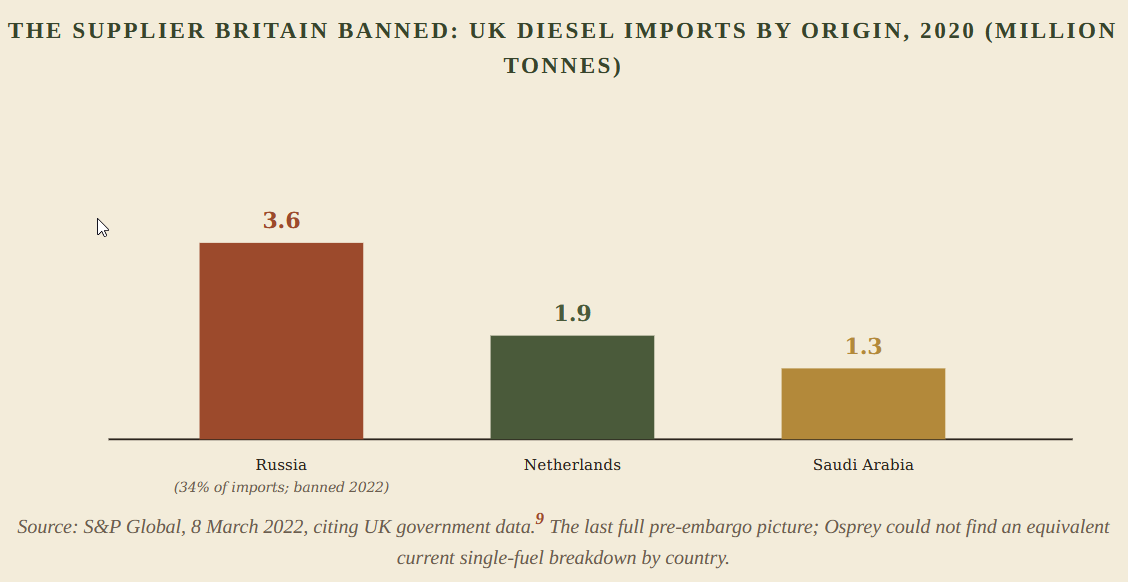
The short answer to “where is Britain getting its diesel now that it has sanctioned Russia?” contains an uncomfortable detail. Russia was once Britain’s biggest single diesel supplier: in 2020 it provided about 34% of UK diesel imports, some 3.6 million tonnes.1
London banned direct Russian imports in 2022, and that ban still stands.
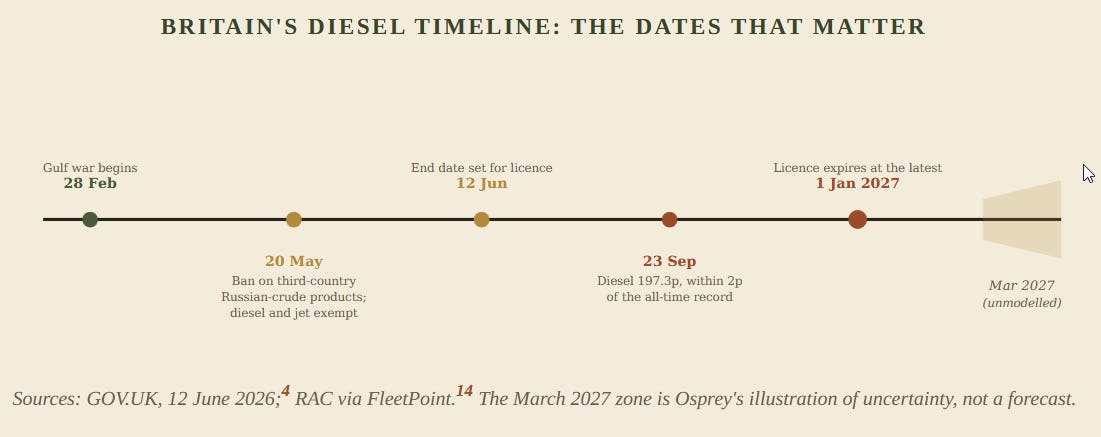
But on 20 May 2026, when the UK went a step further and banned oil products refined from Russian crude in third countries, it exempted diesel and jet fuel, the two fuels Britain imports most, through a general trade licence.2,3
Government has since said that licence will end by 1 January 2027 at the latest.4
This investigation maps where Britain’s diesel actually comes from, what the exemption means, and why the date that matters for the UK is not March 2027 but the first day of the 2027 New Year.
The Refineries That Are No Longer There
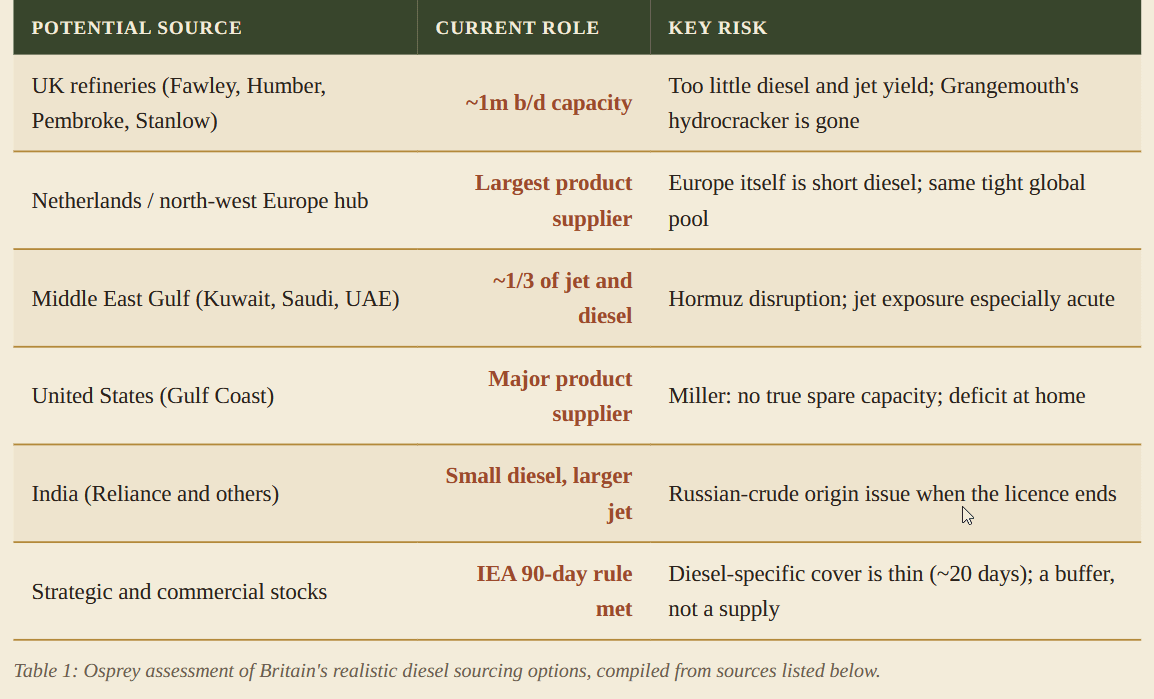
Britain’s exposure is a story of closures. The Petroineos Grangemouth refinery in Scotland shut in April 2025, removing about 150,000 barrels a day of capacity; as the country’s only refinery with a hydrocracker, it is estimated to have supplied roughly 15% of UK diesel at its peak.5
The Prax Lindsey refinery closed the same year.6
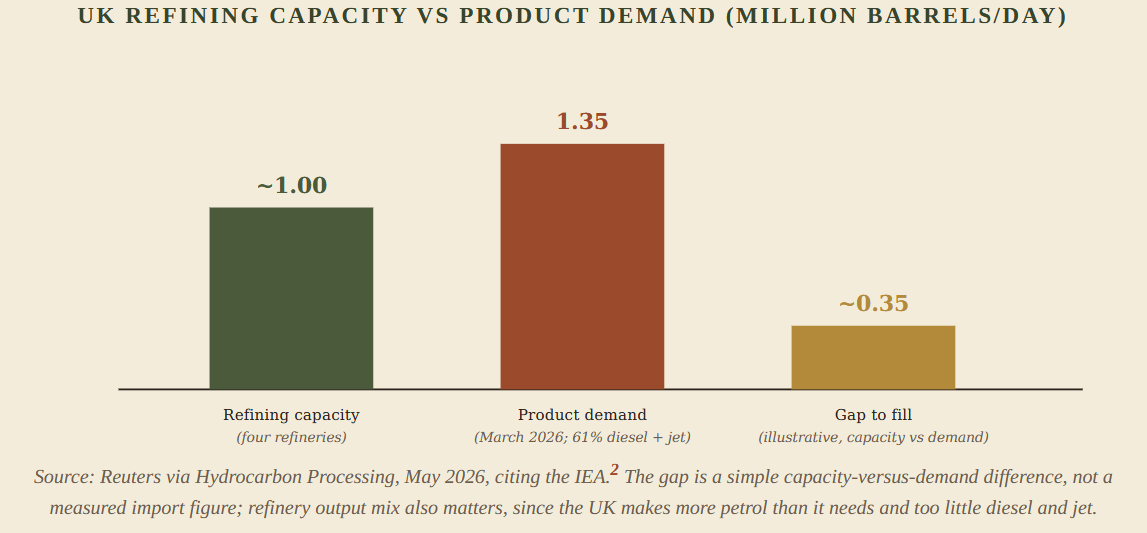
Only four refineries remain: Fawley, Humber, Pembroke and Stanlow, down from nine in 2000, with combined capacity of about 1 million barrels a day against product demand of 1.35 million per day, in March 2026, of which 61% is diesel and jet fuel.2
Fuels Industry UK figures cited by CNBC show Britain imported 2.5 times as much diesel as it produced in 2024, in a fuel where it was self-sufficient as recently as 2011.6
Who Supplies Britain Now
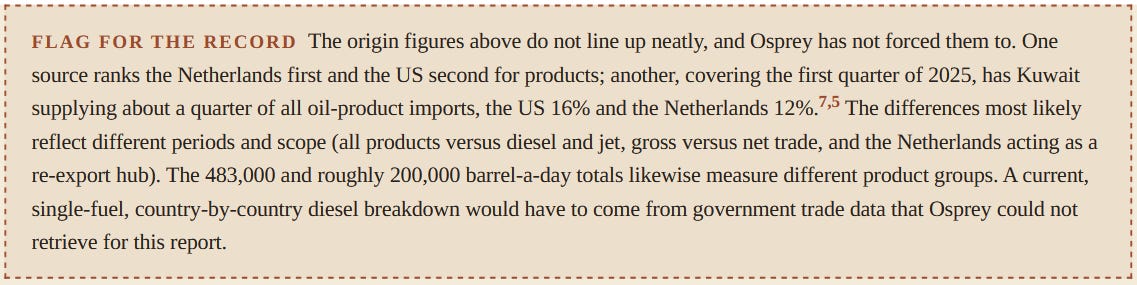
The gap is filled from a shifting mix of sources. Since the 2023 embargo, the Netherlands has been the largest supplier of oil products to the UK, followed by the United States, with Kuwait rising from 2022 to 14% of imports in 2024; Saudi Arabia is an important source of diesel and heating oil.7
Kpler data put UK imports of middle distillates, meaning diesel plus jet and kerosene, at 483,000 barrels a day in 2025, with India, Kuwait, Saudi Arabia and the UAE together supplying 35%.2
S&P Global data show about a third of the roughly 200,000 barrels a day of diesel and jet fuel Britain imported in 2025 came from the Middle East Gulf.8
The Back Door
The May 2026 measure was billed as closing the “refinement loophole”, under which crude of Russian origin could be refined in India or Turkey and the diesel sold to Britain legally.11,10
The Minister told the House of Commons the regime was tougher than the day before and that no existing sanctions were being lifted.10
Yet the general licence, in force from 20 May 2026, with no end date at the time, exempts diesel and jet fuel refined from Russian crude in third countries, which law firm Harneys describes as the two categories making up the vast majority of the UK’s refined Russian-origin imports.11
Ministers defended it as a sensible decision to protect supply for industry, airlines and households; a Ukrainian opposition lawmaker called it deeply disappointing.2
One compliance analysis reads the carve-out as a recognition of the supply pressure from the Hormuz disruption.12
How much diesel actually sails through that door is not known.
In 2025 the UK took an average of 7,000 barrels a day of Indian gasoil, against 32,000 bp day of Indian jet and kerosene.8 The direct effect appears modest.
The precedent matters more: Britain’s sanctions policy gave way to supply security in a single announcement, and the stated end date, 1 January 2027, is now the pressure point.

The American Connection
This is where Johnson and Miller’s analysis, the subject of our Australian Investigation, lands squarely on Britain.
The United States is one of the UK’s biggest product suppliers, and Miller’s arithmetic shows it is running a small diesel deficit of about 62,000 barrels a day while exporting over 1.3 million, with Gulf Coast refiners preferring Europe and Latin America to their own East Coast because margins abroad are so high.1
For Australia, an American cutoff would remove a marginal, emergency channel.
For Britain it would remove a mainstream one.
Add the Gulf: about 60% of UK kerosene imports come from Saudi Arabia, the UAE and Kuwait, and Kuwait alone supplies 38%, which is why the Hormuz disruption cuts so deep.6
Diesel is less concentrated than jet fuel, but the Netherlands hub that carries the largest volumes is itself supplied from the same tight global pool.13
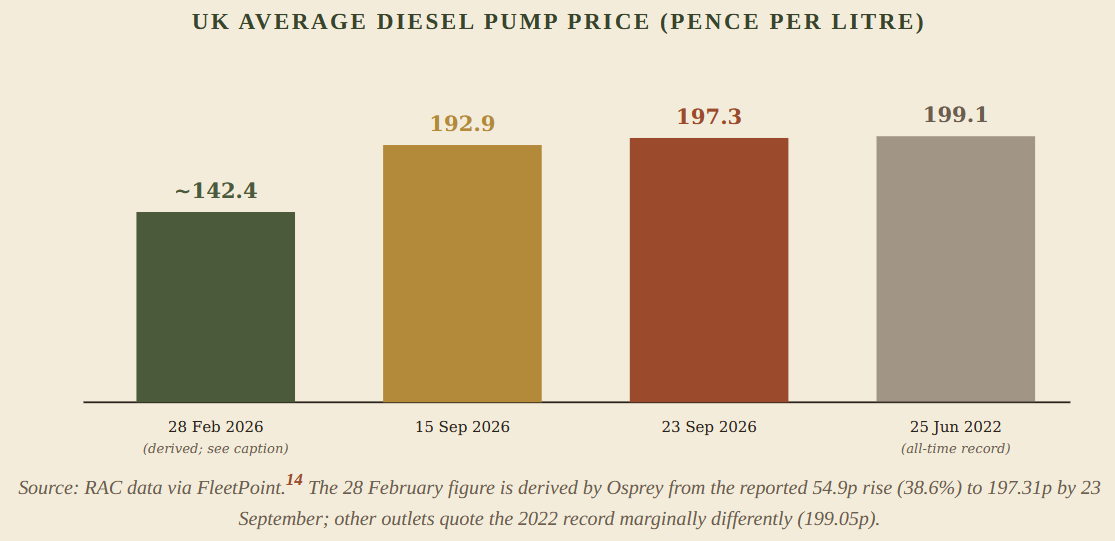
Diesel stands within 2p of its all-time record, up 38.6% since the Middle East conflict began on 28 February.14
physical buffer looks better than the price. DESNZ data show the UK held about 11.2 million tonnes of oil stocks in 2025, above the 90 days of net imports the IEA requires.13
But that measures total oil against net imports, not days of diesel.
One independent tracker, drawing on DESNZ figures, put commercial diesel cover at about 20 days on the latest — May 2026 data.15
Osprey treats that tracker as a secondary source, and its own correction note stresses the two measures cannot be compared. The takeaway is a comfortable strategic cushion sitting behind a thin operating one.
The Cliff Before March
Australia’s question was where diesel comes from if the US cannot supply it.
Britain’s is sharper and sooner.
If the licence lapses on schedule on 1 January 2027, cargoes refined from Russian crude in India or Turkey become illegal to land, in the middle of a global diesel squeeze and with Britain leaning on the very suppliers, Gulf and American, that Johnson and Miller show are constrained.
If the UK government instead extends the licence, it breaks its own public commitment to lift it at the earliest date, and Ukraine’s allies will notice.
Osprey does not forecast which way that goes.
The point is that the choice is being made on a
diesel market with no spare barrels in it.
Osprey on Overwatch thanks Larry C. Johnson and Karl Miller for the US analysis this UK edition builds on. We will keep tracking the licence reviews, UK pump prices and Gulf and American cargo flows through Christmas and the New Year.
Sources
“America’s Diesel Surplus Is an Illusion.” Larry C. Johnson, citing analysis by Karl Miller, 27 September 2026. larrycjohnson.substack.com
“UK defers import ban on diesel, jet fuel derived from Russian crude.” Reuters via Hydrocarbon Processing, May 2026. hydrocarbonprocessing.com
“UK bans imports of Russian oil refined abroad, exempts diesel and jet fuel.” S&P Global, 19 May 2026. spglobal.com
“UK to set end date for imports of Russian diesel and jet fuel via third countries.” GOV.UK, Department for Business and Trade / FCDO, 12 June 2026. gov.uk
“UK data: Grangemouth refinery closure triggers largest stock build in three years.” S&P Global, 2025. spglobal.com
“UK jet fuel supply risk: Diesel, kerosene imports and air travel.” CNBC, 15 April 2026. cnbc.com
“Diesel, jet fuel: The key GB exposures to the Middle East conflict.” Energy Voice, 31 March 2026. energyvoice.com
“UK bans imports of Russian oil refined abroad, exempts diesel and jet fuel” (2025 import data). S&P Global, 19 May 2026. spglobal.com
“Global diesel prices soar as bans on Russian supplies add to tightness.” S&P Global, 8 March 2022. spglobal.com
“Processed Russian Oil Products: Sanctions.” Hansard, UK House of Commons, 20 May 2026. hansard.parliament.uk
“Russia sanctions update: UK exempts Russian-origin diesel and jet fuel from Russian crude new import ban.” Harneys Regulatory Blog, June 2026. harneys.com
“UK imposes new Russia sanctions: mirroring of EU position on maritime transport of LNG and refined products.” Trade Compliance Resource Hub, 20 May 2026. tradecomplianceresourcehub.com
DUKES 2026, Chapter 3: Oil and Oil Products. DESNZ (UK Government). assets.publishing.service.gov.uk
“UK diesel prices approach £2 a litre as global supply crisis deepens.” FleetPoint, citing RAC data, September 2026. fleetpoint.org
“UK Diesel Reserves: What 23 Days of Cover Actually Means.” UKOilWatch, updated 11 August 2026. ukoilwatch.com