

Executive Summary
Classification: [SEC=UNCLASSIFIED]
Date: 28 August 2026
Subject: Economic Sovereignty Failure — North Sea Oil Privatization [1982-1987].
Bottom Line Up Front:
The United Kingdom’s decision to privatise North Sea oil and gas assets between 1982 and 1987 represents one of the most catastrophic failures of national economic security in modern British history.
While Norway — facing identical resources, identical challenges, and identical opportunities — chose State Ownership and built a $2 TRILLION sovereign wealth fund, Britain chose Privatisation and collected merely $400 billion in total revenue.
The gap: £800 BILLION.
This was not an accident of markets or geology.
This was a deliberate policy choice that transferred unprecedented public wealth into private hands — often foreign corporate hands — while leaving British citizens with no lasting endowment, no sovereign wealth fund, and no intergenerational justice.
This briefing details the mechanism of this transfer, quantifies its impact, and frames it for what it truly was: the financial disarmament of the British nation.
The Tale of Two Nations
The Shared Opportunity
In the early 1970s, both the United Kingdom and Norway discovered vast hydrocarbon reserves beneath the North Sea. The circumstances were remarkably similar:
Comparable populations of skilled workers
Similar technological challenges in deep-sea extraction
Identical geological resources in adjacent territorial waters
Equivalent industrial capacity to develop the fields
Both nations stood at the same crossroads.
Both faced the same strategic decision:
Who should own and control this national wealth?
The Divergent Paths
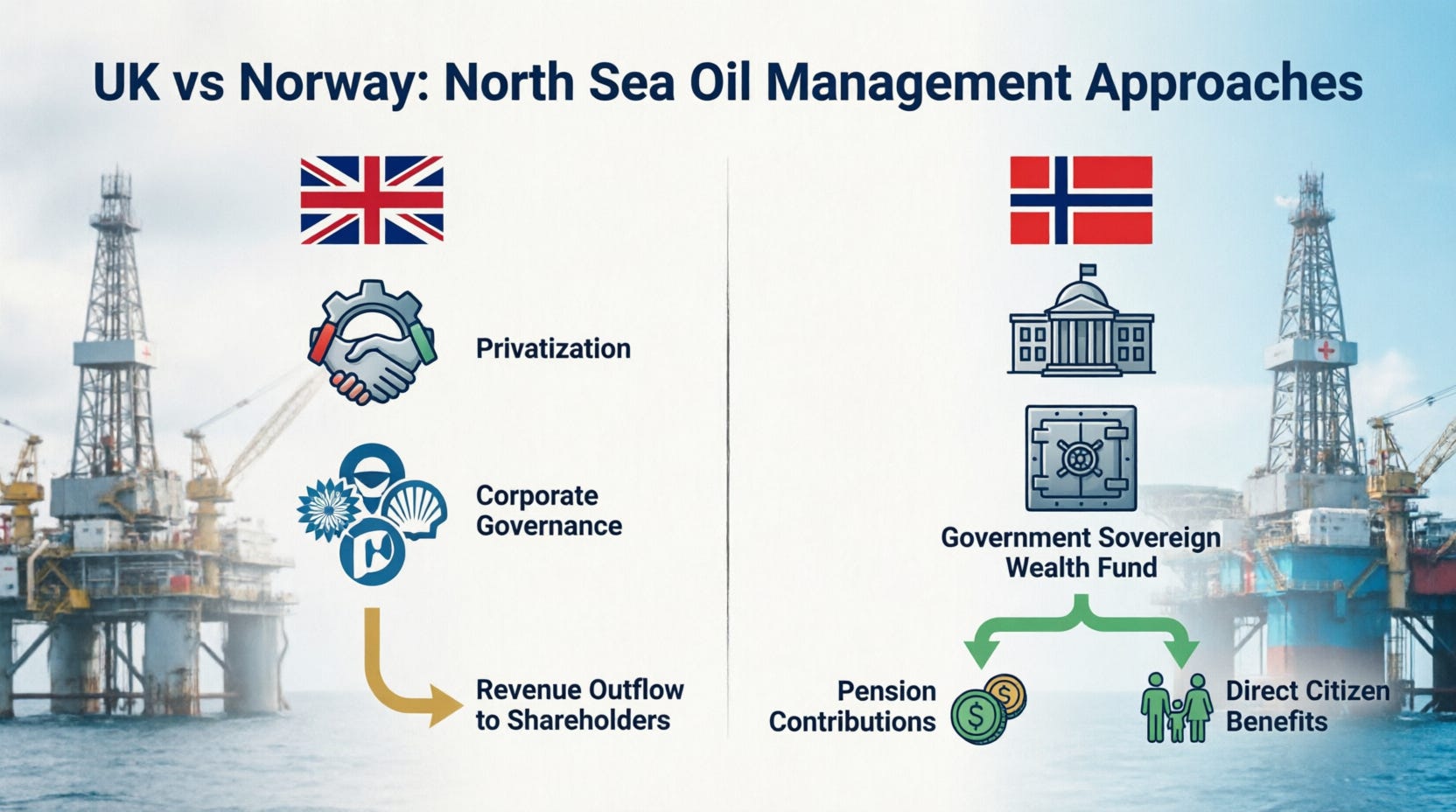
🇳🇴 NORWAY’S CHOICE: State Ownership
Norway established Statoil — now Equinor — in 1972 as a state-owned enterprise with majority government control. The Norwegian model prioritized:
State participation in all production licenses
Gradual, controlled development
Direct government ownership of resources
Creation of the Government Pension Fund Global — 1990.
Result:
✅ US$2.1 TRILLION sovereign wealth fund — 2026.
✅ US$385,000 per citizen in fund value.
✅ US$1.2 TRILLION total revenue collected — 1975-2025.
✅ Permanent intergenerational endowment secured!
🇬🇧 BRITAIN’S CHOICE: Privatisation
Under the Thatcher government, Britain systematically dismantled state control through the Oil and Gas [Enterprise] Act 1982.
British National Oil Corporation [BNOC] trading activities privatized —1982.
BNOC production assets sold to create Enterprise Oil — 1982-1983.
Remaining state stakes eliminated by 1987.
Assets transferred to BP, Shell, and private corporations
Result:
❌ $400 BILLION total revenue collected — 1975-2025.
ZERO sovereign wealth fund established.
❌ £800 BILLION revenue gap — UK Vs. Norway.
❌ Profits flowed to private — often foreign — shareholders.
❌ No intergenerational wealth created.
Source: Norway & UK Crude Oil Production — Norway & UK Natural Gas Production
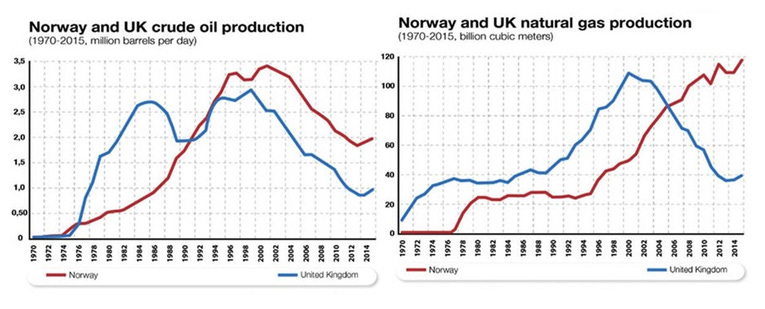
1970 - 2015 Norway [RED] - UK [BLUE]

Insert — Current Oil & Gas SITREP - August 2026
Norway State of Exploration 2016-2025
« Over the last decade, Norway has remained one of the most active and successful offshore exploration regions globally. Despite the maturity of the basin, exploration has continued to generate commercial discoveries and support future production through a combination of near-field opportunities and selective higher-risk exploration.
In the decade, 279 exploration well programmes were drilled on the NCS at an estimated cost of US$10.0 billion, resulting in 89 commercial discoveries and
c. 2.6 Billion Barrels of Oil Equivalent of discovered resource.»
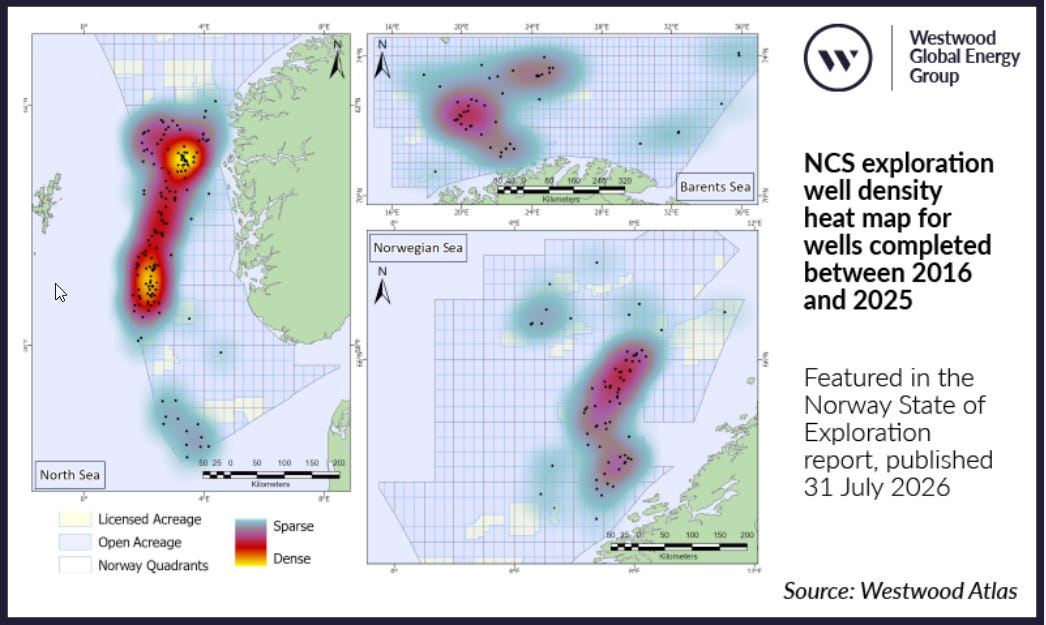
Source: Westwood Atlas - Norwegian Continental Shelf - well density heat map.
UK State of Exploration 2016 - 2025
« The geology has not changed – just the mindset. While political rhetoric paints UK production in terminal decline, the subsurface still holds untapped potential. What is needed is a new perspective. Opportunities which existed in 2019 still exist today. Commodity price volatility has always been a challenge. Instead, the fiscal, regulatory and political environment has led to companies deferring or cancelling plans for both short and long-term investments.
Westwood estimates that in a high case, the UK Continental Shelf (UKCS) could produce 4.3 billion boe [Figure 1]. However, in a substantially improved market environment, including significant changes to tax, licensing and regulatory approvals, and favourable commodity prices, the UK could unlock up to 7.5 billion boe[1].»
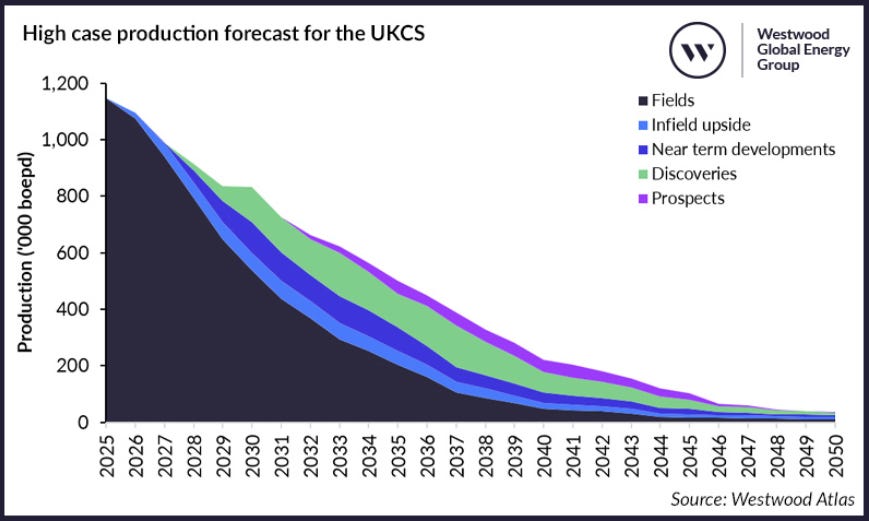
Source: High case production forecast for the UKCS, including upside from infill drilling, near-term developments, discoveries and prospectivity. Source: Westwood Atlas
Conclusion - The Norwegian State Oil Company - Equinor - conducted 279 exploration wells - the UK did nothing.

The National Security Implications
Economic Sovereignty IS National Security
Traditional definitions of national security focus on:
Military capability.
Intelligence services.
Border defense.
Cyber warfare.
This is an incomplete list and as we have already seen, outdated too!
True national security requires ECONOMIC SOVEREIGNTY:
The ability to fund defense without crippling debt.
The capacity to invest in critical infrastructure.
The resilience to withstand external economic shocks.
The independence to make strategic decisions free from creditor pressure.
The wealth to care for citizens and maintain social stability.
The Financial Disarmament of Britain
By squandering £800 billion in potential sovereign wealth, Britain effectively disarmed itself financially.
What £800 billion, invested as Norway did, could have funded:
✅ Full renewal of the UK’s nuclear deterrent - £30-40 billion × 20 times over
✅ The entire HS2 project - £106 billion estimated × 7 times over
✅ Annual NHS England budget - £160 billion × 5 years
✅ UK’s total annual defense budget - £50 billion × 16 years
✅ A sovereign wealth fund generating £40-50 billion annually in returns — in Perpetuity.
Instead, Britain got:
❌ Austerity programs — 2010-2020s with Crumbling infrastructure
❌ Underfunded public services.
❌ Rising national debt & critically, Intergenerational inequality!
❌ Dependence on foreign capital.
The World GDP - Purchasing Power Parity Index - 2026 - Worldometer
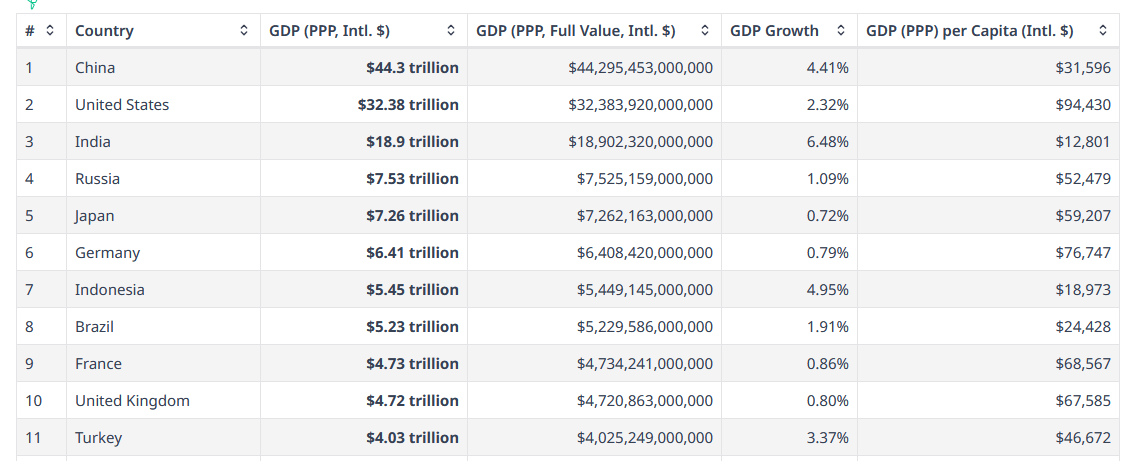
Source: worldometer website with IMF data
The Legatum Prosperity Index - G20 Nations - Rankings 2026
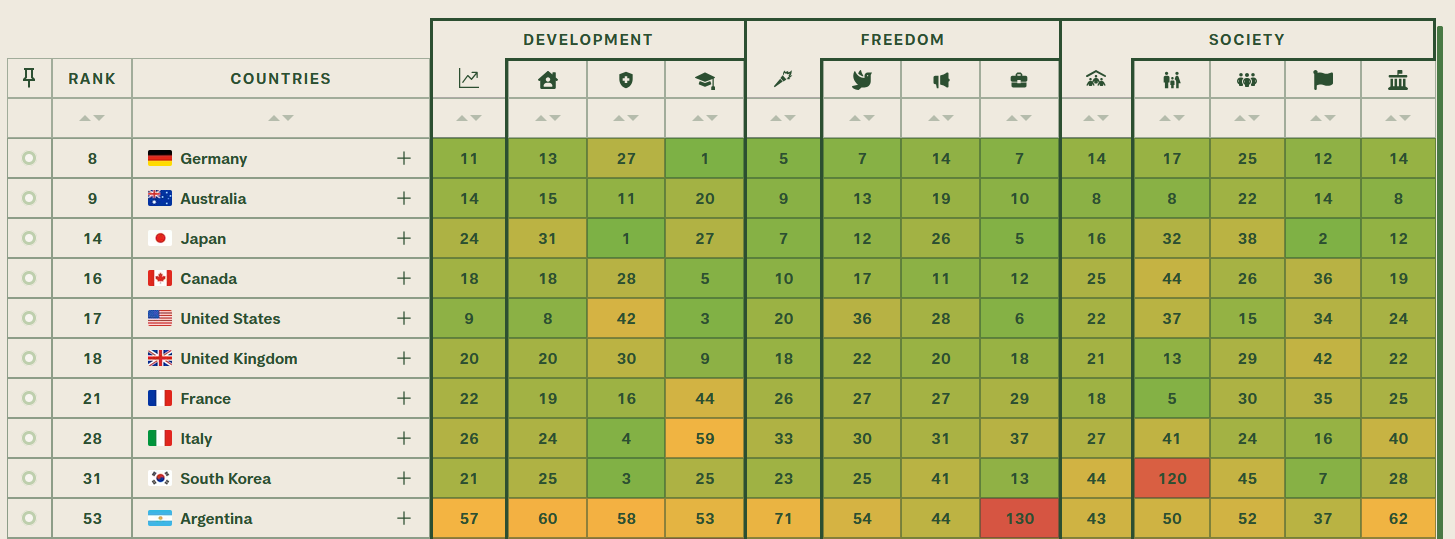
The Legatum Prosperity Index measures how nations flourish through resilient development, the advancement of freedom, and meaningful social relationships.
The Path Forward — Actionable Intelligence
Acknowledging the Breach
The first step toward recovery is honest accounting. The UK must recognize that:
This was not inevitable. Norway made different choices with identical resources.
This was not misfortune. This was deliberate policy.
This was not “free market efficiency.” This was wealth transfer from public to private.
This is a national security issue. Economic sovereignty is foundational to all other forms of sovereignty.
Policy Imperatives
Immediate Actions:
1. Establish a UK Sovereign Wealth Fund.
Capitalize with windfall taxes on remaining North Sea production!
Include revenues from offshore wind, carbon credits, and other national resources
Mandate intergenerational protection — ensure that it cannot be raided for short-term spending.
2. Renationalization Debate.
Consider partial state ownership of strategic energy assets
Model on Norway’s Equinor (state majority stake, commercial operations)
Ensure future resource revenues flow to citizens, not foreign shareholders.
3. Stricter Fiscal Regime
Increase effective tax rate on hydrocarbon extraction
Eliminate all subsidies to fossil fuel companies
Implement “resource rent” taxes on Resource Profits.
4. Transparency and Accountability
Public dashboard showing all natural resource revenues.
Annual “Sovereign Wealth Report” to Parliament.
Independent oversight of resource management.
The Moral Imperative
This is not merely about economics. This is about intergenerational justice.
Conclusion
The £800 Billion Question
Britain stands at a crossroads — again.
We can continue to pretend that the North Sea story is simply “history” — a policy difference, a matter of ideology, or just an unfortunate outcome.
Or we can face the truth:
🔴 Britain was economically disarmed.
🔴 £800 billion was transferred from public to private hands.
🔴 Future generations were robbed of their birthright.
🔴 National security was compromised — not by foreign armies, but by domestic policy.
This is not a partisan issue. This is a patriotic issue.
Why does Norway have US$2.1 trillion and Britain has £0?
Why does every Norwegian citizen have $385,000 in their national wealth fund, and every British citizen has £0?
Why do we subsidize the companies that extract our remaining resources, instead of owning those resources ourselves?
The Call to Action
To Policymakers:
Establish a UK Sovereign Wealth Fund. NOW.
Not in five years. Not after the next election. NOW.
To Journalists:
Investigate this story. Follow the money.
Ask why Britain accepted £400 billion when Norway secured $1.2 trillion.
To Citizens:
Demand accountability. Share this briefing. Tag your MP. Join the conversation.
This is YOUR wealth that was lost.
To Independent Media — @BritishIntelUK and others:
This is the economic security story of our generation. Amplify it. Investigate it. Make it impossible to ignore.
🇧 One Sea. Two Nations. Radically Different Choices.
🇬🇧 THE GAP: £800 BILLION.
🇬🇧 THE QUESTION: WHEN DO WE RECLAIM OUR SOVEREIGNTY?
Link to JULY 2026 report: The £800 Billion Mistake - Britain Gave Away North Sea Oil - While Norway Built a $2 Trillion Fortune!
What is missing in this description is politics. Norway since the Viking days of about 900AD has had many local rulers that rarely liked to cooperate so some other body controlled them. In the past they were ruled by Kings from Denmark and Sweden. During WW2 they were occupied by the socialist rulers of Germany. They have a democratic system which caters for every citizen in the country and has limitations on the more powerful. (I have been to Oslo & help the Norwegian Para-Olympic team in 2000 Unions are not important there). Norway is not in the EU does not accept the policies of the EU although it has accepted to the belief that CO2 emission should be restricted. Their electricity mainly comes from Hydro. UK has been since 1066 a feudal (another form of socialism) country. Since WW1 the idea of socialism expressed by Marx and Lenin has taken root and accepted by Union leaders. It is Unions and the socialist Labour governments that have ruined the economy of UK.
I have recently seen this comment
"Public Sector vs private sector
The public sector cannot operate with the same efficiency as private businesses because the incentives aren't right.
No politician or bureaucrat profits if a department is competently run. Nor do they suffer if it is incompetently run.
In fact, when a government program fails, legislators – perversely – tend to throw even more money at the problem.
That's why P.J. O'Rourke famously noted that giving money and power to government is like giving whiskey and car keys to teenage boys.
Taxpayers, understandably, are fed up."
Big companies are not much different to governments- ie insufficient. Australia has followed UK with powerful unions. There is no chance of operating resources like Norway runs oil and gas.