

Lee Kuan Yew [LKY] is recognized as one of the most influential political figures in Asia during the 20th and 21st centuries.
He is frequently described as a "strategist extraordinaire," admired for steering Singapore through the complexities of decolonization, the Cold War, and regional instability.
Source: youtube ~ 5 reasons why America will regret attacking Iran
« Lee, the founding father of modern Singapore and its prime minister from 1959 to 1990, has honed his wisdom during more than a half century on the world stage.
He has served as a mentor to every Chinese leader from Deng Xiaoping to Xi Jinping, and as a counselor to every U.S. president from Richard Nixon to Barack Obama.
With his uniquely authoritative perspective on the geopolitics of East and West, Lee does not pull his punches.»
Source: youtube ~ 5 reasons why America will regret attacking Iran
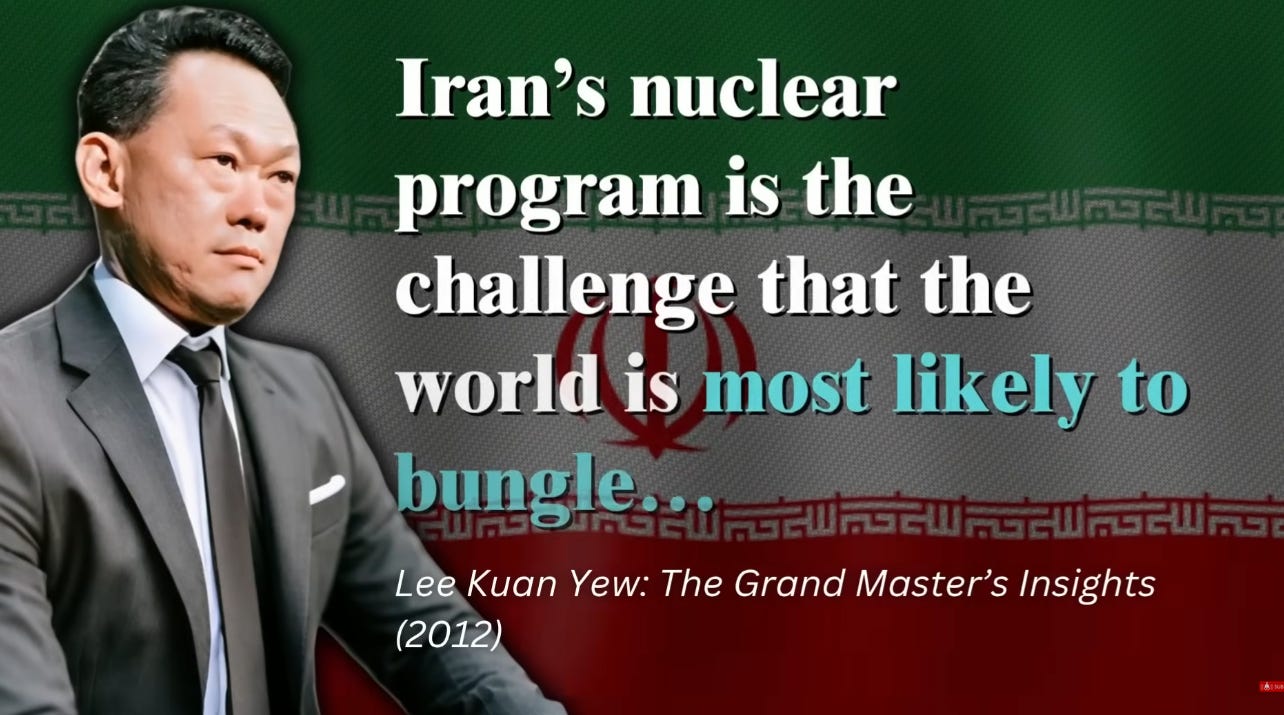
LKY — “Iran’s Nuclear Program ~ The Challenge the World is likely to Bungle!”
Video Transcript ~ from 3:10 minutes;
« Lee understood that attacking Iran isn’t just a simple geopolitical conflict over oil or even nuclear weapons. It is a religious war a thousand years in the making.You see, Iran is the world’s dominant Shia power. While most of the surrounding states follow Sunni Islam, their intense rivalry spans over a thousand years rooted in a dispute over who should lead the faith after the prophet Muhammad’s death.
And with roughly 200 million Shia Muslims spread across the world, Iran has spent decades building influence across every country where those populations live.As Lee explained, Sunni Arab states are deeply suspicious of Iran because of the hold that Iran has on Shia minorities living across the region.
Shiites are almost always loyal to Iran and not the countries where they live.
You see, in Lebanon, Iran has Hezbollah on Israel’s northern border.
In Yemen, the Houthis strangling the Red Sea shipping lines.
And in Bahrain, where the US Navy’s fifth fleet is headquartered, 70% of the population is Shia, ruled by a Sunni monarchy, making it one of the most volatile flash points in the entire Gulf.
And what makes this even more alarming is that Lee believed the Sunni Gulf states, though wealthy and oil rich, are ultimately an artificial construct dependent on American military protection for their survival.»
How Tiny Singapore Beat the Last Iran Oil Crisis
The story about how Singapore, a small City-State, grew to become a global powerhouse with no resources and no large agricultural holdings, is amazing.
Even more astonishing is how Lee ]LKY] successfully navigated Singapore through two global Oil Shocks in 1973 and then again in 1979 cementing LKYs leadership strategy in global affairs.
Source: youtube ~ how tiny Singapore beat the last Iran oil crisis
Unlike Norway with their successful Oil & Gas « experiences » in securing resource ownership, Singapore took the the next best option.
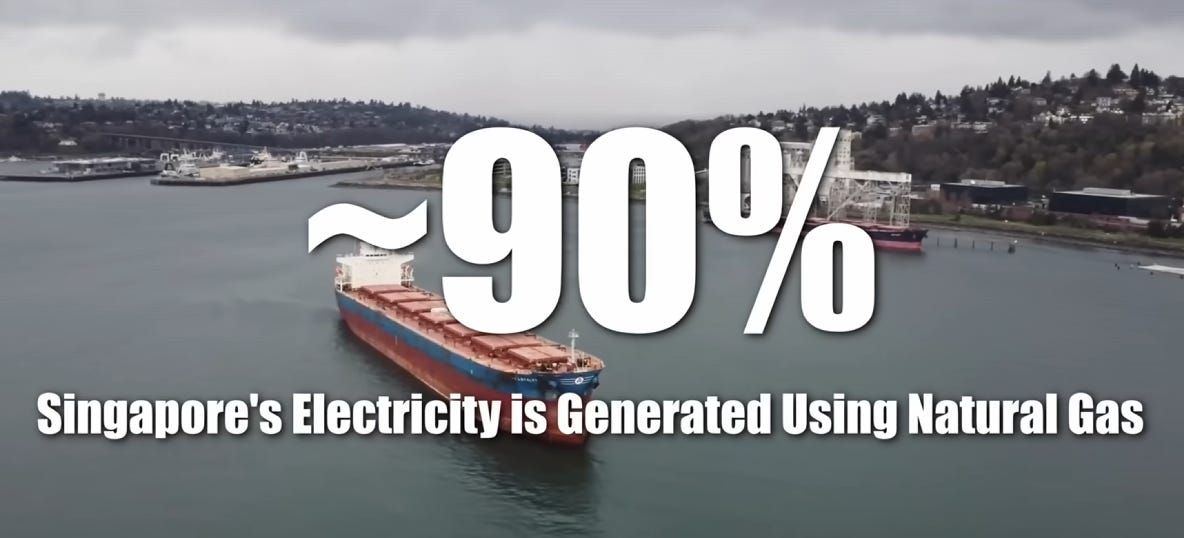
They invested heavily in the Oil & Gas business by up-scaling Industry & Skills by constructing 4 large state-or-the-art refineries at the Global Crossroads in Singapore.
1973 — OPEC and the First Oil Shock
Video Transcript at 3:40 minutes;
“Stocks in the S&P 500 and the Dow Jones lost almost 50% of their value during that first oil crisis. And because inflation stayed so high, many investors saw their portfolio stay flat for almost two decades. Additionally, food prices jumped 14.5% in America alone, while Singapore’s domestic food inflation peaked at a staggering 60% in late 1973.”
As LKY stated: « Our biggest problem has been the sharp increase in prices of food and essentials. We cannot look for soft options like subsidizing food, absorbing the rise in oil prices and keeping down electricity charges. We do not have oil wells, nor do we grow rice, corn or soy beans. The feed stuff for our pigs and chickens is imported at world market prices.»Singapore was in shock. You see, just before the first oil crisis, Singapore was experiencing rapid economic growth since its independence in 1965.
Unemployment had fallen from around 9% to 4.5% as multinational corporations flooded the island.
At the same time, Singapore had become one of the world’s major oil refining centers with four refineries built in just over a decade, processing over a million barrels a day. But when the oil embargo hit, Lee faced a choice that would define the nation’s future. The math was simple. Singapore’s refineries held enough oil to power the island for two full years. He could have seized it all, played the populist, and shielded his people from the global chaos.Instead, LKY did the opposite, stating;
« Within days of the oil crisis in October 1973, I decided to give a clear signal to the oil companies that we did not claim any special privilege over the stocks of oil they held in their Singapore refineries.
If we blocked export from those stocks, we would have enough oil for our own consumption for 2 years, but we would have shown ourselves to be completely undependable.»By putting global reliability above immediate relief, he proved Singapore was the most dependable partner in the world trade system.
1975 ~ LKY Visits Japan ~ Another Resource Poor Nation
Video Transcript at 6:00 minutes;
As the global energy map shifted, Lee began studying how other resource poor nations were surviving the shock and his eyes turned to Japan.
As LKY states: « What we must do is really achieve our maximum, which means using the talent that we’ve got to maximum advantage, which is what the Japanese have done. No natural resources. 100 million Japanese, 900 million Chinese.
I don’t know. I don’t believe the Japanese are that much cleverer than the Chinese, but look at the productivity. And the knowledge, know-how, organization, technical skills, the technology, the capital that they have, the trading knowledge, the links they have with the rest of the world.»
LKY traveled to Tokyo to see their approach firsthand, stating;
« I found that all offices in public buildings, including their top hotels, had reduced power use. That summer, the temperature in my air conditioned hotel room could not be brought below a minimum of 25°C. The Chambermaid’s assiduously switched off all lights and air conditioners every time we left our rooms.»
You see, Japan had been pushed to the brink, importing 80% of its energy.
The 1973 Oil Shock caused its GDP to shrink for the first time since the war. Factories shuttered and citizens fought in the streets over basic goods like toilet paper.But the government’s response was a masterclass in mobilization.
As Lee observed, the construction industry took conservation measures to prevent heat loss through external walls and windows. Manufacturers improved the efficiency of domestic appliances like air conditioners and were required to display the power efficiency of each.
The government gave tax incentives for installing energy-saving equipment. No wonder Japan achieved the lowest electricity consumed per unit of industrial production.As a result, the methods Japan developed during this crisis allowed them to capture the American car market. As US consumers abandoned their V8 guzzlers for fuel-efficient Hondas and Toyotas, the global power balance shifted. By 1980, Japan had done the unthinkable. It surpassed the United States to become the largest automobile manufacturer on Earth. Even today, with the straight of Hormuz closed and oil markets in chaos, Japan’s discipline and preparedness remains its ultimate buffer.
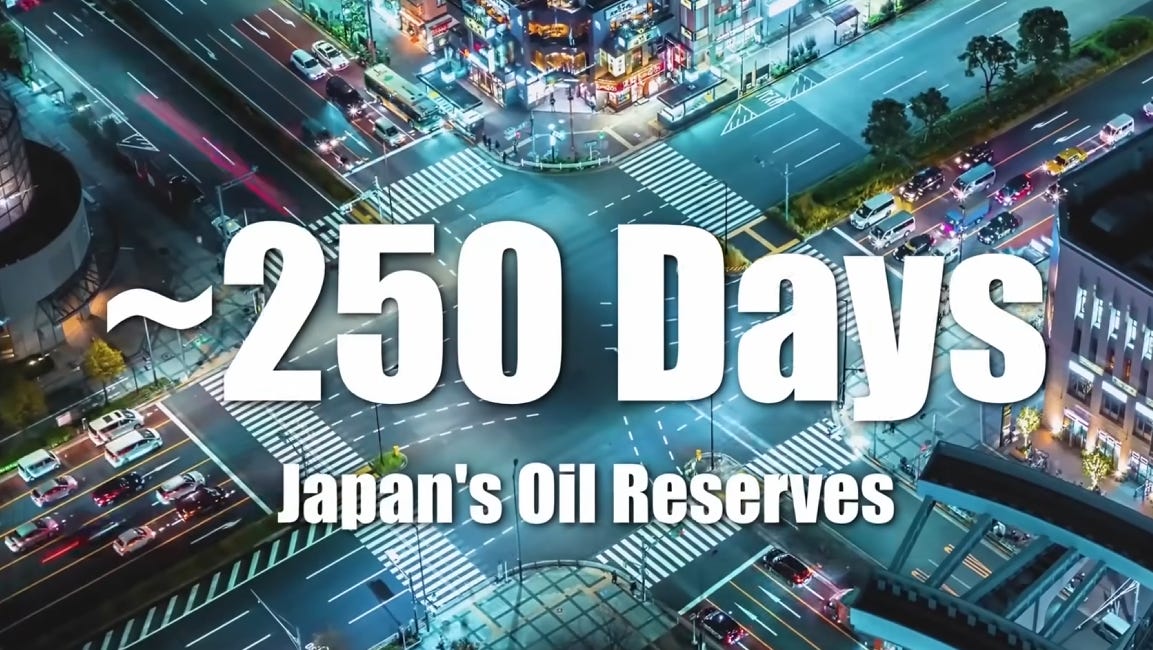
They hold over 200 days of petroleum reserves. A staggering contrast to resource-rich Australia which sits on just three weeks of physical fuel.
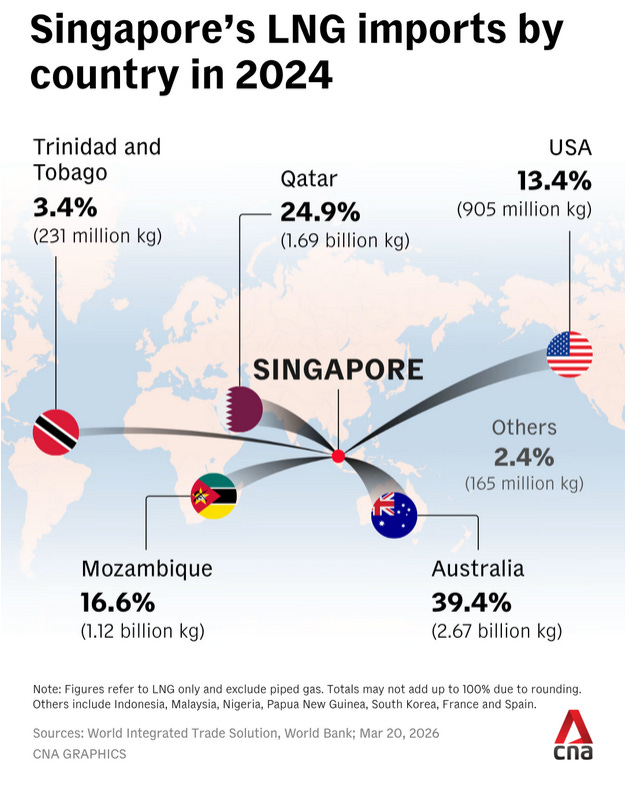
Source: channel news asia
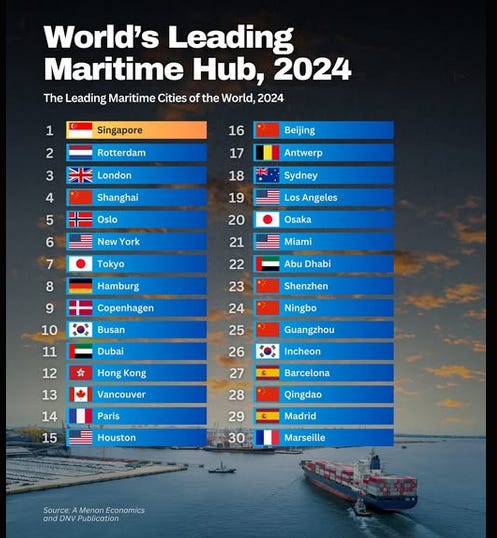
Source: facebook seasia
Australia goes begging for National Fuel Security
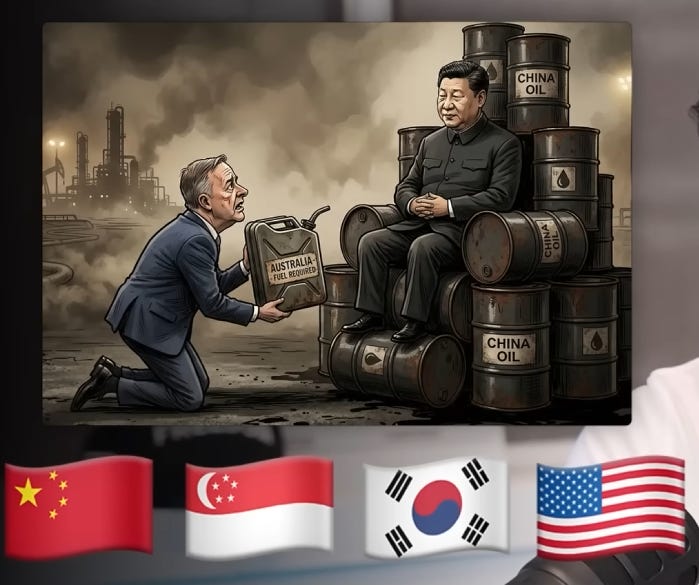
Why Australia Killed All Its Own Refineries - And Gave Away Its Gas For Free? —It Was All Planned!
In This video above ~ Scott Kuru reports about Australia’s Catastrophic Fuel Security Strategy.
A Call to Action
The current Middle East Conflict began on the 28th February, 2026 — as at the 2nd August 2026, there is still no resolution.
Australia still has NO Plan for Building State-Owned Refineries — guaranteeing Aussie Fuel Security. WHY NOT?
A Call to Action ~ Contact List
The Shadow Minister for Energy is Dan Tehan, the MP from Wannon, Victoria.
The Minister for Climate Change & Energy is Chris Bowen, MP from Fairfield NSW.
Really interesting read Graham, a friend of mine works for a Japanese multinational and one of his observations were around the temp setting in the hotel as well the offices. There is a cultural element at play here as well -- one of the collective vs the individual, the former more rooted in Asian cultures whilst the latter in the Anglosphere (both have its pros and cons). Also the governance structure in Singapore lends to single decision making as well which allows it to make easier to implement visionary decision making for the greater good :)