

On paper, the United States should be the world’s spare tank of diesel. Its refineries produce far more than Americans burn. In a new assessment, hydrocarbon analyst Karl Miller — shared this week by veteran former CIA analyst Larry C. Johnson — shows that “paper surplus” is an illusion.
Every barrel is already spoken for, between rising domestic demand, heavy export commitments and refineries running flat out.
America is drawing down its own fuel stocks, not sitting on a reserve it could send to a fuel-starved world.1 That finding matters far beyond Washington.
It matters in Fremantle, in Tamworth, and on every farm and mine site waiting on a diesel delivery.
This investigation takes Johnson and Miller’s numbers and asks the question they don’t: where does that leave Australia, if the U.S. genuinely has nothing left to give and the Gulf war runs past March 2027?
America’s Empty Reserve
Miller’s arithmetic is precise. In the four weeks to 11 September, U.S. refiners produced about 5.2 million barrels of distillate a day, running at 96.8% of capacity.1 That looks enormous next to domestic demand of roughly 3.4 to 3.7 million barrels a day — a headline surplus of over a million barrels daily.
But for the week ending on 18 September 2026, after exports of 1.331 million barrels a day and domestic use of 3.975 million, the country actually ran a shortfall of about 62,000 barrels a day, made up from its own stockpile.1
Refinery utilisation hit 98% in late August, the highest since 2018. There is no spare capacity left to turn on.
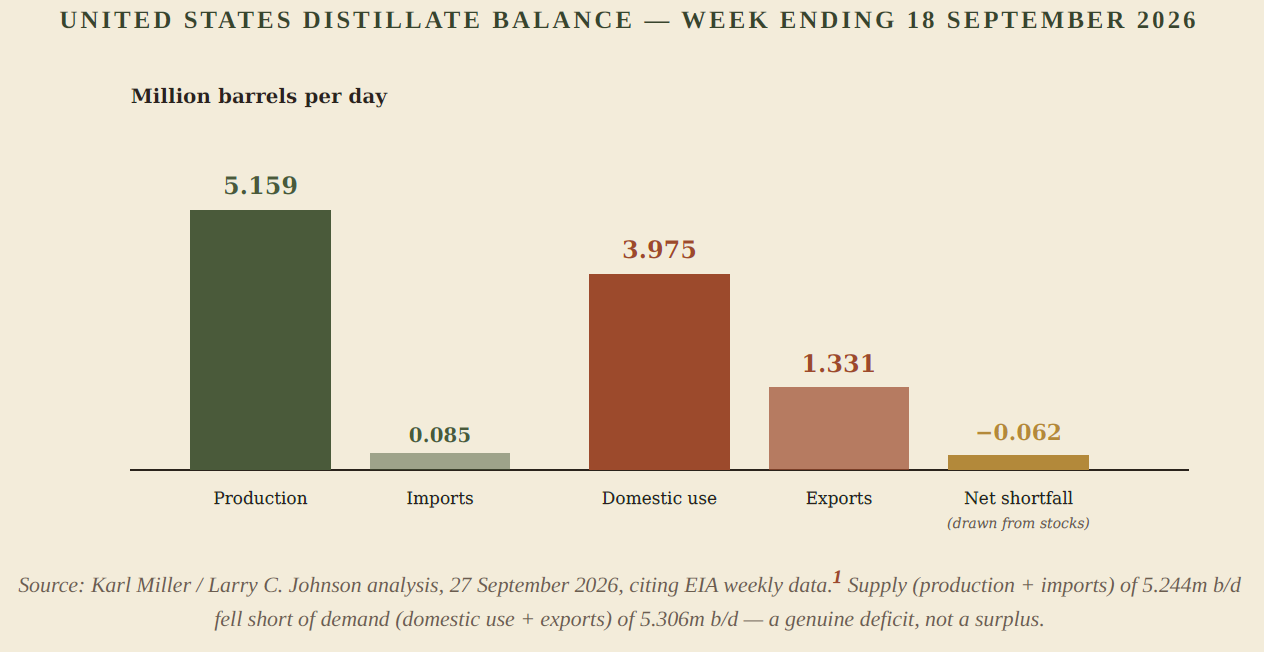
The stockpile that shortfall draws from is thin and badly located. Commercial distillate stocks stood at 107.9 million barrels on 11 September — about 30 days of cover, 12% below the five-year average — and the U.S. Energy Information Administration expects them to fall below 100 million barrels this month and stay below the five-year low through most of 2027.1 East Coast diesel stocks were 33% below a year earlier at the end of August; the Lower Atlantic region, which supplies the U.S. Southeast, was down about 40%.
The surplus, such as it is, sits on the Gulf Coast — and Gulf refiners currently earn more shipping diesel to Europe or Latin America than to their own East Coast, because global crack spreads are near record highs.1

The Cost of Moving Diesel
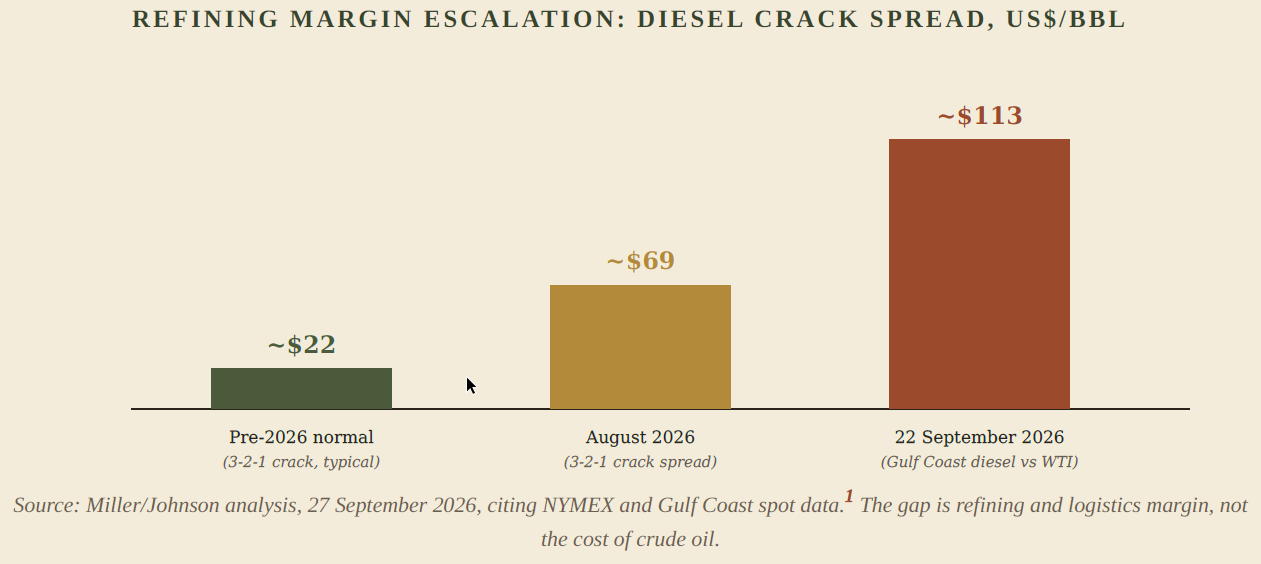
Two things are driving the price of diesel worldwide, and only one of them is crude oil. The first is refining margin: on 22 September 2026, Gulf Coast diesel traded at $209.66 a barrel against WTI crude at $96.41 — a gap of about $113 a barrel that reflects a bottleneck in refining and delivery, not in crude supply.1
The broader NYMEX 3-2-1 crack spread — the standard refining-margin benchmark — averaged around $69 a barrel in August, itself already far above the pre-2026 range of roughly $19 to $25.1
The second driver is freight, and this is where the war has done most of its damage. The conflict has not shrunk the world’s tanker fleet — it has lengthened every voyage, as ships detour around danger zones, sail further for substitute cargoes, and idle offshore waiting for clearance.1 Supertankers hauling Gulf crude to China were earning over $1 million a day in September, roughly 30 times their ten-year average.1
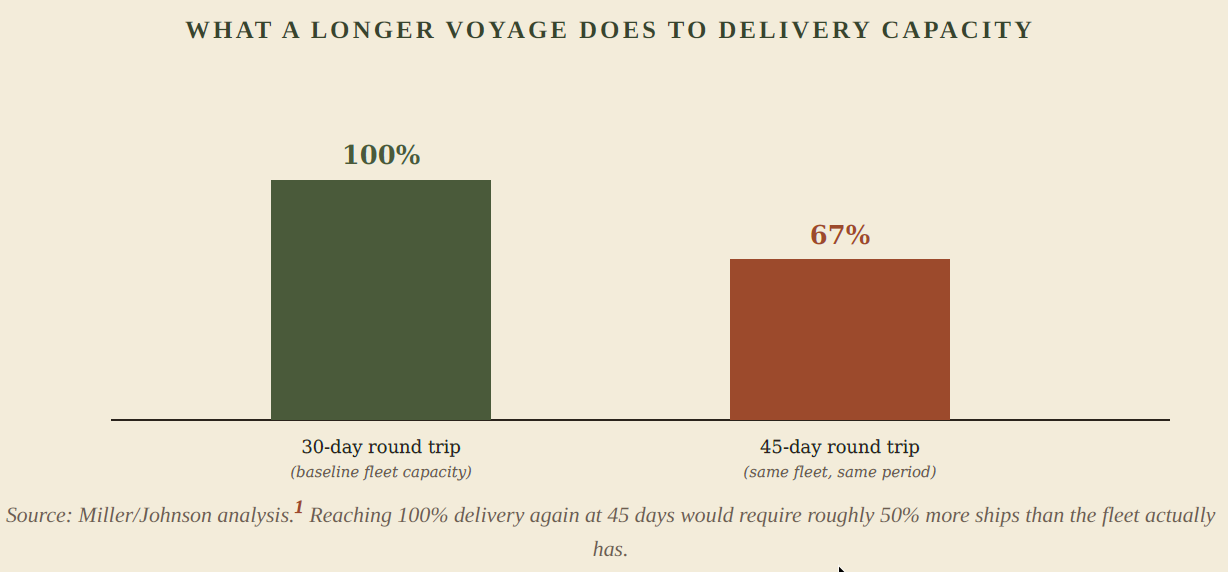
Miller’s own arithmetic on why this matters is stark: stretch a tanker’s round trip from 30 days to 45, and the same fleet delivers only two-thirds as much fuel — meaning it would take 50% more ships just to hold deliveries steady.1
Fewer tankers are even available for diesel specifically. The one class of ship that can carry either crude or clean products — the coated LR2 — has largely defected to crude, where day rates run three times higher; more than half the coated LR2 fleet was hauling crude by late April.1 The world is losing diesel-carrying capacity in the middle of a diesel shortage, which is precisely the mechanism behind the price spikes Australian motorists have been feeling at the bowser.

How This Reaches Australia
Australia was never the intended destination for America’s diesel. Its exposure runs through a different, more direct channel: the country imports roughly 90% of its refined liquid fuels, and only two refineries — the Ampol Lytton plant in Brisbane and Viva Energy’s Geelong facility — still operate onshore, together covering under 20% of national demand.2
Most of the remainder arrives from Singapore, South Korea and Japan — refiners who are themselves heavily supplied by Middle Eastern crude.2 The Gulf war reaches Australian bowsers by one step of indirection, through Asian refiners’ own feedstock costs, rather than through any direct Australia-Gulf shipping route.
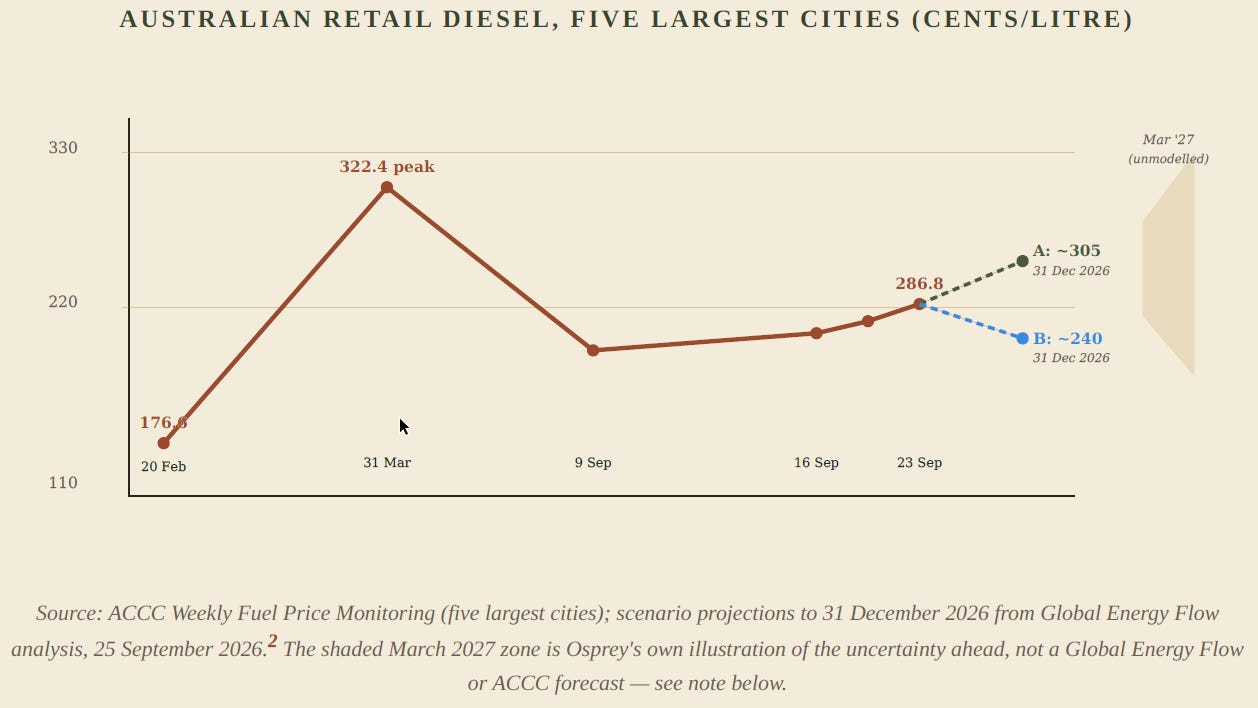
That exposure is visible in this year’s price trajectory. Average retail diesel across Australia’s five largest cities sat at 176.6 cents a litre on 20 February 2026, before the war began.
It peaked at 322.4 cents on 31 March 2026, after the Hormuz closure and a fire at the Geelong refinery, eased over winter, then climbed again as the conflict re-escalated — reaching 286.8 cents in the week to 23 September, up 18.9 cents in a single week.2
Independent analysis from Global Energy Flow, cross-checked against the Australian Institute of Petroleum’s national average, puts two scenarios on the table for the end of 2026: diesel near 305 cents a litre if the squeeze persists, or near 240 cents in a verified reopening — both well above the pre-conflict level, because global distillate stocks are expected to stay tight into 2027 regardless of which path plays out.2
Where Could Australia Turn To Next?
This is the question Johnson and Miller’s U.S. analysis doesn’t ask, because it isn’t about Australia, but America.
But it is exactly the question an Australian reader needs answered: if the Gulf war runs past March 2027 and the American “surplus” stays illusory, what actually stands behind Australia’s diesel supply?
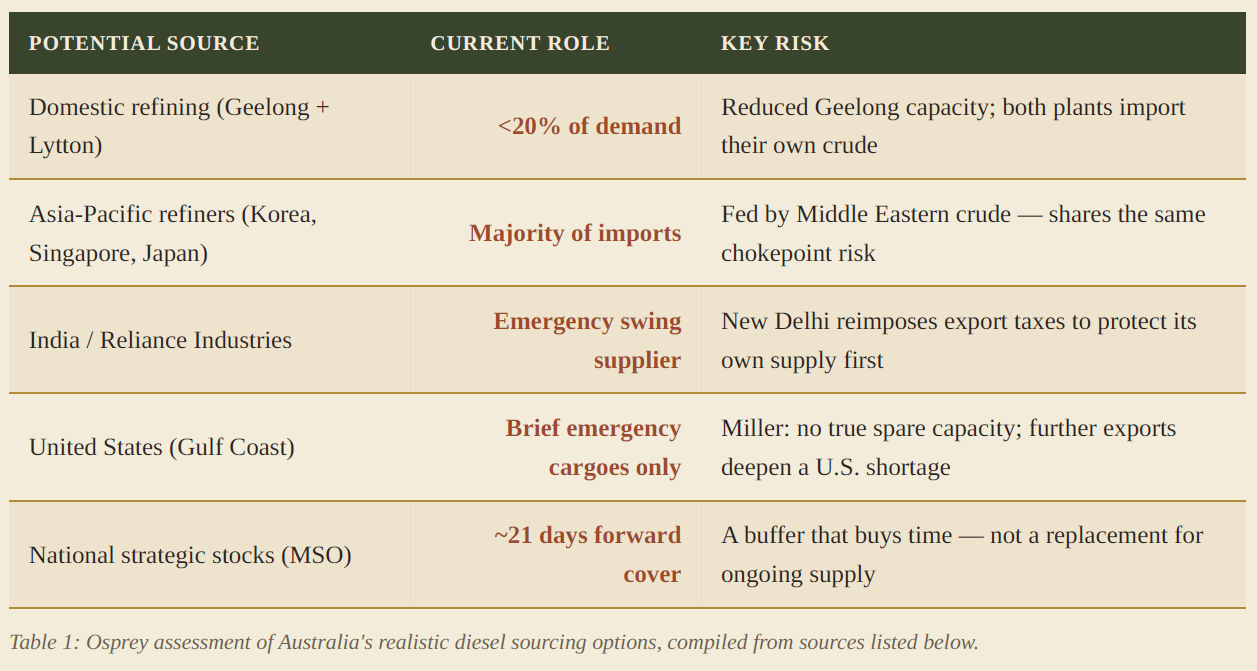
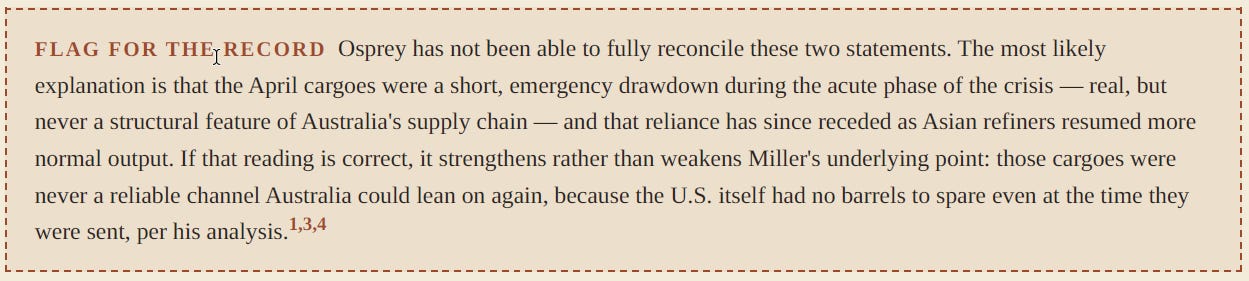
The U.S. row deserves particular scrutiny, because it is where the public record contradicts itself. In April 2026, at the height of the crisis, energy analytics firm Vortexa tracked tankers carrying over 925,000 barrels of ultra-low sulfur diesel from the U.S. West Coast to Australia, with the U.S. reportedly supplying about 18% of Australia’s fuel that month.3
Yet the ACCC’s own weekly report for 23 September states plainly that Australia does not import a large amount of diesel from the United States.4
India’s Reliance Industries — operator of the world’s largest refining complex — is the more credible swing supplier. In March 2026, as the war disrupted Middle East supply and China banned refined product exports outright, Reliance-led shipments pushed India’s diesel exports to Southeast Asia to a seven-year high, with cargoes also reaching Australia.5
But India moved in the opposite direction days later, reimposing export taxes of roughly 21.5 rupees a litre on diesel specifically to protect its own domestic market.6
A supplier willing to tax its own exports at the exact moment global demand peaks is hardly a stable & reliable foundation for Australia. We need certainty for planning a Harvest Season, a mining contract schedule, or back-up Hospital Power Gensets in the event of Blackouts.
What If — March 2027 Arrives Like This?
Miller’s most important warning is not about today’s prices — it’s about the false comfort of a ceasefire. Even in his central case, where Gulf shipping resumes safely, roughly 11.8 million barrels a day of Gulf export capacity would still be unavailable a full year later, with restoration costing between $380 billion and $870 billion over five years.1
Damaged wells, shared processing plants and specialist repair crews don’t move on a diplomatic timetable. Global Energy Flow’s own reopening scenario reaches the same conclusion from the Australian side: even its optimistic path keeps diesel roughly 50 cents a litre above pre-conflict levels, because distillate stocks stay tight into 2027 regardless of what happens at Hormuz.2
Osprey will not put a false number on March 2027 — nobody honestly can, and our earlier Investigation already flagged the danger of treating industry modelling as more precise than it is.
What both analyses agree on is the shape of the risk: a ceasefire announcement is not the same as barrels moving, and even a real reopening leaves Australia’s actual suppliers — Asian refiners still short of Middle East crude, an Indian swing exporter that taxes itself first, and a U.S. market with nothing spare to give — working through the same constraints for months or years after the shooting stops.
Osprey on Overwatch thanks Larry C. Johnson and Karl Miller for the research underpinning this investigation, and encourages readers to follow their work directly at the link below. We will continue tracking Australia’s diesel exposure, the the India/Reliance swing-supply relationship as the situation develops toward 2027.
Sources
“America’s Diesel Surplus Is an Illusion.” Larry C. Johnson, citing analysis by Karl Miller, Son of the New American Revolution (Substack), 27 September 2026. larrycjohnson.substack.com
“Australia Petrol & Diesel — 2026 Two-Scenario Forecast.” Global Energy Flow, updated 25 September 2026. global-energy-flow.com
“Rare Diesel Cargoes Move From US West Coast to Australia.” Transport Topics, 23 April 2026. ttnews.com
“Australian Fuel Prices Rise: Petrol Up 6%, Diesel Up 7% in Week to 23 September 2026.” IndexBox, citing ACCC Weekly Fuel Price Monitoring. indexbox.io
“India Becomes Asia’s Diesel Lifeline as Iran War Chokes Global Energy Routes.” Asia Daily, 31 March 2026. asiadaily.org
“India Lowers Fuel Taxes, Says Rumours of Lockdown ‘Completely False’.” Al Jazeera, 27 March 2026. aljazeera.com
Fuel statistics — weekly reserve and supply reporting. fuelplan.gov.au, data as at 15–18 September 2026. fuelplan.gov.au
“Expanding Australia’s Diesel Storage to Boost Long-Term Fuel Security.” Australian Government, Minister for Industry, Energy and Emissions Reduction. minister.industry.gov.au
“Australia Extends Subsidy Plan for Refiners to 2030.” Argus Media, 20 March 2026. argusmedia.com
“As Fuel Costs Escalate Again, Regional Australia Is Hurting.” ABC News, 25 September 2026. abc.net.au