

▓ Osprey reports about the UK are framed within the Animal Farm allegory. ▓
On 2 October 2026, the average price of diesel in Britain reached 200.01 pence a litre, the first time it has crossed £2 at the pump.1 Filling a 55-litre family car now costs £110.01, up £31.70 since 28 February, the day before the US-Iran war began.2
The same week, the Trump administration told European governments to release strategic diesel reserves “immediately”, floated a US diesel export ban if they refused, and watched the G7 agree to release 100 million barrels in response.3,4
Those two stories are the same story. A new forward-looking model from hydrocarbon analyst Karl Miller, published 3 October 2026, explains why draining a reserve is not the same thing as fixing the problem it was built for.5
The Record Nobody Wanted
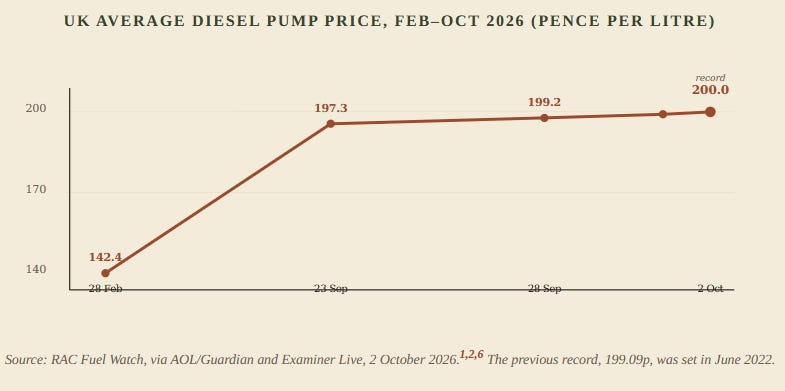
UK transport minister Keir Mather insisted the country was not facing a diesel shortage, a point made specifically in response to Donald Trump’s threat to cut off US supplies.1
That distinction, between a shortage and a price shock, is the heart of this investigation. There is no queue at British service station forecourts. There is a global market in which the marginal barrel costs far more than it used to, and Britain, which imports more than half the diesel it burns, pays that marginal price on every litre.5
Source: Tejvan Pettinger - Economics Help
The Diesel Reserve War
On 1 October 2026, the US told European allies to release strategic diesel reserves “immediately” to bring global prices down, with EU states due to discuss a coordinated response the next day.3
Treasury Secretary Scott Bessent pressed the point publicly; Trump told reporters he “may” formally request it.4 A European official told Politico that Washington’s proposal asked for 120 million barrels over 180 days.7 The alternative on the table was a US diesel export ban, which analysts said could remove close to a third of the world’s seaborne diesel supply with one stroke of the pen.7
On 2 October 2026, the G7 announced a coordinated release of 100 million barrels of diesel fuel reserves, short of the 120 million Washington had asked for.4
Trump told reporters Europe had “agreed to release a massive amount” of diesel.4 Most of Europe’s emergency diesel sits in Germany and France, and France’s own presidency said no formal demand had been made of Macron directly when he met Trump at the UN.3
The French response captures the mood: an agreement in principle, delivered under open threat of an export ban, with the practical mechanics still being worked out.

Why a Reserve Is Not a Repair
This is where Karl W. Miller’s new model, shared by Larry C. Johnson on 4 October 2026, changes the picture.
Miller’s argument is that a ceasefire can reopen a shipping lane overnight, but it cannot manufacture a compressor, mobilise commissioning engineers, or pay a contractor.5 Rebuilding the Gulf’s damaged energy infrastructure is, in his words, a competition for cash, equipment, qualified contractors and finished fuel, not a problem that ends with a diplomatic announcement of a peaceful resolution.5
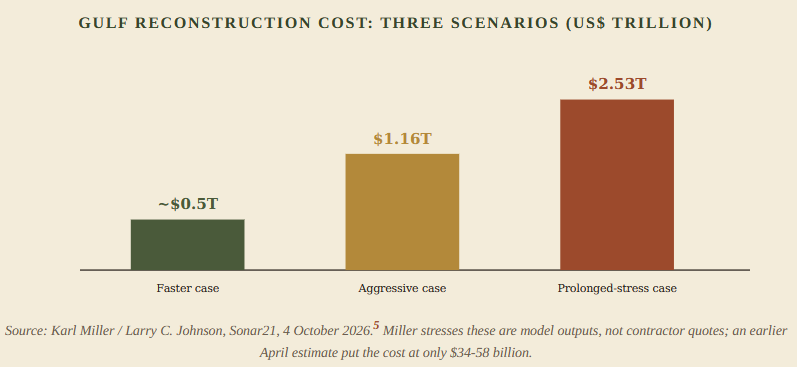
His cost model runs from;
Under $500 Billion, in a fast-recovery case, to
$1.16 Trillion in his aggressive case, and,
As high as $2.53 Trillion if the rebuild proceeds under prolonged stress, with scarce equipment and rising prices.5
Miller is explicit that these are model outputs, not contractor quotes; an April 2026 assessment had put energy-related repair costs at only $34-58 billion, a small fraction of his own range.5
The timeline matters as much as the cost: weighted by spend, the rebuild averages almost five years from today, only 60% of the work is done by 2031, and the longest-lead equipment packages run to seven years.5
Miller’s most original point is about cash, not just steel, materiel & concrete.
A damaged refinery can be technically repairable and still sit idle, because the government that owns it must pay for food imports, salaries, electricity and water before it pays an engineering contractor.5
Iraq illustrates the trap: in July it faced a monthly public salary bill of about
$5.96 Billion against a funding shortfall of $2.52 Billion.5 A government in that position rebuilds nothing. It pays its people, and the export capacity that would restore its revenue waits in line behind payroll demands.
The Barrels That Are Actually Missing
The scale of the shortfall is already visible in trade data. Gulf diesel net exports in August were just over a quarter of prewar levels. Combined Gulf and Russian diesel exports sat 1.6 million barrels a day below February.
Global oil stocks have fallen 507 million barrels since the war began, and global refinery throughput in August ran 4.2 million barrels a day below the same month a year earlier.5
In his severe case, Miller models a shortfall of at least 3 million barrels a day of diesel and jet fuel, every year, for five years; this equates to about 1.1 billion barrels a year, 5.5 billion barrels in total.5
He calls it a stress test, not a forecast, and notes a faster-recovery path closes the gap by year four.5 But he is equally clear that no country’s emergency stocks were built to cover a gap that size for that long, which is exactly the mechanism now playing out between Washington and Europe.5
Europe’s Perishable Cushion
This is where the G7’s 100-million-barrel diesel pledge runs into a problem Miller spends real time on: diesel is not crude oil.
Crude can sit in a salt cavern for decades. Conventional ultra-low-sulfur diesel typically lasts six to twelve months in storage, extendable to 18-24 months with chemical stabilisers and well-managed tanks, before oxidation, sediment and microbial growth set in.5
The EU’s own road-diesel standard allows up to 7% biodiesel, which oxidises faster still; Concawe, the refiners’ research body, recommends a maximum six-month storage life for blends containing biodiesel.5

That perishability changes what a “diesel reserve” really is. It is not a stockpile a government fills once and forgets; it is stock that must be continually rotated, sold into the market, and replaced with fresh fuel on a one-to-two-year cycle.5 Every barrel Europe releases now under US pressure has to be bought back later, in the same tight market Miller describes, from suppliers who are already short.
A reserve with an eighteen-month shelf life cannot cover a structural deficit Miller’s severe case puts at five years.5
Source: Lena Petrova - World Affairs in Context
Who Replaced the Persian Gulf?
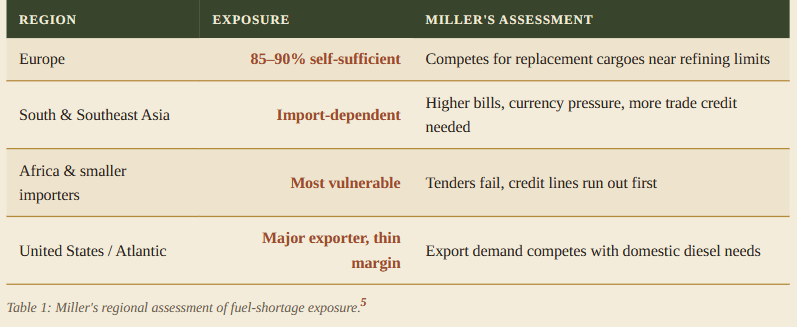
Europe’s exposure runs deeper than the reserve question. The continent burns about 5 million barrels of diesel a day; EU refineries, running flat out, can supply 4.5 to 5 million, leaving it 85-90% self-sufficient at best, with the remaining margin, roughly 580,000 barrels a day of imports, setting the price for the entire market.5
Since March, the United States has supplied more than half of Europe’s diesel imports, and more than two-thirds of imports in August and September.5
Europe has swapped dependence on Moscow for dependence on Washington, and Washington has just demonstrated it is willing to use that leverage.5
The crude behind that diesel tells the same story twice over. The EU imports about 97% of the crude it refines, and the Gulf was never its main source: Gulf Cooperation Council states supplied only about 7% of EU crude imports in 2025, Iraq another 5.8%.5 The United States, Norway and Kazakhstan together supplied nearly half of EU petroleum imports in the second quarter of 2026, and while the volume held steady, the bill rose 56%.5
Much of Europe’s refining capacity was built for medium-sour crudes like Russia’s Urals; American shale-crude is light and sweet, refines readily into petrol, and yields proportionally less diesel, the very product in short supply.5 Even the non-American barrels carry risk: most Kazakh crude reaches Europe via the Novorossiysk terminal on Russian soil, a route already hit by Ukrainian drones.5
The Mechanism Behind the Price
Miller’s explanation for why prices move faster than volumes is simple: when supply falls short, buyers bid for the marginal cargo, and that bid sets the price for every barrel still being bought, not just the missing ones.5
A $40-a-barrel premium across 10 million barrels a day of global purchases adds $146 billion a year to the world’s fuel bill; applied only to the 3 million barrels actually missing, it would add $43.8 billion, understating the real cost.5
Scarcity reprices credit too: at $150 a barrel, a buyer holding 15 extra days of inventory on 1 million barrels a day needs $2.25 billion in financing; at $200, $3 billion.5
A cargo that wins a bidding war for one buyer leaves another buyer short, which is precisely the competition now playing out between Washington and Brussels over the same reserve barrels.

Britain’s £2 litre is not an isolated national story. It is the leading edge of a shortage Miller models running for up to five years, being managed in its first weeks by asking Europe to spend down a reserve that cannot be refilled quickly and was never designed to last that long.
Osprey will keep tracking the reserve-release mechanics, the UK pump price, and Miller’s rebuild timeline as the northern winter approaches.

Winter is just around the Corner — will the animals have enough Fuel this Christmas?
Sources
“UK diesel price hits record high of £2 a litre.” The Guardian, via AOL, 2 October 2026. aol.co.uk
“UK diesel price hits new record high of £2 a litre.” RAC Fuel Watch, 2 October 2026. rac.co.uk
“US presses Europe to release diesel reserves ‘immediately’ as Trump threatens export ban.” France 24, 1 October 2026. france24.com
“G7 nations to release diesel stocks as wars in Europe and Middle East constrain fuel supplies.” CNBC, 2 October 2026. cnbc.com
“The Five-Year Fuel Crisis: Why the World Economy Is Paying for a War It Thinks Is Ending.” Larry C. Johnson, citing analysis by Karl Miller, Sonar21, 4 October 2026. sonar21.com
“UK diesel prices hit record average of 199.18p a litre.” Examiner Live, 29 September 2026. examinerlive.co.uk
“Trump vs Europe as US presses for release of emergency diesel stocks.” Al Jazeera, 2 October 2026. aljazeera.com
“Britain Has 40 Days of Diesel.” youtube.com
“The EU Faces a Major Oil Shock — Trump Demands Oil Reserves as Diesel Shortage Looms.” Lena Petrova, World Affairs in Context youtube.com