Once-upon-a-time, there were 2 major diametrically opposed geopolitical Blocs ~ the Western ~ under US & Allies control, & the Eastern Bloc ~ under Soviet control.
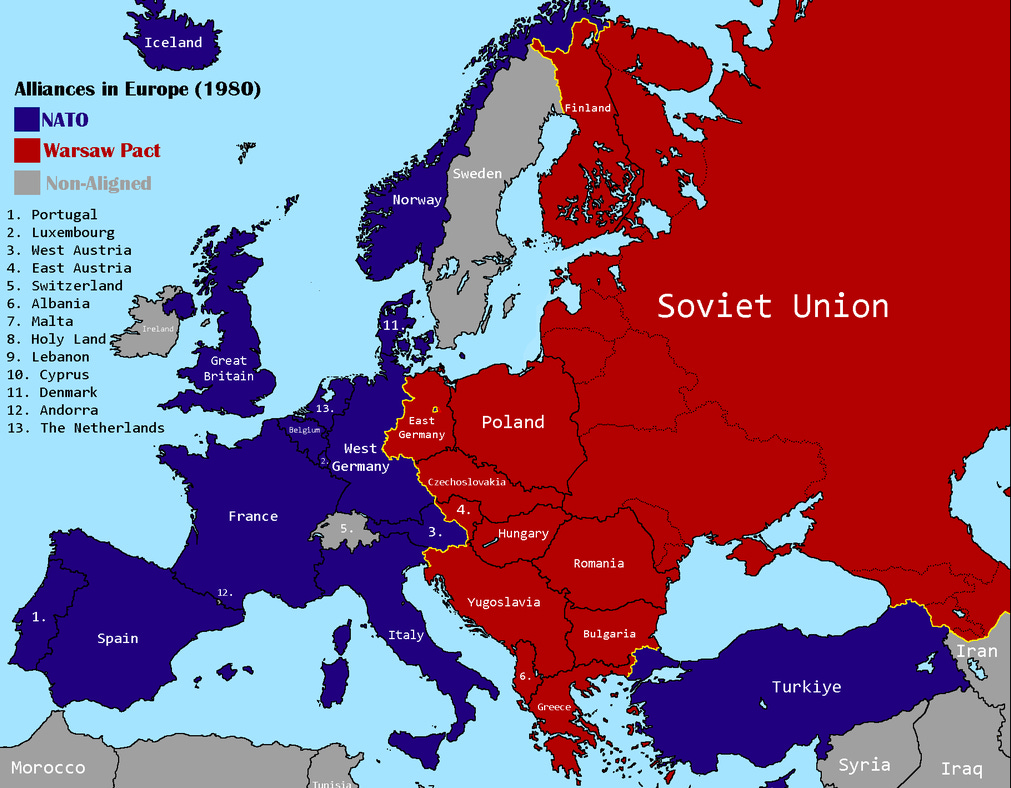
There were many jokes made about life and times in the Eastern Bloc nations;
« Bulgaria has the longest cow in the world; it grazes in Bulgaria but it’s milked in Moscow.»
Eastern Bloc joke, cited by the authors of «Secession by Western Australia.»« It just so happens that Western Australia has an even longer cow; grazing in Western Australia but milked industriously by the Canberra kleptocracy.»
Professor Gigi Foster and Michael Baker, The Spectator Australia, March 2026.
This takes us to the Heart of the proposal for Western Australian Independence.
A 400-page manifesto for independence landed on Australia’s political doorstep in March 2026. By the time the dust had settled, it had been covered by every major national newspaper, every commercial television news programme, every influential radio station in the country.
The authors had been called everything from visionaries to vandals.
Secession by Western Australia ~ written by former barrister Julian Gillespie, University of NSW economist Professor Gigi Foster, economic consultant Michael Baker, and nutritional medicine pioneer Professor Ian Brighthope.
It is not a pamphlet.
It is a 600-page digital document [400 pages in print] with a complete constitutional draft, detailed fiscal modelling, governance architecture, and a research pipeline to follow.
It launched at the Adam Armstrong Pavilion in Dalkeith WA, on 13 March 2026, and it is now available as a free digital download.
The Osprey has read it in detail.
This report focuses on the first foundational chapter;
Chapter 1: The Socio-Economic Case, and;
Chapter 2: The Legal Case ~ will be covered in the next Substack Report.
If these arguments hold true, then every subsequent chapter is worth reading.
If they don’t hold, nothing else matters. So let us examine them carefully.
Chapter 1: The Socio-Economic Case
The Bulgarian Cow
The Eastern Bloc joke that opens the authors’ Spectator Australia article ~ Bulgaria has the longest cow in the world, grazing in Bulgaria but milked in Moscow ~ is not merely rhetorical decoration. It is the argument in miniature, applied to Western Australia .
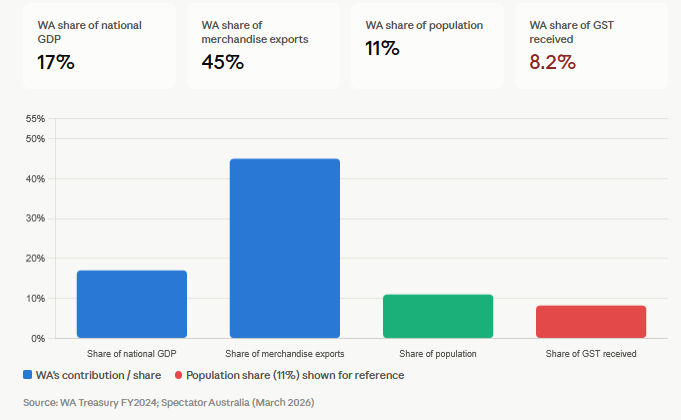
Western Australia, with 11 per cent of Australia’s population, accounts for 17 per cent of its GDP and 45 per cent of its merchandise exports, thanks to its mineral and agricultural sectors.
Gross State Product per capita is 57 per cent higher than the national average. Western Australia’s net debt to GDP ratio is the lowest in the country.
By every measure of economic productivity, WA is the engine of the national economy.
And yet.
According to Western Australia’s own budget documents, there is a huge gap between what the state remits to Canberra in corporate and personal income taxes, GST and other payments, and what the Commonwealth spends on Western Australia’s behalf. In Financial Year 2024, the Treasury estimates that the state paid out A$39 billion more than it got back ~ A$112 billion outgoing versus A$73 billion incoming.
This translates to A$13,000 more retained in Western Australia for every man, woman, and child ~ if secession were successful.
The GST system compounds the injustice.
WA currently receives only 8.2 per cent of GST ~ the lowest share of any state or territory, despite generating 17 per cent of GDP.
The mining boom of the 2000s and 2010s actually worsened WA’s position under Horizontal Fiscal Equalisation [HFE] ~ as the state’s resource royalty revenues rose, its GST share fell, effectively penalising economic success.
The GST reforms of 2018, which established a 70 cent floor rising to 75 cents, partially addressed the problem but left WA as the lowest-funded state per capita in the Commonwealth.
Chapter 1 of the manifesto frames this as not an accounting anomaly but a structural design: a federal architecture in which the most productive state transfers wealth to less productive states, indefinitely, with no mechanism for correction.
WA has raised this grievance since federation. It has raised it in parliament, in intergovernmental forums, in bilateral negotiations, and in the 1933 referendum ~ the only time the question was put directly to the people.
The Result
Five years after federation, the Western Australian Legislative Assembly resolved that federation « had proved detrimental to the interest of the state.»
In 1933, 68 per cent of voters ~ a supermajority ~ voted to leave.
The result was overridden by a foreign parliament ~ within the UK.
The matter has never been constitutionally resolved.
As the authors observe, one recurring argument by proponents of secession is based on the assumption that a federal government in Canberra will favour the business and popular interests of the larger population centres lying to the east.
This is not an assumption. It is a structural feature of a democratic federation in which the most populous states outvote the most productive ones.
The Proposed Economic Model
The socio-economic case does not merely diagnose the problem.
It proposes a solution.
Funding for the slimmed-down government of the new Western Australia would come primarily from a higher, simpler, fairer royalty rate on the state’s resource extractions.
The proposal is a 20 per cent resource royalty ~ applied to WA’s mineral and energy resource sector, which generates approximately A$130 billion in annual value ~ replacing almost all existing taxes including personal income tax.
Workers would keep every dollar they earn.
Businesses would no longer pay corporate income tax on their Western Australian operations.
Most resource companies would still come out ahead or neutral under the new system ~ the royalty replaces the corporate tax they currently pay, at a rate the authors argue is broadly equivalent in aggregate.
The retained fiscal transfer ~ the A$39 billion that currently flows to Canberra and does not return ~ would remain in Western Australia.
The interactive fiscal model in this article lets you adjust both the royalty rate and the estimated bureaucracy reduction to see what the budget outcome would be.
At the manifesto’s proposed 20 per cent royalty, with the authors’ estimated efficiency savings from eliminating government bloat, the model projects a surplus.
The manifesto’s authors acknowledge what critics will immediately raise: that the fiscal feasibility depends on maintaining commodity prices, achieving the proposed bureaucracy reduction targets, and successfully replacing income tax revenue with royalty revenue at a scale that works.
Chapter 4 ~ the fiscal feasibility chapter ~ models these scenarios in detail, including downside cases.
What Chapter 1 establishes is the baseline: the current system is not working for Western Australia, the numbers are not in dispute, and the case for change ~ whether inside or outside the federation ~ is founded on documented fiscal reality rather than political grievance.
The Strategic Geography
Chapter 1 also addresses something the fiscal argument alone cannot: WA’s strategic position in the world.
Western Australia is the world’s second-largest administrative division by area, behind only the Sakha Republic in Russia.
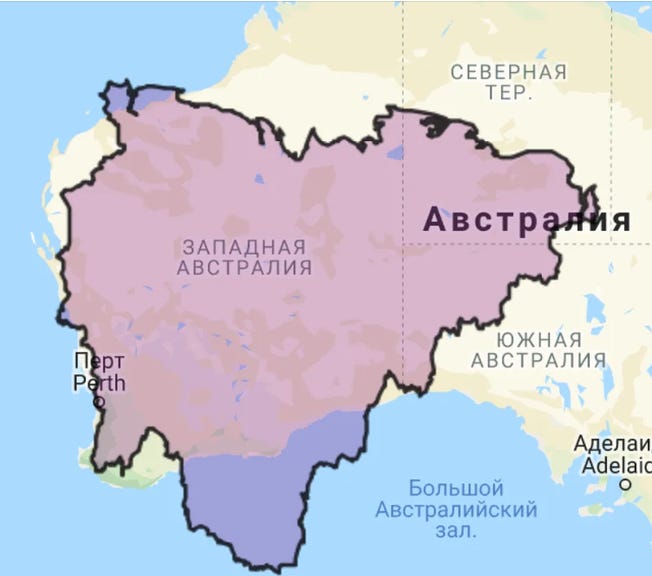
Its coastline spans more than 13,000 kilometres.
Its ports are state-of-the-art.
It sits on the Indian Ocean in close proximity to its major Asian markets ~ iron ore buyers in China, LNG buyers in Japan and South Korea, agricultural buyers throughout Southeast Asia.
An independent Western Australia would not need to export its products through eastern Australian ports or eastern Australian political institutions.
It would trade directly, negotiate directly, and build the bilateral relationships its geography and resource profile make natural.
The manifesto envisions becoming a global free trade zone ~ a Singapore of the Indian Ocean, constitutionally committed to low regulation, zero income tax, and resource-royalty funded public services.
Chapter 1 ~ establishes is the geographic and economic foundation on which it rests.
Below is an Interactive Link ~ where you, dear reader can adjust the Inputs.
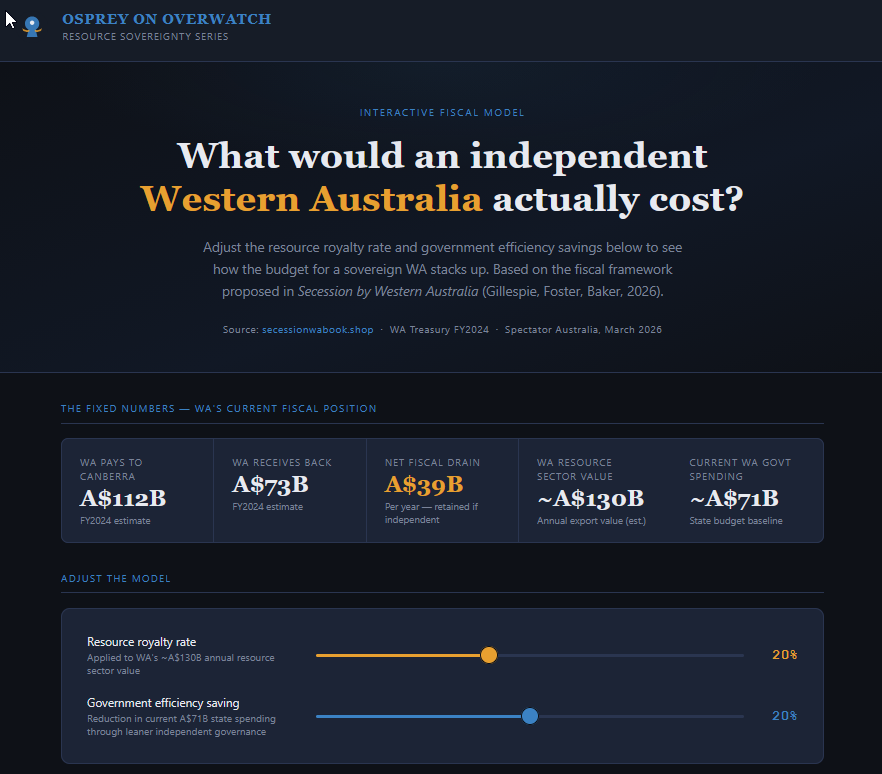
Try Interactive Fiscal Model ~ adjust Resource Royalty Rate & Govt efficiency rating.
Click onto the above green text ~ the pink hyperlink appears below.
Click onto this hyperlink.
A new tab opens with the Interactive Fiscal Model ~ ready to go.
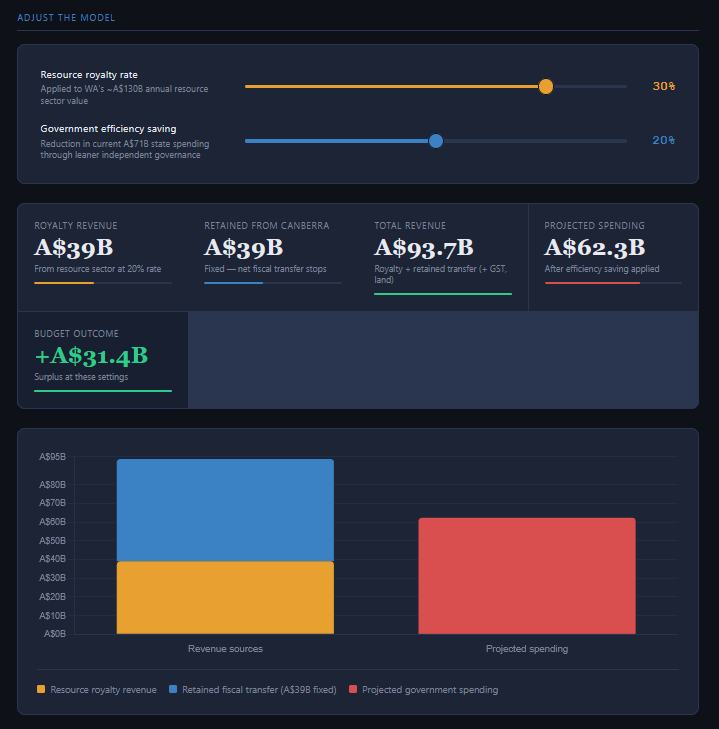
Adjust the Resource Rate slider anywhere up to 35% and watch the income levels rise.
Below is a screenshot showing a Resource Rate of 30% & Govt Efficiency of 20%.
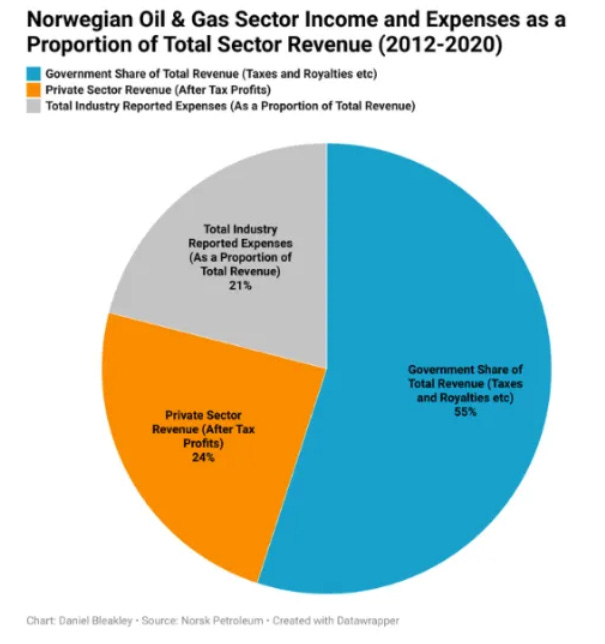
As a credible comparison on Resource Royalty & Taxation Rates, consider the Norwegian reality ~ they harvest 55% of their Oil and Gas Sector Income, with Private Corporations having a 24% profit on their investments.
Take Home Messages
The Economic modelling for WA Secession is credible.
Australian Federal politicians could have easily used the Norwegian, Qatar or other blueprints for the benefit of Aussies.
They chose to enrich themselves & Foreign Multinational Corporations, rather than act for their own constituents.
Is it any wonder that Western Australia would consider Secession?